
Get our plumbing guides firstAdd U.T. Trenchless as a preferred source and see our posts more often in Google Top Stories.
Add as a preferred source on GoogleYes. Tree roots grow back after cutting because the crack or joint that let them into the sewer line is still open, and the tree is still thirsty. Regrowth can show up within months or take a couple of years. To stop tree roots growing back in a sewer line for good, you have to seal the entry points or remove the tree.
Cutting restores flow, but it treats the symptom. This guide is for El Paso homeowners and property managers deciding whether to keep maintaining a rooty line or fix it permanently.
We cover why regrowth happens, what root killers can and cannot do, and how lining or replacement closes the door.
What’s in this guide
The short answer: cutting clears the pipe, not the cause
A root cutter or a hydro jetter removes the root mass inside the pipe. It leaves the rest of the root system alive in the soil, and it leaves the leaking joint exactly as it was. The moisture that attracted the root in the first place keeps escaping, so new feeder roots follow the same path back in.
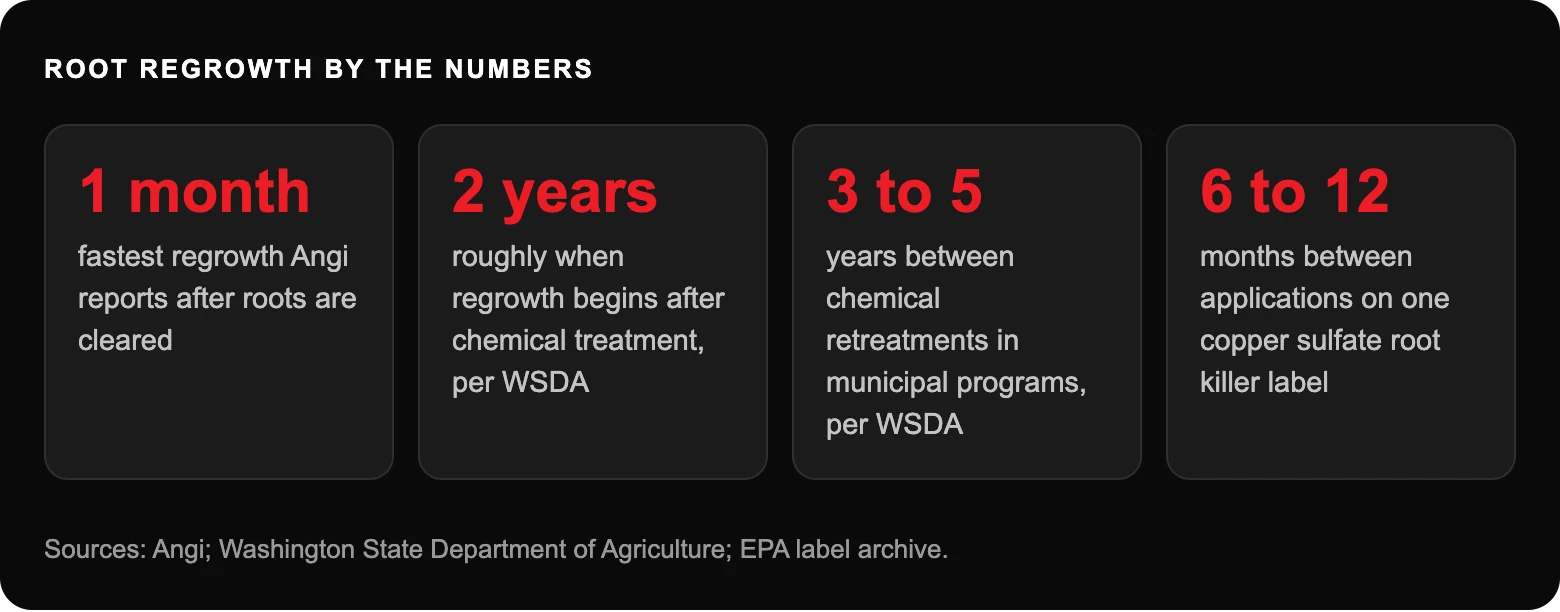
How fast depends on the tree, the season and how big the gap is. Angi puts sewer root regrowth at anywhere from one month to a couple of years.
Do roots come back thicker?
A Washington State Department of Agriculture training manual on sewer line chemical root control says root masses grow back heavier each time they are cut. It explains that injured roots produce a growth hormone that hastens and thickens regrowth, which is one reason maintenance schedules tend to tighten over time.
Do foaming root killers stop regrowth?
They can slow it, which is useful, but they do not fix a broken pipe. Professional foaming products typically pair metam sodium, which kills roots on contact, with dichlobenil, a growth inhibitor that lingers on the pipe wall. The foam fills the pipe and reaches the crown, where roots actually grow.
The WSDA manual describes regrowth beginning within a couple of years of treatment, with retreatment often needed every three to five years. Consumer foaming products sold at hardware stores cost about $10 to $20, according to Angi, and are usually applied a couple of times a year.
Read the label first
Root killers are registered pesticides, and the label is legally enforceable. The WSDA manual warns that metam sodium releases a gas that can injure the lungs, that foam can travel back into buildings through service lines, and that treatment plant operators should be notified before municipal applications. Use these products outdoors or through a cleanout, exactly as directed.
Should you flush copper sulfate?
Copper sulfate is the old standby, and it does kill roots it touches. It also comes with the most caveats. One copper sulfate root killer label in the EPA pesticide label archive states that the product is toxic to fish and aquatic organisms and calls for written notice to the local treatment plant before it is discharged to a sewer system. The WSDA manual adds that copper can harm the microorganisms treatment plants rely on, and Angi cautions it can damage plumbing and the environment.
Anything dissolved in the flow travels along the bottom of the pipe, while roots hang from the top. We do not treat it as a long term answer.
| Method | What it does | How long it holds | Main caveat |
|---|---|---|---|
| Mechanical root cutting | Shaves roots back to the pipe wall | Months to a couple of years | Entry point stays open; regrowth can be heavier |
| Hydro jetting | Cuts fine roots, scours grease and scale | Similar to cutting | Fragile pipe needs care |
| Foaming root killer | Kills roots and inhibits regrowth | Regrowth within about 2 years; retreat 3 to 5 years | Pesticide label rules; does not open a blocked line |
| Copper sulfate | Kills roots it contacts | Label interval 6 to 12 months | Toxic to aquatic life; treatment plant concerns |
| Pipe lining or bursting | Removes the joints roots use | Designed as a permanent repair | Needs a camera assessment; not for every defect |
Root Cutting and Removal in El Paso
Want a straight answer about your pipes?
Every U.T. Trenchless job starts with a camera inspection and a photo report, so you see the problem before you decide on a fix. Licensed Master Plumber Ubaldo Torres leads the work.
How to stop tree roots in a sewer line for good
Permanent means removing the openings. There are three realistic ways to do that, and the camera footage tells you which one fits.
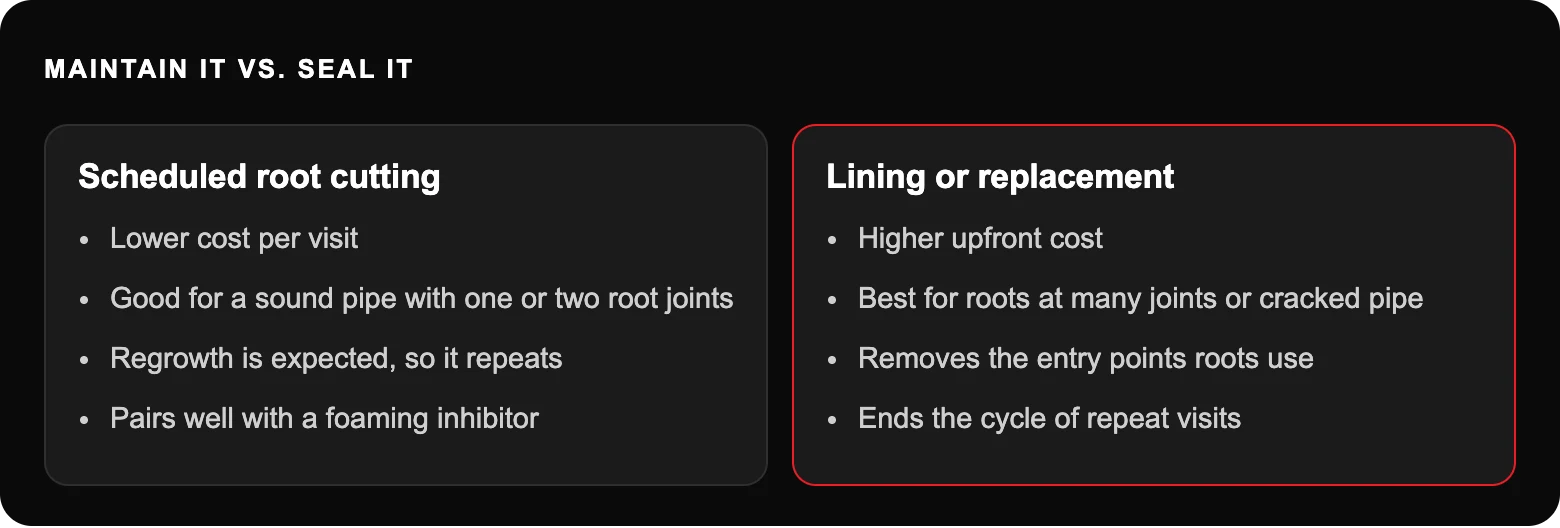
Line the pipe
CIPP pipe repair installs a resin soaked liner that cures into a smooth, jointless pipe inside the old one. With no joints left, roots have nowhere to enter. Our pipe relining page explains the process, and our guide to how long CIPP lining lasts covers expected service life.
Replace the pipe without a trench
Pipe bursting pulls a new pipe along the path of the old one, breaking the old pipe outward as it goes. It suits lines too damaged to line. Our comparison of pipe bursting vs. pipe lining walks through the choice.
Remove or relocate the tree
Sometimes the tree is the problem, especially a fast growing, water hungry species planted right over the lateral. Removing it stops future intrusion, though roots already in the pipe still need clearing. If you are replanting, check our list of trees that are worst for sewer lines in El Paso first.
When lining is the wrong call
A liner takes the shape of the pipe it is installed in. If the camera shows a collapsed section, a large offset or a sag that holds water, lining alone will not correct it. Those sections need pipe bursting or a spot excavation first.
A sensible maintenance schedule for El Paso
If the pipe is in fair shape and you choose maintenance, set the interval from evidence, not a calendar guess. Have the line cleared, note the date, then watch for the first signs of slowing. Trees put on new growth in spring, and summer monsoon rain adds moisture, so a cleaning before those periods is sensible.
Ask for a camera pass after each root cutting and removal visit. Comparing footage over time shows whether joints are holding steady or getting worse. For background on how roots enter to begin with, see how tree roots get into sewer lines.
Skip the harsh chemicals
Caustic drain openers will not dissolve roots and can harm old pipe. Our master plumber explains why in chemical drain cleaners vs. professional drain cleaning.
What to do next
- Write down when the line was last cleared and when symptoms returned.
- Get a camera inspection with a photo report to count how many joints have roots.
- If one or two joints are involved and the pipe is sound, set a maintenance interval.
- If roots are at many joints or the pipe is cracked, compare lining and bursting.
- Avoid dumping copper sulfate or caustics into the line without professional advice.
- Request Service or call 915.858.0166 to talk it through with our team.
Questions El Paso homeowners ask about root regrowth
How often should roots be cut out of a sewer line?
There is no single interval. Some lines need clearing every year, others every few years. The best approach is to clear the line, record the date and schedule the next visit shortly before symptoms usually return. If the interval keeps shrinking, the pipe is likely deteriorating and a permanent repair is worth pricing.
Does rock salt kill roots in a sewer line?
Angi describes rock salt as a low cost option that dries out roots when it sits in the line for several hours. It is slow, it only touches roots the salt contacts, and salt near the line can stress landscape plants. It is a stopgap, not a fix.
Can I use a weed killer on sewer roots?
Only use products labeled for sewer root control, and follow the label exactly. Lawn and garden herbicides are not made for this, and some can move through soil and injure the tree or nearby plants. Pesticide labels are legally enforceable, so off label use is not a safe experiment.
Will a root killer damage my tree?
Products labeled for sewer use are designed to act on roots inside the pipe without killing the tree. If the tree matters to you, talk with an arborist before choosing between treatment and removal.
Is root regrowth covered after a professional cleaning?
Regrowth is a natural process rather than a workmanship defect, so a cleaning alone does not stop it. Ask any contractor exactly what their service includes before work starts, and ask what would end the cycle for your pipe.
Serving El Paso, Horizon City, Socorro and Las Cruces
Talk to a family owned trenchless team with 40+ years in the trade
Tell us what is going on and we will tell you what the camera shows, what your options are, and what we would do if it were our own property. Learn more about our root cutting and removal service.
Keep reading
Sources
- Sewer Line Chemical Root Control, Washington State Department of Agriculture, hosted by Auburn University.
- Copper sulfate root killer label, U.S. Environmental Protection Agency pesticide label archive.
- Tree root killer for sewer pipe clogs, Angi.
- Tree Roots and Sewers, NC State Extension.