
Get our plumbing guides firstAdd U.T. Trenchless as a preferred source and see our posts more often in Google Top Stories.
Add as a preferred source on GoogleDye testing finds leaks, cross connections and illegal hookups by adding tracer dye to one drain, fixture or inlet at a time, then checking which pipe, manhole or storm outlet the color reaches. If dye from a restroom shows up in a storm drain, or roof water shows up in the sewer, the connection is proven on the spot.
Buried pipes do not come with labels. After decades of remodels, tenant changes and patch jobs, many El Paso buildings have drains that go somewhere other than where the drawings say.
This guide walks through how an investigation actually runs, what each result means, where dye testing reaches its limits, and why a wrong connection is the property owner’s problem to fix.
What’s in this guide
How dye testing finds leaks and cross connections
Every dye test asks the same question: where does water that enters here come out? The investigator picks one entry point, doses it with a measured amount of dye, flushes it with enough water to carry the color, and posts people or cameras at every possible exit.
The power comes from isolation. Testing one fixture at a time, or using different dye colors for different sources, turns a tangle of pipes into a set of simple yes or no answers. Fluorescein can be seen at very low concentrations, and a handheld ultraviolet light helps confirm faint traces in murky water.

What counts as a cross connection or illegal hookup
In sewer work, a cross connection is a pipe tied into the wrong system. There are two directions, and both cause real trouble.
Wastewater into the storm drain
This is the more serious case. EPA’s fact sheet on illicit discharge detection and elimination defines an illicit discharge as any discharge to a storm sewer that is not entirely stormwater, and names wastewater piping connected to storm drains as a direct source. Storm systems are not treated; EPA notes that municipal storm sewers often discharge untreated into local water bodies.
Common examples: a garage or shop floor drain piped to a parking lot inlet, a laundry or wash bay line tied into a storm lateral, or a remodel that connected a new restroom to the nearest pipe.
Stormwater into the sanitary sewer
The reverse hookup, roof leaders, area drains or yard drains tied into the sewer, sends rain into pipes built for household and business flow. EPA defines this as inflow in its guide to infiltration and inflow. During an El Paso monsoon storm, it can surcharge a private main and push sewage back up through the lowest drain on the property.
Drinking water cross connections are different
On the potable side, a cross connection is a link that could let contaminated water flow backward into the water supply. That is controlled with air gaps and backflow assemblies, which El Paso Water lists among the customer’s responsibilities. Dye is rarely the right test there; a certified backflow tester is.
| Dye added at | Color appears in | What it means | Next step |
|---|---|---|---|
| Restroom or floor drain | Storm inlet or outfall | Illicit wastewater connection | Locate and reroute to sanitary |
| Roof drain or downspout | Sanitary manhole | Illegal inflow hookup | Disconnect and redirect |
| Any building fixture | Wet spot or yard puddle | Broken lateral leaking | Camera inspection to locate |
| Shower pan or tub | Ceiling or wall below | Fixture or drain leak | Isolate pan vs. drain |
| Any source | Correct system only | Connection is proper | Record and move on |
Dye Testing and Flow Monitoring in El Paso
Want a straight answer about your pipes?
Every U.T. Trenchless job starts with a camera inspection and a photo report, so you see the problem before you decide on a fix. Licensed Master Plumber Ubaldo Torres leads the work.
Warning signs that point to a bad connection
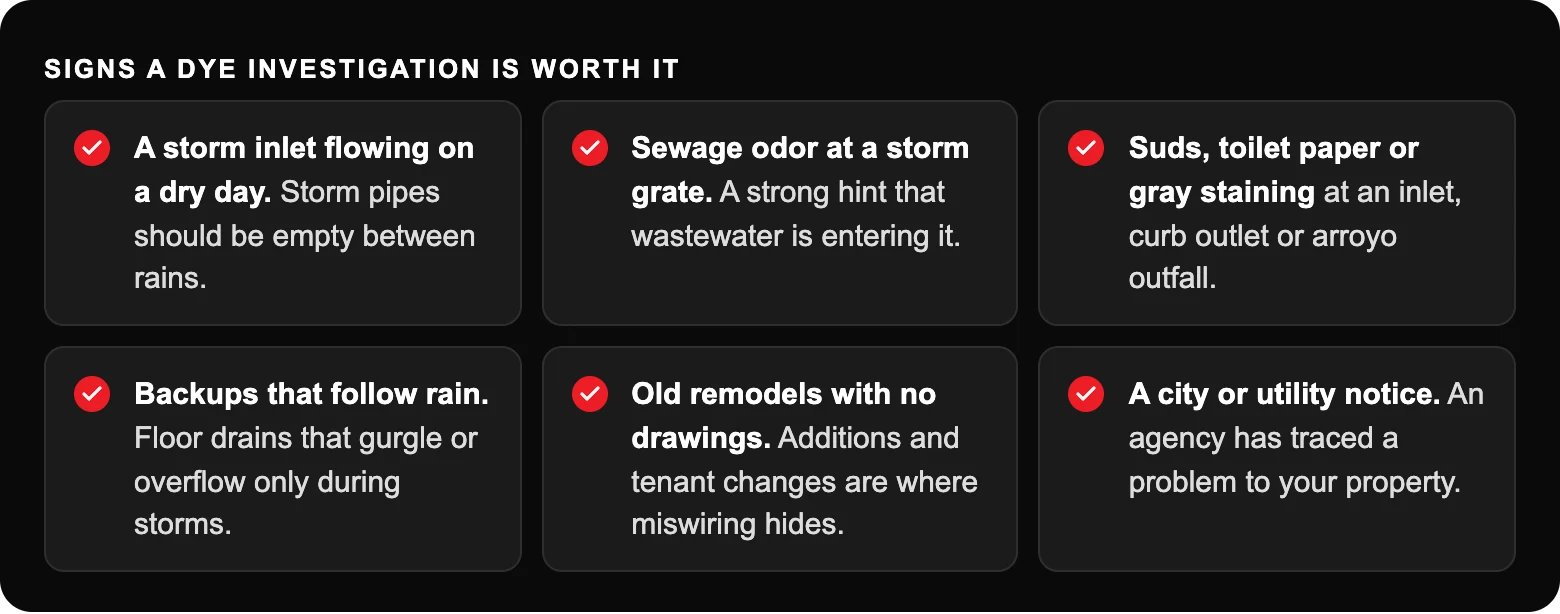
Odor inside the building is a slightly different problem. Smoke often finds that faster; see why a house smells like sewer and how smoke testing finds it.
Why this matters in El Paso
El Paso runs its storm system as a separate utility, formed in 2008, and its stormwater page explains how monsoon rains can deliver huge volumes in days. A sewage connection into that system sends waste toward arroyos and ponds. A roof tied into the sewer does the opposite and loads the sanitary side just when storms hit.
Responsibility usually lands on the owner. El Paso Water says the customer owns the sewer service line from the tap at the main into the property. For the storm side, read who is responsible for a clogged storm drain in El Paso.
Where dye testing falls short
Dye proves a connection. It does not show where a buried pipe runs or which joint is cracked. Once a test finds a problem, pipe locating and mapping traces the line and a camera inspection shows the defect, documented in a photo report before any repair is recommended.
Dye also struggles with pressurized water lines, where acoustic or pressure testing works better. And on large sites with many openings, smoke testing screens faster, with dye confirming each suspect.
Do not guess and reroute
Rerouting a line on a hunch can move a violation rather than fix it. Test first, map second, repair third, and keep the dye photos for the file.
Start with the basics
New to dye tests? Our primer on what a plumbing dye test is covers toilet flappers, shower pans and dye safety.
What to do next
- Walk the site and note storm inlets, manholes, cleanouts and roof drains.
- Check storm inlets after a dry spell; any flow is a lead.
- Gather old drawings and remodel permits for the building.
- Schedule a fixture by fixture dye investigation through our dye testing and flow monitoring service.
- Call 915.858.0166 or use our contact page to Request Service.
Questions El Paso property owners ask about dye testing
Is the dye used in these tests harmful to the environment?
At test doses, no. The U.S. Geological Survey describes fluorescein as non toxic and safe for the environment, and it is used in stream and groundwater studies nationwide.
How long does a dye investigation take?
A single home can take under an hour. A commercial site with many fixtures can take a day or more, since each source is tested separately and every exit is watched.
Will a dye test disrupt tenants or customers?
Usually very little. Each fixture is out of use only for minutes, and exterior work happens at manholes and inlets.
Can dye testing find an illegal hookup from a neighbor?
Yes, if the neighbor’s source can be dosed. Dye entering an upstream inlet and appearing on your side of the system proves where the water came from.
What happens if a test finds a cross connection?
The line is located, mapped and rerouted to the correct system. Keep test photos as proof the problem was found and corrected.
Serving El Paso, Horizon City, Socorro and Las Cruces
Talk to a family owned trenchless team with 40+ years in the trade
Tell us what is going on and we will tell you what the camera shows, what your options are, and what we would do if it were our own property. Learn more about our dye testing and flow monitoring service.
Keep reading
Sources
- Stormwater Phase II Fact Sheet 2.5: Illicit Discharge Detection and Elimination, EPA.
- Stormwater Discharges from Municipal Sources, EPA.
- Guide for Estimating Infiltration and Inflow, EPA Region 1.
- Hydrologic study to use non toxic green dye, USGS.
- Stormwater, El Paso Water.
- Customer Rights and Responsibilities, El Paso Water.