

Get our plumbing guides firstAdd U.T. Trenchless as a preferred source and see our posts more often in Google Top Stories.
Add as a preferred source on GoogleThe trees worst for sewer lines in El Paso yards are large, fast growing, water hungry species: Siberian elm, cottonwood, true willows, Arizona ash and the aging mulberries planted before the city banned new ones. Smaller desert trees such as Mexican redbud or desert willow are safer choices, planted at least 10 feet from the line.
No tree is completely sewer safe. Roots go where water is, and a leaking joint in an old clay lateral is a reliable source of water in a dry yard. Species and placement still matter.
This guide ranks the trees El Paso homeowners most often ask about, explains why each one is a risk, and recommends safer desert trees and planting distances.
What’s in this guide
- The short answer: big, thirsty and close is the problem
- The worst trees for sewer lines in El Paso yards
- Is desert willow safe near a sewer line?
- Safer trees for El Paso yards near sewer lines
- How far from a sewer line should you plant a tree?
- What to do next
- Questions El Paso homeowners ask about trees and sewer lines
- Keep reading
The short answer: big, thirsty and close is the problem
A tree’s risk to your sewer comes down to three things: how large its root system gets, how much water it demands, and how close it grows to the line. University of Tennessee Extension’s guide to choosing sewer safer trees advises against planting large, fast growing species such as ash, poplar, cottonwood and willow near wastewater pipes, and recommends keeping trees more than 10 feet from sewer lines.
Remember that roots only get in where the pipe already leaks. A healthy tree next to a sound PVC line may never cause trouble. The same tree beside a 60 year old clay lateral is a different story.
The worst trees for sewer lines in El Paso yards
Siberian elm
This is the tree we would put at the top of the list. The Texas A&M Forest Service includes Siberian elm on its page of invasive plants in West Texas. Texas Tech’s landscape plant sheet goes further, noting invasive roots and weak wood and calling it a weed tree that should not be used in most landscapes.
Cottonwood and true willows
Cottonwoods and willows evolved along rivers like the Rio Grande, and they are built to chase water. Both appear on the Tennessee avoid list, and a University of Nevada Extension horticulturist answering a homeowner on Ask Extension named willow, elm and cottonwood among the species to steer clear of near sewer lines. Cottonwood is on the city’s approved list as a large tree, which makes sense for a park, not a small lot over an old lateral.
Arizona ash
Arizona ash is a common El Paso shade tree and appears as an approved medium tree on the City of El Paso approved plant and tree list. Approved does not mean sewer friendly, though. Ash species are on the Tennessee list of trees to keep away from sewer pipes, and a mature ash near the lateral deserves a camera check if drains start slowing.
Mulberry
El Paso made it unlawful to sell or plant mulberry trees in 1992 because of their heavy pollen, Texas Standard reports. A 2014 study cited in that story estimated 75,000 white mulberries in the city, and with a life expectancy of 30 to 50 years, many are now in decline. Many stand in older neighborhoods with clay laterals.
A removal is a good moment to check
If an old mulberry or elm is coming out anyway, schedule a video camera inspection of the sewer line at the same time. You will know whether roots are already in the pipe.
| Tree | Sewer risk | Why |
|---|---|---|
| Siberian elm | Very high | Invasive in West Texas; invasive roots and weak wood (Texas A&M Forest Service, Texas Tech) |
| Cottonwood | High | Large, water seeking riverside tree on extension avoid lists |
| True willows | High | High water demand; on extension avoid lists |
| Arizona ash | Moderate to high | Ash species on the Tennessee avoid list; approved by the city as a medium tree |
| Mulberry | Moderate to high | Large, aging shade trees in older neighborhoods; new planting banned since 1992 |
| Desert willow | Lower | Small native tree around 25 feet; still keep it off the line |
Root Cutting and Removal in El Paso
Want a straight answer about your pipes?
Every U.T. Trenchless job starts with a camera inspection and a photo report, so you see the problem before you decide on a fix. Licensed Master Plumber Ubaldo Torres leads the work.
Is desert willow safe near a sewer line?
Desert willow is not a true willow. It is a small native tree with trumpet shaped flowers, and the El Paso County AgriLife Extension office lists it among recommended small trees, around 25 feet tall. That makes it a far better choice near a house than a cottonwood.
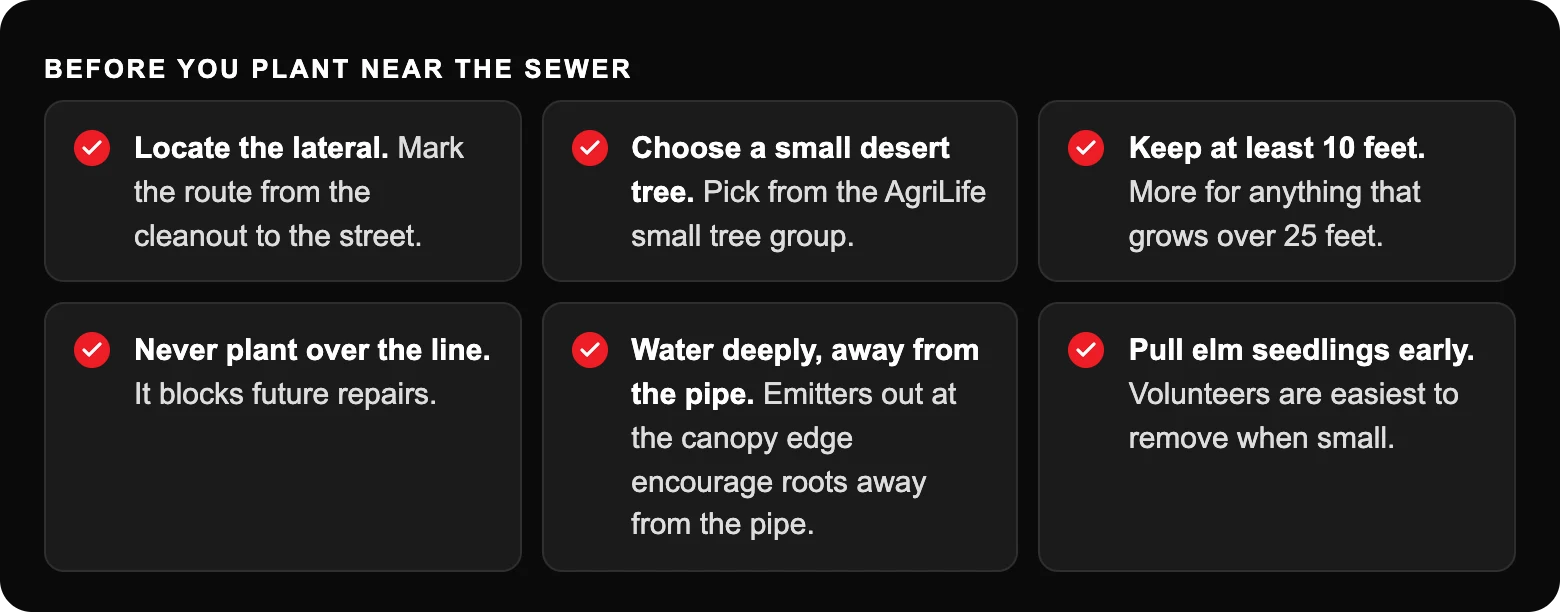
Safer is not the same as risk free. Any tree will send roots into a cracked joint if it finds one, so plant desert willow at least 10 feet from the sewer line and never directly over it.
Safer trees for El Paso yards near sewer lines
The recommended tree list from Texas A&M AgriLife Extension in El Paso County groups trees by mature height. For planting near a sewer route, the small tree group is the place to start:
- Mexican redbud
- Texas mountain laurel
- Mexican buckeye
- Desert willow
- Goldenball leadtree
- Flameleaf sumac
- Vitex
Save large shade trees such as pecan or bur oak for the far side of the yard.
How far from a sewer line should you plant a tree?
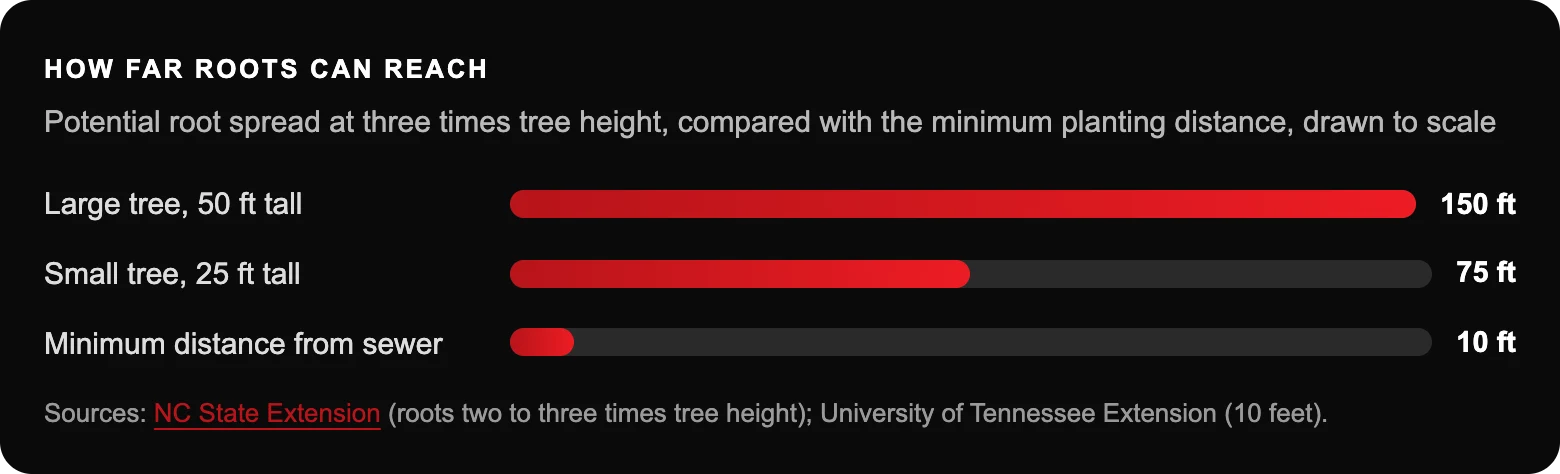
Use 10 feet as the minimum for small trees and go much farther with large ones. NC State Extension adds a useful reality check: roots can spread two to three times as wide as a tree is tall, so moving a tree five feet does less than people hope. Above all, keep trees off the line itself so it stays accessible for repairs.
You cannot plan a distance without knowing where the line runs. Our pipe locating and mapping service traces the lateral from the house toward the street. Also note that utility locators generally do not mark private sewer lines; see whether Texas 811 marks your private sewer line.
Removing the tree does not clear the pipe
Cutting down a problem tree stops new growth, but roots already inside the line stay there until they are cut out. Plan for root cutting and removal after the tree comes down, and read whether tree roots grow back after cutting before deciding.
What to do next
- Walk the yard and note large trees within 10 to 20 feet of the sewer route.
- If drains are slow or you are buying a home with mature trees, book a camera inspection.
- Pull Siberian elm seedlings before they establish.
- Replace aging mulberries and elms with small desert trees, well off the line.
- Read how tree roots get into sewer lines to understand the warning signs.
- Request Service or call 915.858.0166.
Questions El Paso homeowners ask about trees and sewer lines
Should I cut down a tree that has roots in my sewer line?
Not always. If the pipe is in good shape except for one joint, clearing the roots and sealing or lining the pipe can let you keep the tree. Removal makes more sense when the species is invasive, like Siberian elm, or the tree grows directly over the line.
Are palm trees safe near sewer lines?
Palms have fibrous roots rather than large woody ones, so they are often considered lower risk near pipes. They still seek moisture and can enter a cracked joint. Keep the same 10 foot minimum and do not plant them over the lateral.
Do root barriers work around sewer lines?
Physical or chemically treated barriers can redirect roots, but installing them requires digging along the line. University of Tennessee Extension notes long term results are difficult to guarantee, so a barrier is not a substitute for a sound pipe.
Is my neighbor responsible if their tree roots damage my sewer?
It depends on the facts and local law. Document the problem with a camera report showing where roots enter. For who maintains which part of the line, see our guide on sewer line responsibility in El Paso.
Should I get a sewer scope when buying a home with big trees?
Yes. Mature trees near an older lateral are a strong reason to scope the line before closing. Our guide to a sewer camera inspection before buying a home in El Paso explains what to look for.
Serving El Paso, Horizon City, Socorro and Las Cruces
Talk to a family owned trenchless team with 40+ years in the trade
Tell us what is going on and we will tell you what the camera shows, what your options are, and what we would do if it were our own property. Learn more about our root cutting and removal service.
Keep reading
Sources
- Invasive Plants in West Texas, Texas A&M Forest Service.
- Siberian Elm landscape information sheet, Texas Tech University.
- Recommended tree list, Texas A&M AgriLife Extension, El Paso County.
- Approved Plant and Tree List, City of El Paso.
- Choosing Sewer Safer Trees, University of Tennessee Extension.
- Tree Roots and Sewers, NC State Extension.
- Sewer friendly trees, Ask Extension, University of Nevada Cooperative Extension.
- 3 decades into El Paso’s ban on new mulberries, Texas Standard.