
Get our plumbing guides firstAdd U.T. Trenchless as a preferred source and see our posts more often in Google Top Stories.
Add as a preferred source on GoogleCIPP lining is a new resin pipe cured inside your old sewer line, with no trench. Liners designed to ASTM F1216 are engineered for a 50 year service life, and lab testing plus liners pulled from service after decades support that figure. For CIPP lining in El Paso, the real lifespan depends on cleaning, design and cure quality.
If a plumber says your sewer line can be “lined,” you want to know what goes into the ground and whether you will pay for it again in ten years.
This guide covers where the 50 year number comes from, what shortens a liner’s life, and when lining is the wrong call, with notes for older El Paso properties.
What’s in this guide
The short answer: built for 50 years, if it is done right
A properly designed and installed cured in place pipe liner should last about 50 years. That is the design target municipal engineers write into their specifications.
The caveat: 50 years is a design life, not a guarantee. A liner installed over debris, under cured, or sized for the wrong load can fail far sooner.
What CIPP lining actually is
Cured in place pipe, or CIPP, is a flexible felt or fiberglass tube saturated with resin. It is pushed or pulled into the damaged pipe, pressed tight against the old walls, and hardened in place.
The governing standard, ASTM F1216, covers rehabilitating pipes from 2 to 108 inches in diameter by inverting a resin impregnated tube with water or air pressure, then curing it with hot water, steam or light.
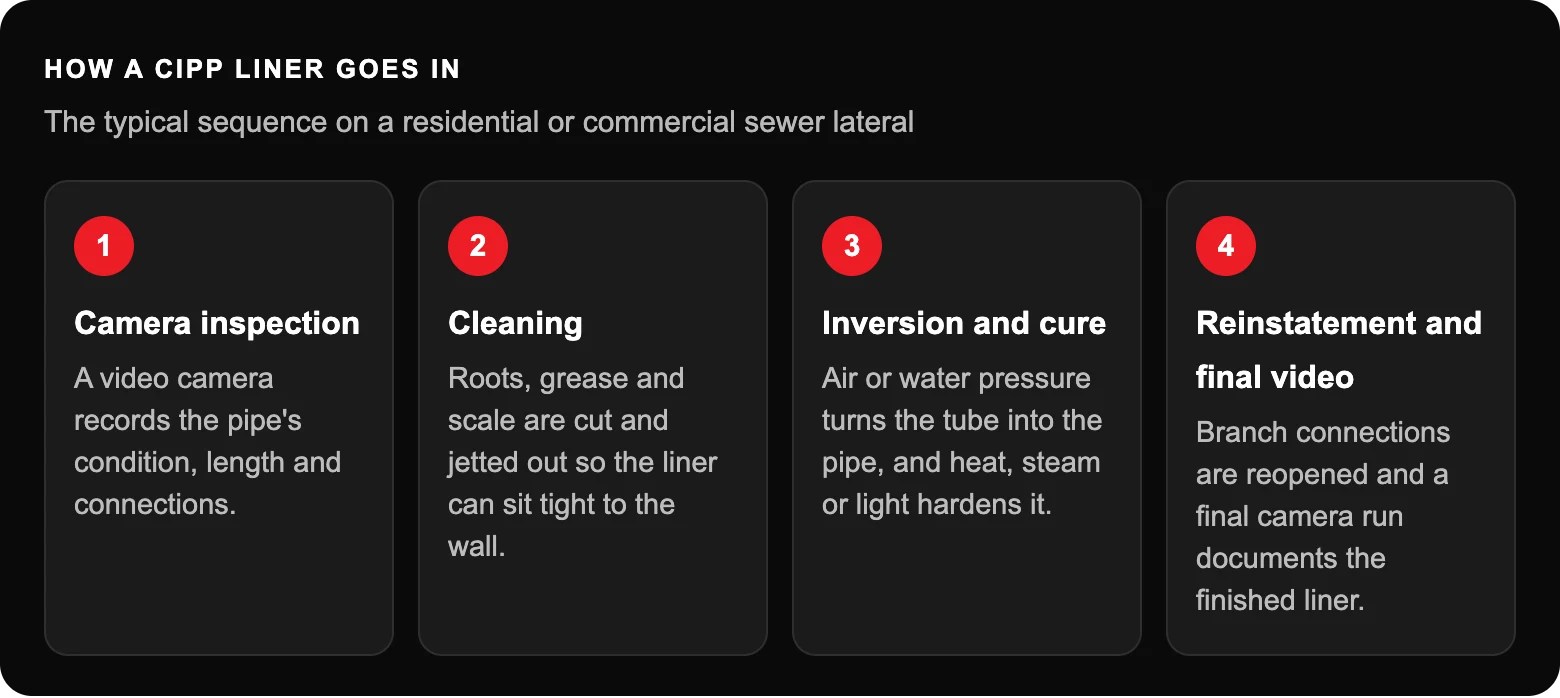
On our CIPP pipe repair jobs, that first step is never skipped. Every project starts with a high resolution video camera inspection and a photo report.
Where the 50 year number comes from
The figure comes from engineering specifications, accelerated lab testing, and liners dug up and tested after years in service.
The design standard
Engineers size a liner’s wall thickness using the design equations in Appendix X1 of ASTM F1216. City specifications spell out the target plainly.
“Since sewer products are intended to have a 50 year design life, and in order to minimize the Owner’s risk, only proven products with substantial successful long term track records will be approved.”
That line comes from a City of Worcester, Massachusetts CIPP specification, which also requires the liner to be designed assuming no bond to the old pipe wall.
Lab tests and field samples
A 2017 industry review in Underground Infrastructure reported that accelerated testing at Louisiana Tech University’s Trenchless Technology Center indicated CIPP life expectancy should exceed 50 years under normal use. The same article describes samples cut from a 30 year old liner in England whose flexural strength beat the original specification by 50 percent.
An EPA funded retrospective study published in Cogent Engineering examined liners retrieved after 5 to 34 years of service at 18 locations.

What the data does not say
No liner has yet been in the ground for a full 50 years in large numbers, because the method dates to the early 1970s. The 50 year figure is a strong engineering projection backed by decades of evidence, not a record anyone has finished measuring.
What shortens a liner’s life
When a liner fails early, the cause is usually installation, not the material wearing out.

That is why the final video matters as much as the first: it proves a smooth, continuous wall and gives you a baseline for later.
CIPP Pipe Repair in El Paso
Want a straight answer about your pipes?
Every U.T. Trenchless job starts with a camera inspection and a photo report, so you see the problem before you decide on a fix. Licensed Master Plumber Ubaldo Torres leads the work.
How CIPP lining in El Paso holds up
A resin liner does not rust and has no joints for roots along its length. The bigger El Paso factor is what the old pipe looks like before lining.
Many central and east El Paso homes still drain through original cast iron or clay laterals. Cast iron builds heavy corrosion scale that must be removed with pipe descaling before a liner goes in, and clay pipe often has root filled joints that need cutting first. Our guide to lining old cast iron sewer pipes covers that prep in detail.
Ownership matters too. El Paso Water’s customer rules make the property owner responsible for the sewer service line from the tap at the main into the property, and for keeping it in serviceable condition. A long lasting repair on that line is your investment, not the utility’s.
| Pipe | Typical expected life | Basis |
|---|---|---|
| CIPP liner | 50 years | Design life in municipal specifications |
| Cast iron waste pipe, below ground | 50 to 60 years | InterNACHI life expectancy chart |
| Cast iron waste pipe, above ground | 60 years | InterNACHI life expectancy chart |
| PVC or ABS waste pipe | 50 to 80 years | InterNACHI life expectancy chart |
When lining is not the right fix
Lining needs a host pipe that still holds its shape and slope. It cannot lift a sagging section, straighten a badly offset joint, or pass through a pipe that has fully collapsed. In those cases, pipe bursting or a spot excavation is usually the better answer.
Lining also narrows the pipe slightly. Our comparison of CIPP lining vs. full pipe replacement walks through how to weigh these tradeoffs.
Be wary of a lining quote without video
If someone recommends lining without showing you camera footage of the whole run, including sags and offsets, you have no way to know whether a liner can succeed. Ask to see the video before you approve the work.
What to do next
- Get a full camera inspection of the line and ask for the video and a written photo report.
- Confirm the pipe still holds its shape and slope, with no collapsed or badly sagging sections.
- Ask how the pipe will be cleaned or descaled before lining, and how branch connections will be reopened.
- Request a final video of the finished liner and keep it with your property records.
- Compare lining with bursting or replacement for your specific line, then contact our team or call 915.858.0166 to talk it through.
Questions El Paso homeowners ask about CIPP lining
Is pipe lining as good as a new pipe?
Structurally, a well installed liner acts as a new, jointless pipe inside the old one, and it is designed to carry loads without help from the host pipe. The main differences are a slightly smaller inside diameter and a need for the old pipe to hold its shape during installation.
Can roots grow through a CIPP liner?
Roots enter pipes through joints and cracks. A cured liner has no joints along its length, so roots have nowhere to get in within the lined section. Roots can still find their way in at unlined sections or at the ends of the liner, which is why the full length of problem pipe should be lined.
Can a lined sewer pipe be snaked or hydro jetted later?
Yes, with care. Lined pipes can be cleaned with water jetting at appropriate pressures and with cutters suited to lined pipe. Tell any plumber your line is lined before they clean it, since cutters meant for cast iron can damage a liner.
How long does CIPP installation take?
A typical residential lateral is often finished in a single day, including cleaning, lining, curing and reopening connections. Long runs, heavy scale or commercial lines take longer, and drains are off limits while the resin cures.
Does CIPP lining smell or give off fumes?
Some resins, especially styrene based ones, give off odors during curing. Researchers at Purdue University’s CIPP Solutions Group have studied these emissions. Ask your installer which resin they use and how the work area is ventilated.
Serving El Paso, Horizon City, Socorro and Las Cruces
Talk to a family owned trenchless team with 40+ years in the trade
Tell us what is going on and we will tell you what the camera shows, what your options are, and what we would do if it were our own property. Learn more about our cipp pipe repair service.
Keep reading
Sources
- ASTM F1216 standard practice for CIPP, ASTM International.
- CIPP Sewer Line Repairs Specification, City of Worcester, Massachusetts.
- Do CIPP Products Perform as Expected?, Underground Infrastructure, April 2017.
- Evaluation of testing methods for tracking CIPP liners’ life cycle performance, Cogent Engineering, 2018.
- Standard Estimated Life Expectancy Chart for Homes, InterNACHI.
- Customer Rights and Responsibilities, El Paso Water.
- CIPP Solutions Group, Purdue University.