
Get our plumbing guides firstAdd U.T. Trenchless as a preferred source and see our posts more often in Google Top Stories.
Add as a preferred source on GoogleTree roots get into sewer lines through joints, cracks and loose connections that already leak a little moisture and nutrients. Roots follow that trail, slip through the gap and grow into a mat that catches waste. In El Paso, tree roots in a sewer line are removed with a mechanical root cutter or high pressure water jetting, then confirmed with a camera.
Roots are one of the most common reasons a main line backs up, and they rarely announce themselves until a toilet gurgles or a floor drain overflows.
This guide covers how roots find their way in, what removal looks like from the first camera pass to the final check, typical national costs, and when cutting is only a temporary answer for an older El Paso lateral.
What’s in this guide
- The short answer: roots follow leaks, not pipes
- Why El Paso sewer lines attract roots
- Warning signs of tree roots in a sewer line
- How tree roots are removed from a sewer line
- When cutting roots is only a temporary fix
- What to do next
- Questions El Paso homeowners ask about tree roots in sewer lines
- Keep reading
The short answer: roots follow leaks, not pipes
A sound, tight sewer pipe gives a root nothing to grab. The trouble starts at a weak spot: a clay joint whose seal has aged, a hairline crack in cast iron, or a fitting where two pipe materials meet. Warm, moist air and a trace of nutrient rich water escape from that gap into the surrounding soil.
Feeder roots grow toward that moisture, find the opening and push a hair thin root inside. There it branches into a dense mass that snags paper, grease and solids.
An urban forester writing for NC State Extension puts it bluntly: roots do not create the crack, they find one that is already there. So a root problem is also a pipe problem.
Where inside the pipe roots grow
A pesticide training guide from the Washington State Department of Agriculture, hosted by Auburn University, notes that roots live in the damp air space above the flow line and enter from the top and sides of the pipe. On camera, they often look like a curtain hanging from the crown.

Why El Paso sewer lines attract roots
Many homes in central and east El Paso were built with vitrified clay or cast iron sewer laterals. Clay pipe comes in short sections, so there is a joint every few feet, and each one is a potential entry point once its seal ages. Cast iron tends to corrode and scale from the inside over decades, opening small cracks and pinholes.
Our climate adds pressure. In a desert yard, a slowly leaking sewer joint can be one of the most reliably moist spots on the lot, especially in the dry months before monsoon season. A thirsty shade tree does not need to be right next to the line to find it; NC State Extension notes that roots can spread two to three times as wide as the tree is tall.
Warning signs of tree roots in a sewer line
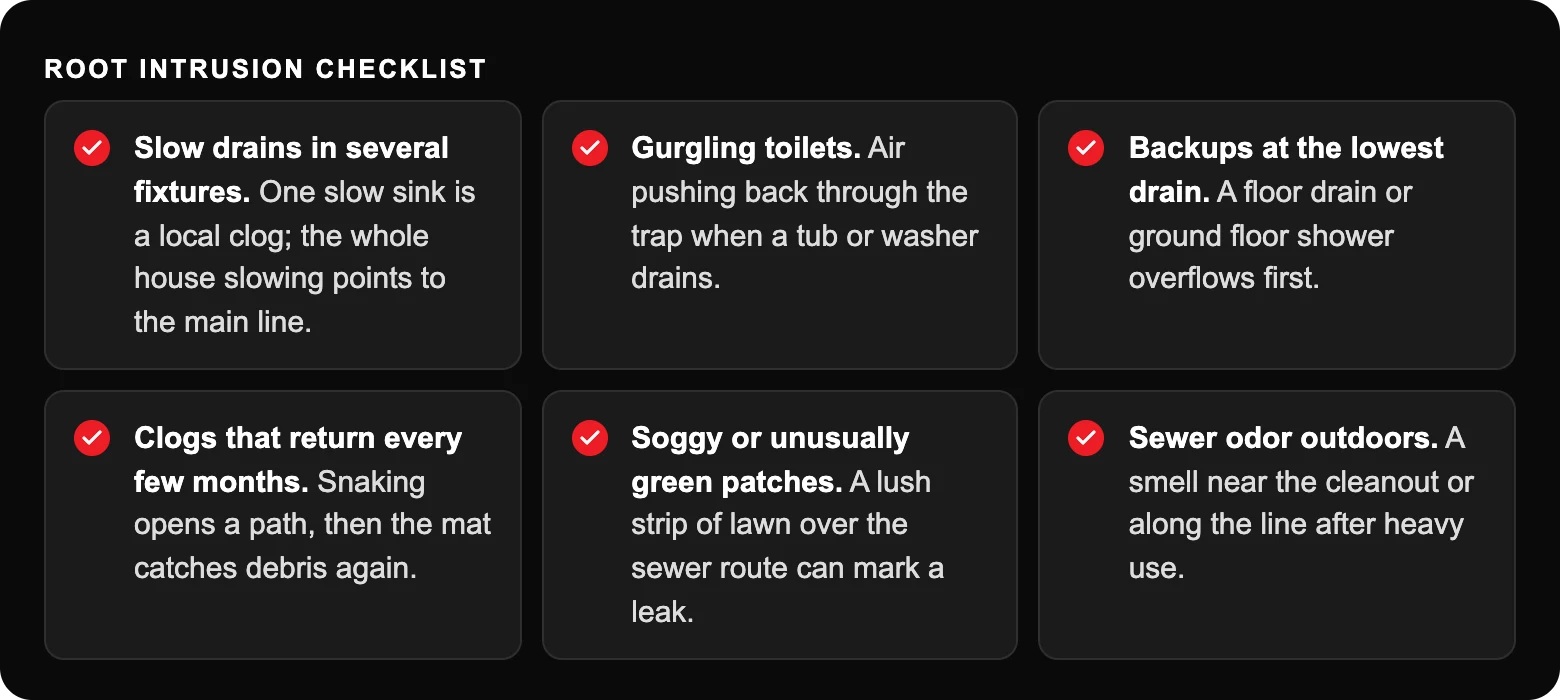
Root blockages build slowly. If you notice several of these at once in a home with a mature tree nearby, roots are a strong suspect.
For a broader list of main line symptoms, see our post on the signs your main sewer line is clogged.
How tree roots are removed from a sewer line
Professional root cutting and removal is not a single tool, it is a sequence. At U.T. Trenchless every job starts with a high resolution video camera inspection, and we document what we find with a photo report before recommending any repair.
Step one: find and measure the roots
A video camera inspection shows where the roots are entering, how many joints are involved and whether the pipe itself is cracked, offset or sagging.
Step two: cut or jet the roots out
A mechanical root cutter is a rotating head with blades on a flexible cable. It shaves the root mass back to the pipe wall. Hydro jetting uses high pressure water through a specialized nozzle to cut fine roots and scour grease and scale off the walls. Heavy, woody masses often need the cutter first and the jetter second. Our comparison of hydro jetting vs. snaking covers the tradeoffs.
Step three: verify with the camera
A second camera pass confirms the roots are gone and shows whether you have a maintenance issue or a pipe that needs repair.
| Service | Typical range | What it does |
|---|---|---|
| Tree root removal | $100 to $600 | Clears roots causing a clog |
| Rodding the main line | $150 to $600 | Flexible rods for larger pipes and roots |
| Hydro jetting | $350 to $600 | High pressure water cleaning of the pipe walls |
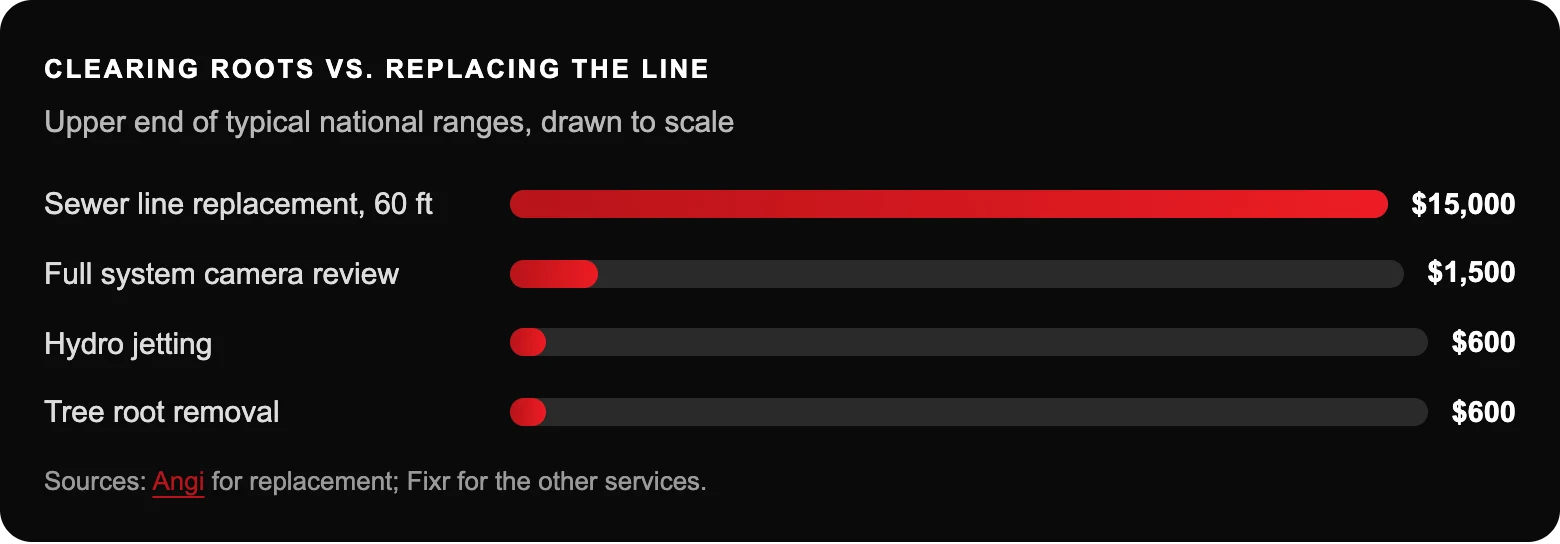
| Camera inspection | $100 to $800 | Locates roots and damage; whole system reviews can run up to $1,500 |
| Chemical treatment | $75 to $300 | Maintenance after jetting or rodding |
Those are national ranges, not our prices. El Paso cost depends on cleanout access, line length, root density and what the camera shows.
Root Cutting and Removal in El Paso
Want a straight answer about your pipes?
Every U.T. Trenchless job starts with a camera inspection and a photo report, so you see the problem before you decide on a fix. Licensed Master Plumber Ubaldo Torres leads the work.
When cutting roots is only a temporary fix
Cutting removes the roots inside the pipe. It does not seal the joint that let them in, so the tree will find the same opening again. For a sound pipe with one problem joint, scheduled maintenance is reasonable. Our follow up guide on whether tree roots grow back after cutting explains regrowth.
When the camera shows roots at many joints, cracked sections or root damage that keeps returning, the long term answer is to close the entry points. CIPP pipe repair installs a cured in place liner that forms a jointless pipe inside the old one. Pipe bursting pulls a new pipe through the path of the old line.
When trenchless is not the answer
A liner follows the shape of the host pipe. If a section has collapsed, is badly offset or sags into a belly that holds water, lining alone will not fix it. Those spots may need pipe bursting or a targeted excavation.
Planting near the line
If you are adding trees, keep large, thirsty species well away from the sewer route. Our list of the trees that are worst for sewer lines in El Paso yards suggests safer choices.
What to do next
- Stop running water heavily if drains are gurgling or backing up.
- Find your outdoor cleanout so a technician can reach the line without pulling a toilet.
- Book a camera inspection before choosing a repair, so the fix matches the pipe.
- Decide between scheduled maintenance and a permanent seal based on how many joints are involved.
- Request Service or call 915.858.0166 for emergency backups.
Questions El Paso homeowners ask about tree roots in sewer lines
Can tree roots break a sewer pipe?
Roots usually enter through an existing crack or joint rather than breaking a sound pipe. Once inside, though, they grow thicker and can widen a crack, pry joints apart and speed up the deterioration of clay and cast iron.
Will cutting roots in the sewer kill my tree?
Removing roots from inside the pipe very rarely harms a healthy tree. Those roots are a small part of the system. Cutting major roots outside the pipe during excavation is a different matter and should involve an arborist.
How long does sewer root removal take?
A straightforward root cutting or jetting visit with camera verification commonly takes a few hours. Long lines, no cleanout or very heavy root masses take longer.
Does homeowners insurance pay for roots in the sewer line?
Many standard policies treat root intrusion as a maintenance issue, but coverage varies by policy and endorsement. Read your policy and ask your agent, and keep the camera report as documentation.
Is hydro jetting or a root cutter better for roots?
They work best together. A cutter removes thick, woody roots quickly; a jetter cleans fine roots, grease and scale from the pipe wall. The camera footage and the pipe’s condition decide which to lead with.
Serving El Paso, Horizon City, Socorro and Las Cruces
Talk to a family owned trenchless team with 40+ years in the trade
Tell us what is going on and we will tell you what the camera shows, what your options are, and what we would do if it were our own property. Learn more about our root cutting and removal service.
Keep reading
Sources
- Tree Roots and Sewers, NC State Extension, Union County Center.
- Sewer Line Chemical Root Control, Washington State Department of Agriculture, hosted by Auburn University.
- Cost to Unclog a Main Sewer Line, Fixr.
- Tree roots in sewer lines, Angi.