
Get our plumbing guides firstAdd U.T. Trenchless as a preferred source and see our posts more often in Google Top Stories.
Add as a preferred source on GoogleA plumbing dye test puts a brightly colored, non toxic tracer dye into a fixture, drain or downspout, then watches where the color shows up. It confirms a silent toilet flapper leak, a leaking shower pan, or a gutter tied into the sewer. In El Paso, you need one when water is going somewhere it should not and nobody can see the path.
Leaks announce themselves with a stain, a smell or a spike on the water bill, but rarely show where they start. A dye test answers one question: does water from point A reach point B?
This guide covers what the dye is, whether it is safe, the four situations where a test earns its keep, and what it cannot tell you on an El Paso property.
What’s in this guide
The short answer: what a dye test proves
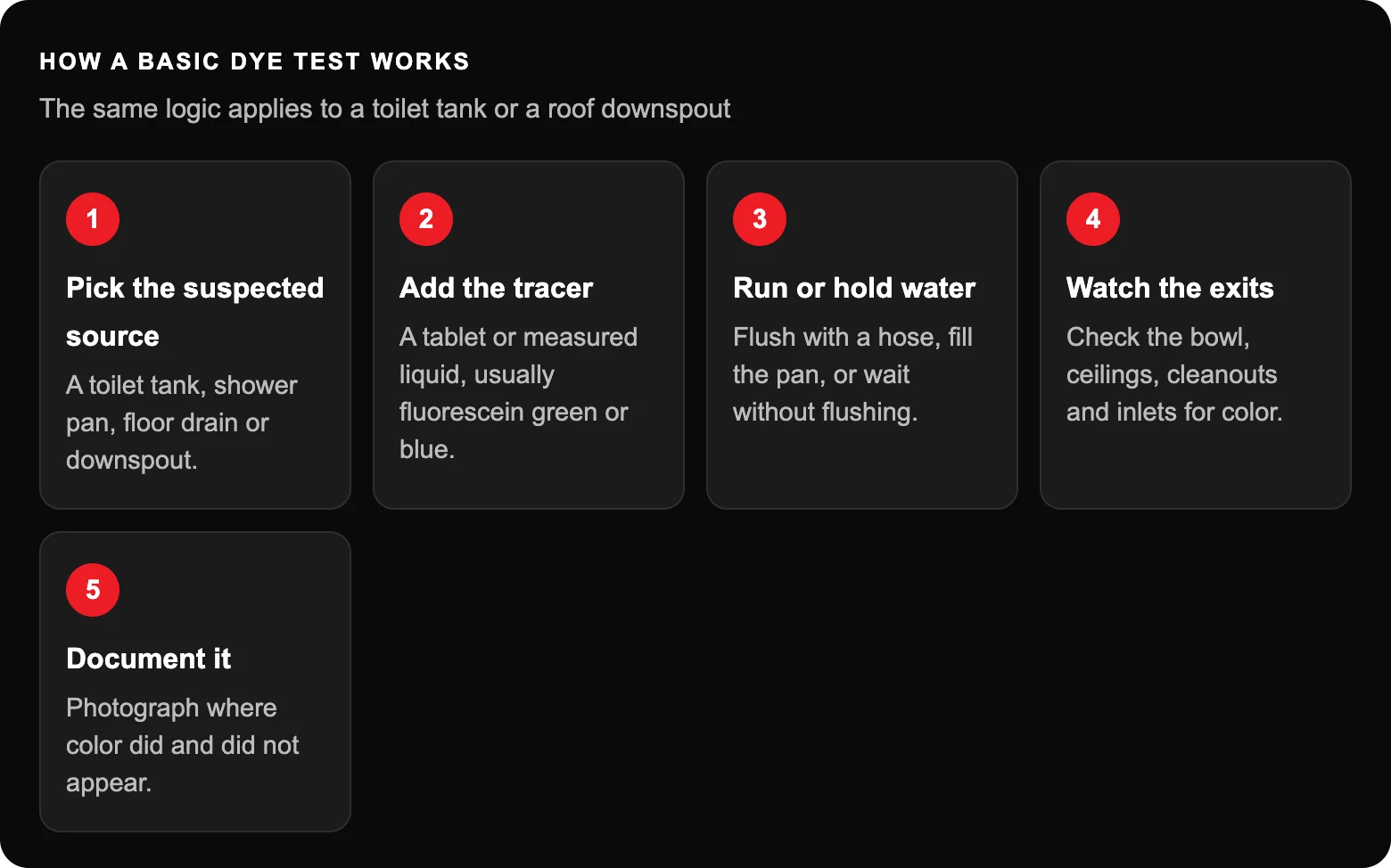
A dye test is a yes or no connection test. You add dye at a suspected source, run water, and look for color at the suspected exit: the toilet bowl, a ceiling stain, a cleanout or a storm inlet. Color means the two points are connected. No color rules out one path.
A plumbing dye test in El Paso needs no digging and leaves a visual record you can photograph. It does not measure how big a defect is or where along a buried pipe it sits. That takes a camera.
What dye is used, and is it safe?
Homeowner toilet kits use blue or green tablets, and many utilities hand them out as a conservation tool. Professional work on drains and sewers usually uses fluorescein, the vivid yellow green dye that glows under ultraviolet light and stays visible even when heavily diluted.
The safety claims are backed by research. The U.S. Geological Survey says fluorescein “is non toxic and safe for the environment”. A peer reviewed study of twelve tracer dyes by Field, Wilhelm and Quinlan in Environmental Monitoring and Assessment (1995) rated fluorescein low to moderate concern and found no acute toxic threat below about 1 to 2 milligrams per liter. The Minnesota Pollution Control Agency calls its toilet kit non toxic dye tablets.
Will it stain?
Undiluted dye can tint grout, porous stone and old porcelain if it sits. Flush the bowl after a toilet test and rinse a shower pan promptly. Concentrated liquid on carpet or fabric is the real stain risk.
When do you need a plumbing dye test?
Four situations account for most dye tests. Each has a hidden water path a visual check cannot confirm.
A toilet that runs, refills or hisses
A worn or warped flapper lets tank water seep into the bowl without a sound. EPA WaterSense says to put a few drops of food coloring in the tank and check the bowl after 10 minutes. EPA also reports 9 percent of homes have leaks wasting 50 gallons or more per day. El Paso’s hard water leaves scale that can keep a flapper from seating; see what hard water does to El Paso plumbing.

A shower pan with a stain below it
When a ceiling or baseboard near a shower shows water, the suspect could be the pan liner, drain, valve or grout. Dye in the pan with the drain plugged isolates the liner; dye poured only at the drain isolates the drain connection. Inspectors typically require a standing water test on new liners, as this county handout shows.
A downspout or yard drain tied to the sewer
Roof water belongs in the storm system or on the ground. Cities with connection programs, such as Lakewood, Ohio, dye each downspout, flush it, and check which system the color enters. In an El Paso monsoon cloudburst, one roof tied into a lateral can overload a line sized for household flow.
A mystery wet spot or odor in the yard
If dye flushed from an upstream fixture surfaces in a soggy patch along the sewer route, the lateral is broken. It quickly separates a sewer problem from an irrigation or water service leak.
Dye Testing and Flow Monitoring in El Paso
Want a straight answer about your pipes?
Every U.T. Trenchless job starts with a camera inspection and a photo report, so you see the problem before you decide on a fix. Licensed Master Plumber Ubaldo Torres leads the work.
Dye test vs. smoke and camera: what each one misses
A dye test confirms connections that carry water, but it will not show a crack that leaks only when the pipe is full, and it gives no location along a buried run. That is why our dye testing and flow monitoring service usually pairs with a video camera inspection, documented in a photo report before any repair is discussed.
| Question | Dye test | Smoke test | Camera inspection |
|---|---|---|---|
| Is this drain connected to that pipe? | Yes, directly | Often | Sometimes |
| Is my toilet flapper leaking? | Yes | No | No |
| Where exactly is the crack? | No | Rough area | Yes, with distance |
| Is sewer gas escaping indoors? | No | Yes | No |
| Is a downspout tied into the sewer? | Yes | Yes | Sometimes |
For odors, smoke testing is usually the better first step. Compare all three in smoke vs. dye vs. camera inspection.
A clean result is not a clean bill
A pan crack may open only under a person’s weight, and a lateral break may leak only when groundwater pushes on it. If symptoms continue after a negative dye test, the next step is a camera.
What to expect when a pro runs the test
A toilet check takes minutes. A shower pan test means plugging the drain, holding dyed water, and checking below. A lateral test may involve opening a cleanout, running a hose, and watching downstream.
El Paso Water says the customer owns the sewer service line from the tap at the main into the property. So if your dye reaches a wet spot in your yard, the repair is almost always yours. See who is responsible for the sewer line in El Paso.
What to do next
- Run the food coloring test on every toilet and replace any leaking flapper.
- Stop using a shower with a stain below it until it is tested.
- Dye test suspect downspouts before monsoon season.
- If dye shows a lateral leak, book a camera inspection before any repair is priced.
- Call 915.858.0166 or use our contact page to Request Service.
Questions El Paso homeowners ask about dye tests
How long does dye take to show up in a toilet bowl?
EPA suggests checking after 10 minutes; the Minnesota kit says 15 to 20 minutes without flushing. A badly worn flapper can tint the bowl within a minute or two, so give a slow leak the full time.
Can I use food coloring instead of dye tablets?
Yes, for a toilet tank; it is what EPA recommends. For drains and sewers, pros prefer fluorescein because it stays visible at tiny concentrations and glows under ultraviolet light.
Is dye safe for a septic system?
At leak test doses, yes. Fluorescein is used in groundwater studies because it works at tiny concentrations and has been reviewed as low concern for toxicity.
Why do some cities require a dye test when a house is sold?
Point of sale programs confirm that roof drains, sump pumps and yard drains are not tied into the sanitary sewer, because that stormwater overloads treatment plants. Rules vary by city, so check with the local building department or utility before listing.
Can a dye test find a slab leak?
It can confirm a drain under the slab is leaking if dyed water surfaces where it should not, but it rarely pinpoints the spot. A camera and pipe locating find the exact position.
Serving El Paso, Horizon City, Socorro and Las Cruces
Talk to a family owned trenchless team with 40+ years in the trade
Tell us what is going on and we will tell you what the camera shows, what your options are, and what we would do if it were our own property. Learn more about our dye testing and flow monitoring service.
Keep reading
Sources
- Fix a Leak Week, EPA WaterSense.
- Hydrologic study to use non toxic green dye, USGS.
- Potential adverse properties of fluorescent tracer dyes, Field et al. (1995).
- Toilet leak dye card, Minnesota PCA.
- Shower Pans, Placer County.
- Dye Test FAQs, City of Lakewood.
- I/I Analyses Guidelines, Massachusetts DEP.
- Customer Rights and Responsibilities, El Paso Water.