
Get our plumbing guides firstAdd U.T. Trenchless as a preferred source and see our posts more often in Google Top Stories.
Add as a preferred source on GoogleEl Paso hard water averages about 175 mg/L, or 10.2 grains per gallon, according to El Paso Water. Those dissolved calcium and magnesium minerals leave scale in water heaters, tankless units, faucets, valves and older drain lines, cutting flow and efficiency. Regular flushing, cleaning fixtures, and a softener where it makes sense protect your plumbing.
If your shower glass turns cloudy a week after cleaning, or your faucet aerator crusts white, you already know the water here is hard. What is less obvious is what that same mineral load does inside the tank, valves and pipes you never see.
This guide looks at El Paso’s actual hardness numbers, where scale causes trouble in a home or commercial building, what it costs to ignore, and which fixes are worth the money. It also covers when a softener is not the answer.
What’s in this guide
The short answer: scale, slowly
Hard water does not burst pipes overnight. It works slowly: every time water is heated or evaporates, some calcium and magnesium drop out as scale. Over years that scale settles in water heater tanks, coats heating elements, narrows small passages in valves and aerators, and adds to buildup in older drains.
Penn State Extension sums it up: as these minerals move through water, they “build up on contact surfaces, possibly plug pipes and damage water heaters.” The fix is not dramatic either. It is maintenance, done on a schedule, plus treatment where the numbers justify it.
How hard is El Paso hard water?
El Paso Water describes local water as “moderately hard to hard.” Its chemical analysis of city water says hardness “may be considered to average about 175 mg/l or about 10.2 grains per gallon,” with individual sources ranging from about 107 to 283 mg/L.
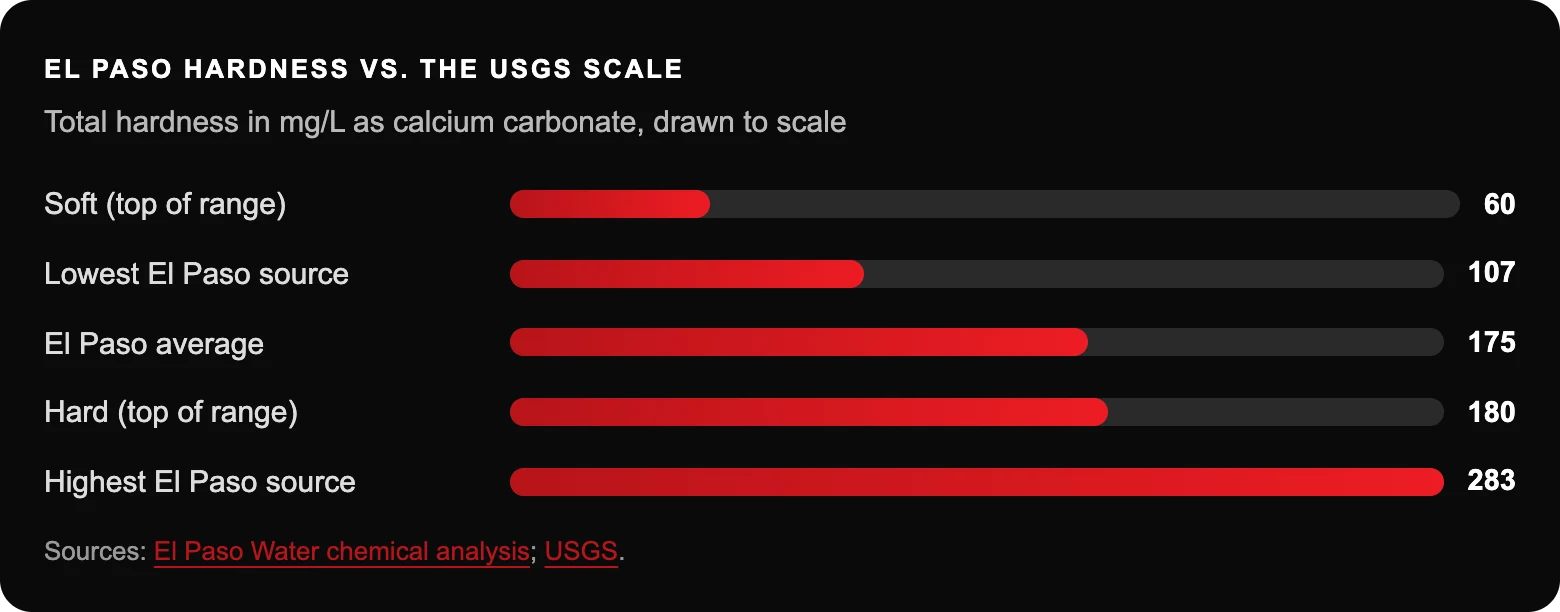
The U.S. Geological Survey calls 121 to 180 mg/L hard and anything above 180 very hard. So the city average sits at the top of the hard range, and some sources cross into very hard.
Your tap may not match the average. El Paso Water draws from the Rio Grande and two aquifers, the Hueco Bolson and Mesilla Bolson, and its 2025 water quality report notes most customers get water from two sources depending on the time of year. That is why buildup can seem worse in some seasons.
Where scale does the most damage
| Part | What scale does | Warning sign |
|---|---|---|
| Tank water heater | Sediment settles on the bottom and insulates water from the burner or element | Rumbling or popping, slower recovery, rusty or cloudy hot water |
| Tankless water heater | Scale coats the heat exchanger | Fluctuating temperature, reduced flow, error codes |
| Faucet aerators, showerheads | Mineral crust blocks small openings | Weak or uneven spray |
| Toilet fill valves, cartridges | Deposits keep seals from closing | Running toilet, dripping faucet |
| Older cast iron drains | Scale adds to rust and grease buildup that narrows the pipe | Recurring slow drains, frequent clogs |
The water heater usually pays the biggest price. A layer of sediment means the burner or element runs longer to heat the same water, and the tank works harder every day. HomeAdvisor’s national data puts a water heater installation at $800 to $2,000, which makes a yearly flush cheap insurance.
What about drain lines?
Hard water is one ingredient in drain trouble, not the whole story. In older central and east El Paso homes with cast iron drains, mineral scale joins rust, soap residue and grease on the pipe wall. Over time that narrows the line enough to catch paper and debris.
When a camera shows heavy buildup on sound cast iron, pipe descaling can restore the inside diameter without replacing the pipe. Our explainer on why cast iron drains need descaling shows how it works. If the pipe is cracked or badly corroded, descaling is not the right fix, and we will tell you so.
Plumbing Service in El Paso
Want a straight answer about your pipes?
Every U.T. Trenchless job starts with a camera inspection and a photo report, so you see the problem before you decide on a fix. Licensed Master Plumber Ubaldo Torres leads the work.
How to protect your plumbing from El Paso hard water
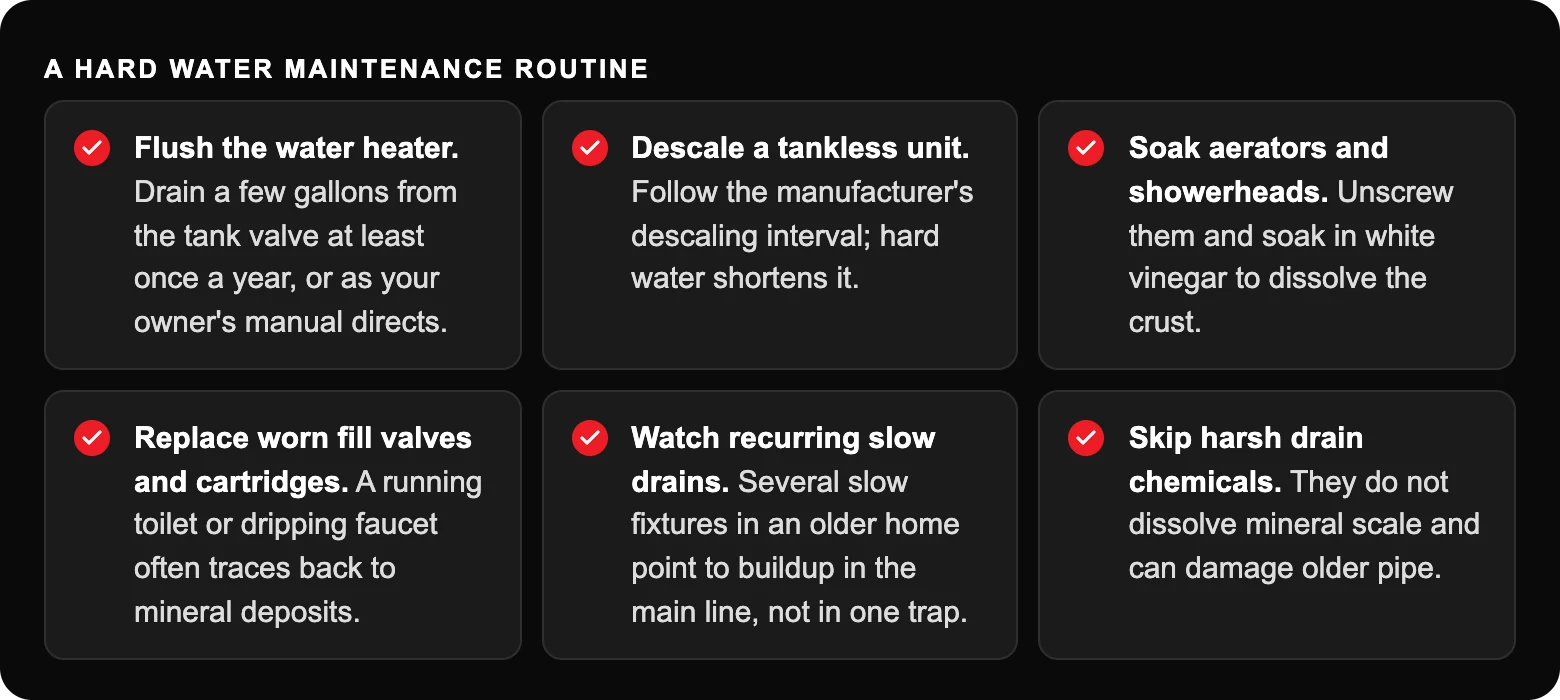
That last point comes up often. Our comparison of chemical drain cleaners and professional drain cleaning explains why pouring chemicals into a scaled cast iron line is a gamble.
Do you need a water softener in El Paso?
A softener is the only common treatment that removes hardness from the whole house. Penn State Extension classifies 7.0 to 10.5 grains per gallon as hard and above 10.5 as very hard, so El Paso’s 10.2 average sits right at the edge.
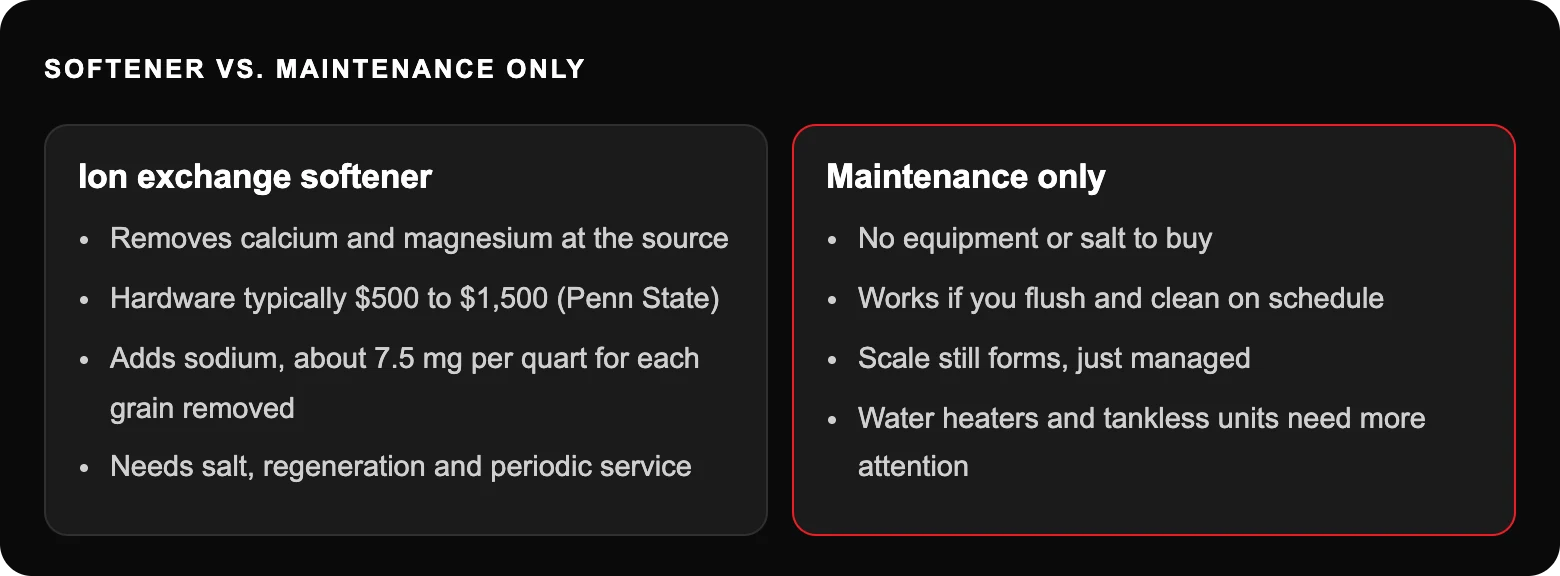
El Paso Water’s water quality FAQ states, “We do not recommend the installation of water softeners for drinking water.” Many owners who soften leave a cold, unsoftened line at the kitchen sink for that reason. Penn State also advises testing your water independently before buying, rather than relying on a sales test.
Honest take
A softener makes the most sense in homes with tankless heaters, large families, or visible scale problems. For many households, a disciplined maintenance routine does the job without the ongoing cost.
What to do next
- Check the date on your water heater and when it was last flushed.
- Clean aerators and showerheads, and note any fixtures that stay weak.
- Test your own tap water if you are weighing a softener.
- If several drains are slow in an older home, ask for a camera inspection before any repair.
- Book plumbing service for water heater, valve or drain work you would rather not tackle.
Our family owned team has worked on El Paso plumbing for over 40 years. Contact U.T. Trenchless or call 915.858.0166.
Questions El Paso homeowners ask about hard water
Is El Paso hard water safe to drink?
Hardness is not a safety issue. The USGS notes the EPA does not set a legal limit for hardness because calcium and magnesium are not considered toxic, and El Paso Water points to evidence that these minerals are desirable in the diet. The concern with hard water is your plumbing and appliances, not your health.
What are the white spots on my faucets and dishes?
That is mineral scale, mostly calcium carbonate left behind when hard water evaporates. White vinegar dissolves it on fixtures, and a rinse aid helps in the dishwasher. If the crust returns within days, your water is on the harder end of El Paso’s range.
How often should I flush my water heater in El Paso?
At least once a year is a common baseline, and your owner’s manual has the final word. With water near 10 grains per gallon, some homes benefit from flushing more often. If the tank already rumbles loudly, sediment may be heavy, and a plumber should look before you open the drain valve.
Does a water softener add salt to drinking water?
It adds sodium. Penn State Extension estimates about 7.5 milligrams per quart for each grain per gallon of hardness removed. At El Paso’s average, that adds up, which is why people on sodium restricted diets often keep one unsoftened tap for drinking and cooking.
Can hard water cause a sewer line clog?
Not by itself. Scale contributes to buildup in older cast iron drains, but most main line clogs involve roots, grease, wipes or damaged pipe. A camera inspection shows what is actually in the line before anyone recommends a fix.
Serving El Paso, Horizon City, Socorro and Las Cruces
Talk to a family owned trenchless team with 40+ years in the trade
Tell us what is going on and we will tell you what the camera shows, what your options are, and what we would do if it were our own property. Learn more about our plumbing service service.
Keep reading
Sources
- Chemical Analysis, City Water, El Paso Water.
- Water Quality FAQ, El Paso Water.
- 2025 Drinking Water Quality Report, El Paso Water.
- Do you have information about water hardness in the United States?, U.S. Geological Survey.
- Water Softening, Penn State Extension.
- How Much Does a Plumber Cost?, HomeAdvisor.