

Get our plumbing guides firstAdd U.T. Trenchless as a preferred source and see our posts more often in Google Top Stories.
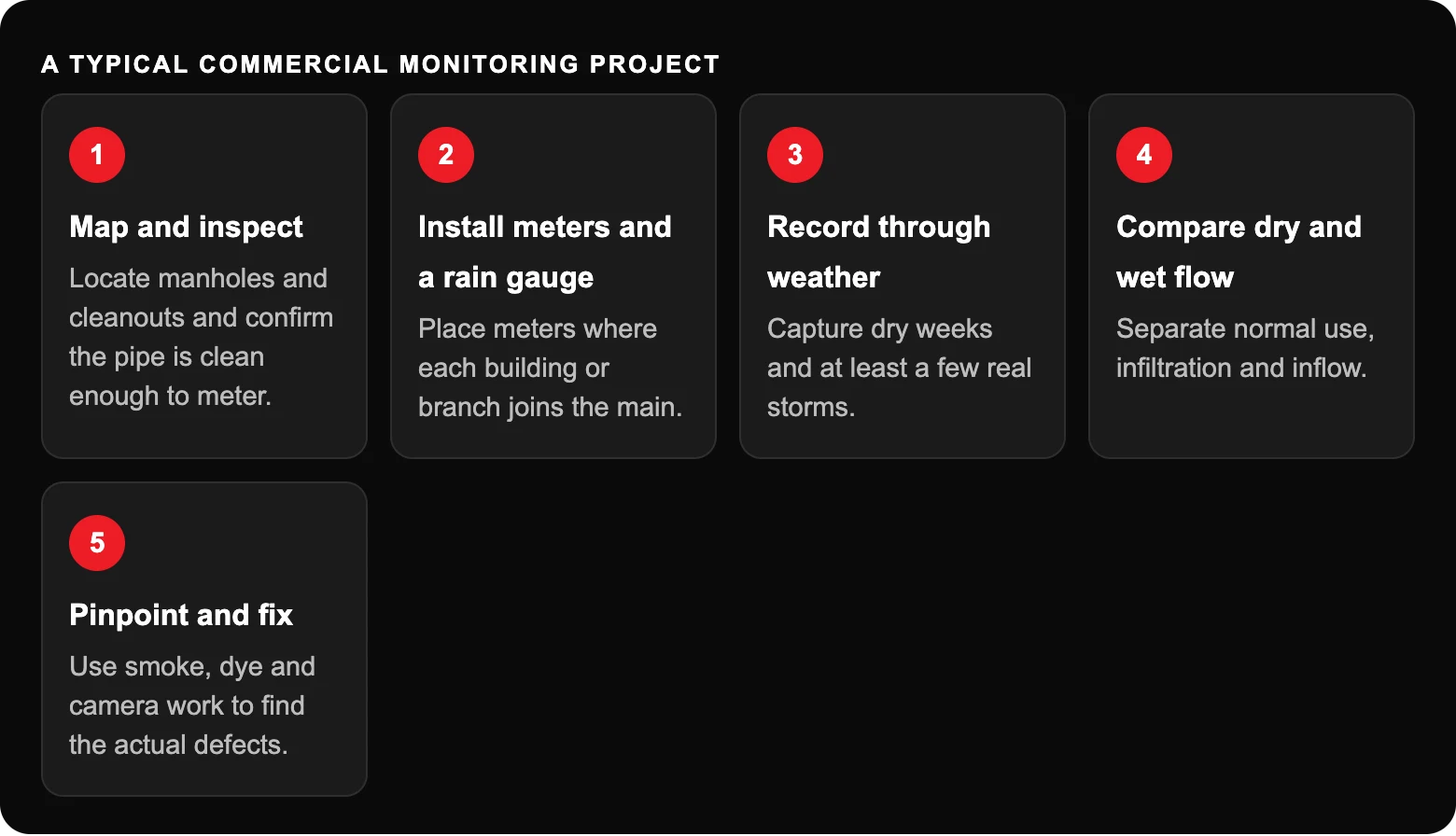
Add as a preferred source on GoogleSewer flow monitoring places meters in a manhole or large cleanout to record how much wastewater moves through a pipe, and when, usually for several weeks alongside a rain gauge. Commercial properties in El Paso use it to catch stormwater and groundwater leaking into private sewers, prove capacity before adding tenants, and back up flow reports the utility requires.
A backup at a shopping center, apartment complex or plant rarely has a single obvious cause. Flow data separates a line that is too small from one that is broken, clogged, or taking on water it was never meant to carry.
This guide explains how the meters work, what the numbers mean, when monitoring is worth it and when it is not, and how El Paso’s monsoon season shapes the data.
What’s in this guide
What sewer flow monitoring actually measures
A flow meter records depth and velocity of wastewater at fixed intervals, often every few minutes, around the clock. Multiply the wetted area of the pipe by velocity and you get flow in gallons per day. Plot weeks of it and you see the property’s daily rhythm: low overnight, a morning peak, a lunch or shift change bump.
The value lies in comparing that rhythm on dry days with what happens after rain. Sanitary sewers should not respond much to weather. If flow jumps within an hour of a storm, water is getting in through a direct opening. If the baseline creeps up for days afterward, groundwater is seeping through cracks and joints.

Those definitions come from EPA’s Guide for Estimating Infiltration and Inflow, which also notes a longstanding screening value of 120 gallons per person per day for excessive infiltration.
Why commercial properties use sewer flow monitoring in El Paso
Homes rarely need metering; one lateral and a camera usually tell the story. Commercial and industrial sites are different because they often own a private collection system with multiple buildings, long mains and several manholes before the utility tap.
Finding hidden stormwater in a private system
El Paso Water treats stormwater as a separate utility, created in 2008, and its stormwater page notes that a 2006 storm caused more than $200 million in damage. When summer monsoon storms hit a property whose roof drains or area drains tie into the sanitary side, that water lands in pipes sized for restrooms and kitchens. Metering during a storm shows how much.
Proving capacity before a change in use
Converting retail space to a restaurant, adding units, or expanding a production line all add flow. Weeks of real data show peak depth in the pipe, so an engineer can judge whether there is room to spare instead of guessing from fixture counts.
Supporting required flow reporting
Industrial users regulated under EPA’s National Pretreatment Program must report the measured average daily and maximum daily flow for regulated process streams, though the control authority can allow verifiable estimates in some cases. A monitoring record makes those numbers defensible.
Explaining recurring backups
If a line surcharges only after storms, the fix is removing inflow, not more cleaning. If it surcharges on dry days at peak hours, look at grease, roots or undersized pipe. Restaurants should also read our guide to preventing grease related sewer backups.

Dye Testing and Flow Monitoring in El Paso
Want a straight answer about your pipes?
Every U.T. Trenchless job starts with a camera inspection and a photo report, so you see the problem before you decide on a fix. Licensed Master Plumber Ubaldo Torres leads the work.
How the meters work
State guidance lists three accepted approaches. The Massachusetts DEP I/I guidelines rank them in order of preference and pair each with a recording rain gauge accurate to 0.01 inches.
| Method | How it works | Best fit |
|---|---|---|
| Weir or flume with depth sensor | A shaped structure creates a known depth to flow relationship | Accessible manholes where a device can be installed |
| Area velocity meter | Sensors measure depth and velocity directly in the pipe | Most private mains and laterals; no structure needed |
| Depth sensor with rating curve | Depth only, converted using field measured velocities | Stable, free flowing pipes and budget studies |
Timing it around El Paso weather
Inflow only shows when it rains, so a study run through a dry spring may miss the problem. In El Paso that points to the monsoon, roughly June through September, when short, intense storms test every roof drain and area inlet. Our checklist for storm drain monsoon prep pairs well with a summer study.
Infiltration is subtler here. Where groundwater sits deep, a cracked pipe may lose sewage into the soil rather than gain water. Flow data can still reveal it as unexplained drops between two meters.
When flow monitoring is not the right tool
Metering tells you how much and when, not exactly where. It narrows a problem to a branch or building; smoke testing, dye testing and camera work find the defect. For a single building with one lateral, a camera inspection is usually faster.
Dirty pipe, bad data
Debris and grease distort velocity readings. We often recommend sewer cleaning before meters go in, so the data reflects the pipe, not the clog.
Meter again after repairs
A short study after lining or disconnecting inflow proves the fix worked. See rehabilitating aging commercial pipes without shutting down.
What to do next
- List every building, manhole and cleanout on the private system.
- Pull records of backups and note whether they followed rain.
- Schedule a camera inspection of the main line to confirm it can be metered.
- Plan monitoring to include monsoon storms if inflow is suspected.
- Talk with us about dye testing and flow monitoring at 915.858.0166 or through our contact page to Request Service.
Questions El Paso property managers ask about flow monitoring
How long does a sewer flow monitoring study take?
Weeks, not days. Massachusetts requires at least ten consecutive weeks for municipal I/I studies. A private site can be shorter, but it must capture both dry weather and real storms.
Do we have to shut down operations while meters are installed?
No. Meters sit inside manholes or large cleanouts and record while the building runs normally; that is the point.
Who owns the sewer pipes on a commercial property in El Paso?
El Paso Water says the customer is responsible for the sewer service line from the tap at the main into the property, so private mains and laterals are the owner’s to maintain.
What is the difference between flow monitoring and a flow test?
A flow test is a short check of one pipe or fixture. Monitoring records continuously over weeks to capture peaks, overnight lows and storm response.
Can flow data tell us where the leak is?
Only to a section. Multiple meters narrow it to a branch or building; smoke, dye and camera work then locate the defect.
Serving El Paso, Horizon City, Socorro and Las Cruces
Talk to a family owned trenchless team with 40+ years in the trade
Tell us what is going on and we will tell you what the camera shows, what your options are, and what we would do if it were our own property. Learn more about our dye testing and flow monitoring service.
Keep reading
Sources
- Guide for Estimating Infiltration and Inflow, EPA Region 1 (2014).
- Guidelines for Performing I/I Analyses, Massachusetts DEP (2017).
- Sewer System Evaluation Survey, California State Water Resources Control Board.
- Sanitary Sewer Overflows, EPA.
- National Pretreatment Program, EPA.
- 40 CFR 403.12, eCFR.
- Stormwater, El Paso Water.
- Customer Rights and Responsibilities, El Paso Water.