

Get our plumbing guides firstAdd U.T. Trenchless as a preferred source and see our posts more often in Google Top Stories.
Add as a preferred source on GoogleA sewer smell in your house almost always means sewer gas is getting past a seal that should stop it: a dry P trap, a failed toilet wax ring, a cracked or disconnected vent pipe, or a stuck air admittance valve. When the source is hidden, smoke testing in El Paso fills the drain system with visible vapor so the leak shows itself.
The rotten egg smell comes mainly from hydrogen sulfide, a gas people detect at tiny concentrations. That sensitivity is useful, but it also sends homeowners chasing a smell that fades, returns with the wind, and seems to come from everywhere.
This guide ranks the common causes from easiest to hardest to find, explains what the smell does and does not mean for your health, and shows how a smoke test pins down the source when basic checks fail.
What’s in this guide
- The short answer: something is breaking the seal
- Common causes of sewer smell in the house, El Paso edition
- Is sewer gas in the house dangerous?
- How smoke testing finds a hidden sewer smell
- When the smell comes from the sewer line itself
- What to do next
- Questions El Paso homeowners ask about sewer smells
- Keep reading
The short answer: something is breaking the seal
Your drain system connects to the public sewer, which is full of gas. Two things keep that gas out of your rooms. Water sitting in each fixture’s trap blocks it at every drain, and vent pipes carry it up and out through the roof. A sewer smell in the house means one of those barriers has a gap.
The trick is that the gap is rarely where the smell seems strongest. Gas drifts through wall cavities, follows air currents from your HVAC return, and pools low because hydrogen sulfide is slightly heavier than air, according to the NIOSH Pocket Guide.
Common causes of sewer smell in the house, El Paso edition
1. A dry P trap
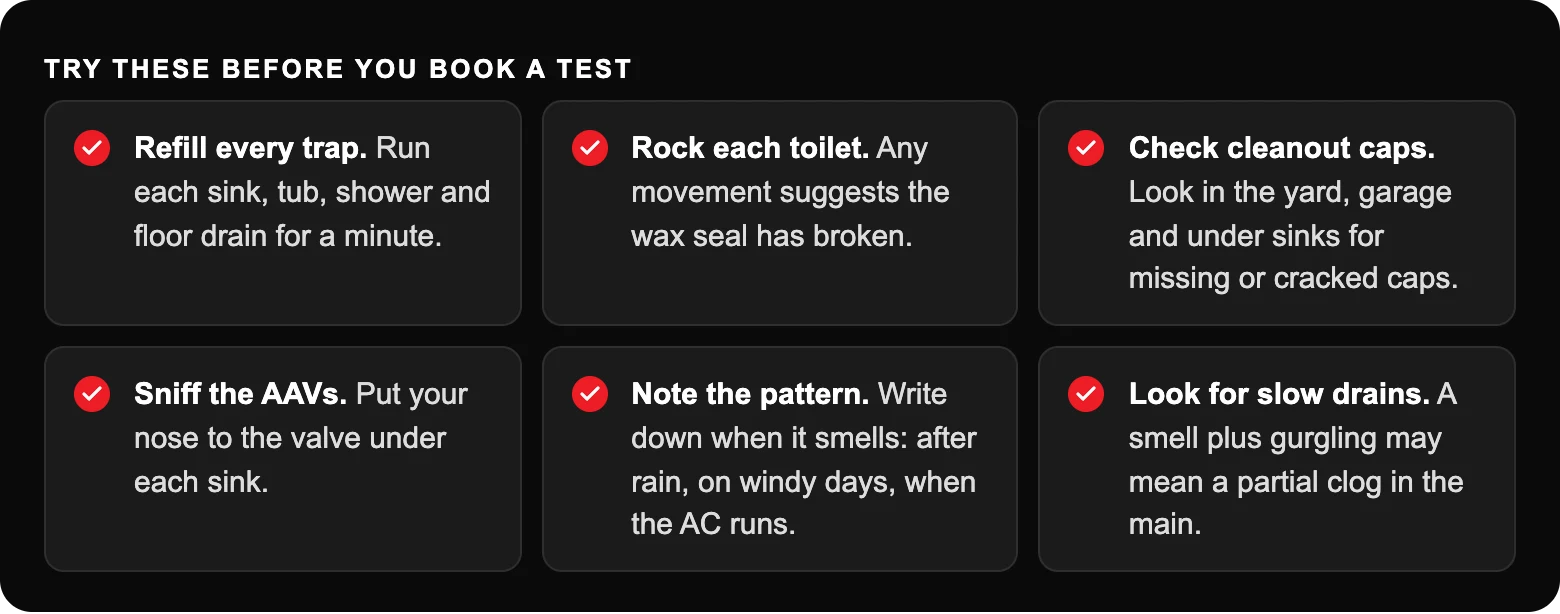
Guest bath showers, basement or garage floor drains, and utility sinks lose their water seal when nobody uses them. Low humidity makes evaporation faster here than in wetter climates. Run water for a minute in every rarely used drain; if the smell fades within a day, you found it.
2. A failed toilet wax ring
The wax ring seals the toilet to the floor flange. A toilet that rocks, a ring that was reused, or a flange that sits below the finished floor can open a gap. Smell concentrated around the base, or a stain on the ceiling below an upstairs toilet, points here.
3. A cracked or disconnected vent pipe
Vents run inside walls and through the attic. A joint that separated during settling, a pipe cut during a remodel, or rusted cast iron in an older home lets gas escape where no one can see it. Attic smells, and odors that get worse on windy days, often trace back to vents.
4. A stuck or failing air admittance valve
An air admittance valve (AAV) is a one way valve under a sink or in a wall that lets air in but should seal shut. The International Code Council explains that it is “designed to close and seal under zero or positive pressure.” When the seal wears or debris holds it open, sewer gas leaks out. The ICC also notes that AAVs cannot relieve positive pressure, so at least one real vent must reach outdoors.
5. Broken drain lines or open cleanouts
A missing cleanout cap, a cracked drain under the slab, or a washing machine standpipe without a trap can all let gas in. These are the hardest to find by nose.
| What you notice | Likely cause | What smoke testing shows |
|---|---|---|
| One bathroom, rarely used | Dry P trap | Smoke rising from that drain |
| Around the toilet base | Failed wax ring or flange | Smoke seeping at the floor line |
| Worse on windy days, attic odor | Cracked or open vent | Smoke in the attic or wall cavity |
| Under one sink cabinet | Stuck AAV | Smoke from the valve cap |
| Whole house, no clear spot | Hidden drain or vent break | Smoke at an outlet, baseboard or slab crack |
Is sewer gas in the house dangerous?
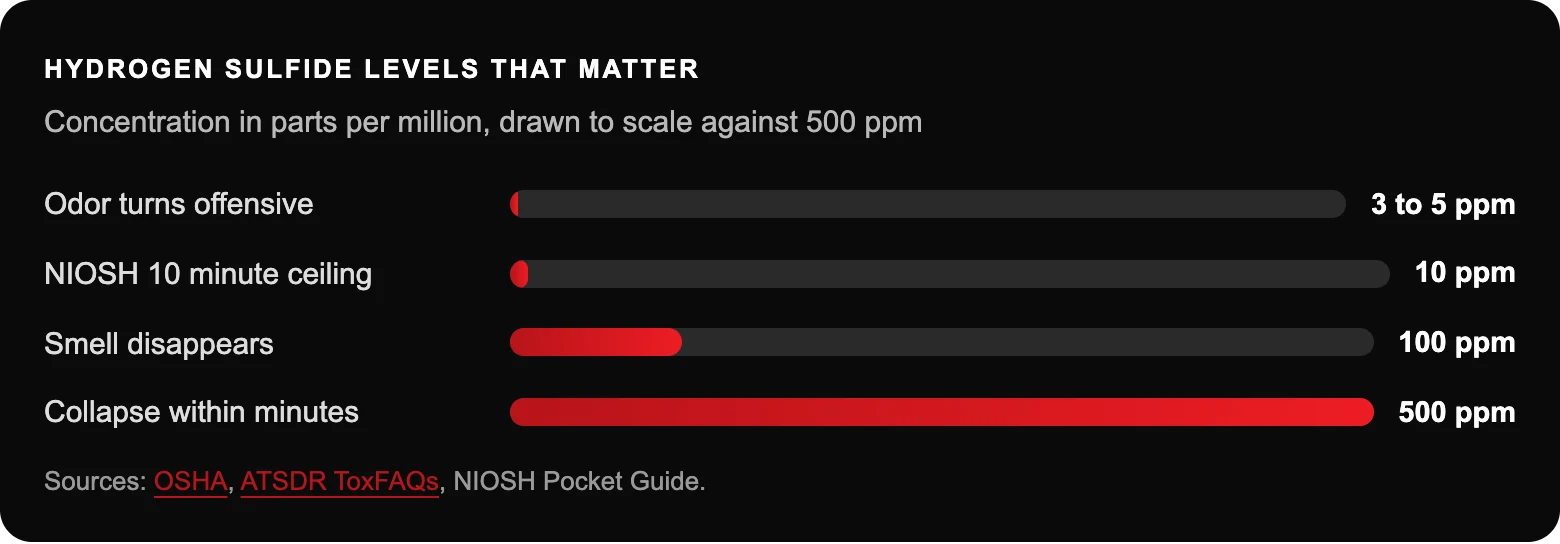
At the levels typical of a household odor problem, the risk is discomfort rather than poisoning, but it is not something to live with. The CDC’s ATSDR says people detect hydrogen sulfide at 0.0005 to 0.3 parts per million, far below harmful levels. OSHA notes that prolonged exposure at 2 to 5 ppm may cause nausea, headaches, eye irritation or lost sleep.
The warning sign that matters is losing the smell. ATSDR states that people “lose the ability to smell the gas after about 2 to 15 minutes of exposure at about 100 ppm.” Homes rarely approach that, but it is why a smell that suddenly disappears is not proof the problem went away.
When to leave and call
If the odor is overpowering, people feel dizzy or sick, or you smell gas near a floor drain in a pit, crawl space or sump, get everyone outside and call for help. Natural gas is odorized to smell similar, so if a gas leak is possible, leave and call the gas utility first.
Smoke Testing in El Paso
Want a straight answer about your pipes?
Every U.T. Trenchless job starts with a camera inspection and a photo report, so you see the problem before you decide on a fix. Licensed Master Plumber Ubaldo Torres leads the work.
How smoke testing finds a hidden sewer smell
When the easy checks do not solve it, a smoke test turns an invisible gas into something you can see. We fill every trap, seal the line at a cleanout, and push smoke through the drain and vent system. Anywhere sewer gas can escape, smoke escapes too. The roof vents should plume; nothing else should.
Our smoke testing service covers the whole building: every room, cabinet, attic space and the yard. If you want the background on the smoke itself, our guide on what sewer smoke testing is and whether it is safe covers safety data and preparation.
When the smell comes from the sewer line itself
Sometimes smoke shows up outside: at a crack in the driveway, a soft patch of lawn, or around the foundation. That points to a broken lateral, and it is where a video camera inspection comes next, so you see the damage before paying for a repair. Our guide to what a sewer camera inspection shows explains how to read that report.
If you are not sure which test fits your situation, compare the options in smoke testing vs dye testing vs camera inspection.
Save the evidence
Photos of where smoke appeared make the repair faster and let you compare options with a clear picture of the problem.
What to do next
- Refill every trap and wait a day.
- Rock toilets, check cleanout caps, and sniff under sinks.
- Track when the smell appears and where it is strongest.
- If it persists, book a smoke test of the drain and vent system.
- If smoke appears outdoors, schedule a camera inspection before any digging.
- Request Service or call 915.858.0166, Monday to Friday 8:00 AM to 5:00 PM and Saturday 8:30 AM to 2:00 PM.
Questions El Paso homeowners ask about sewer smells
Why does my house smell like sewer only sometimes?
Intermittent odors usually follow pressure changes. Wind across a roof vent, a big flush, or the AC pulling air can draw gas through a weak seal for a few minutes. A trap that is nearly dry can also seal and unseal as water levels shift.
Why does my bathroom smell like sewer after a shower?
Hot water and steam can reveal a leaking wax ring or a trap with a slow drain. Also check the tub overflow gasket and the shower drain itself, which can collect hair and soap that smell like sewage.
Can a sewer smell come from the AC?
The AC does not create sewer gas, but its return can pull gas from a leaking wall cavity or a dry condensate line connected to a drain. If the smell is strongest at vents, have both the plumbing and the condensate drain checked.
Will a plumber find the smell with a camera?
A camera shows cracks, offsets and roots inside the pipe, but it cannot show a gas leak from an open vent or a failed wax ring. For odor problems, smoke testing is usually the faster route to the source.
Is it safe to sleep in a house that smells like sewer?
A faint, occasional odor is not usually dangerous, but ATSDR and OSHA note that ongoing low level exposure can cause headaches and nausea. Ventilate, refill traps, and get the source found. Leave if the smell is strong or anyone feels ill.
Serving El Paso, Horizon City, Socorro and Las Cruces
Talk to a family owned trenchless team with 40+ years in the trade
Tell us what is going on and we will tell you what the camera shows, what your options are, and what we would do if it were our own property. Learn more about our smoke testing service.
Keep reading
Sources
- Hydrogen Sulfide Hazards, Occupational Safety and Health Administration.
- ToxFAQs: Hydrogen Sulfide, Agency for Toxic Substances and Disease Registry, CDC.
- NIOSH Pocket Guide to Chemical Hazards: Hydrogen Sulfide, CDC.
- CodeNotes: Installation of Air Admittance Valves, International Code Council.