

Get our plumbing guides firstAdd U.T. Trenchless as a preferred source and see our posts more often in Google Top Stories.
Add as a preferred source on GoogleIn El Paso, storm drain responsibility depends on where the clog is. El Paso Water maintains the public system: street inlets, public storm pipes, channels, dams and city ponds, funded by the monthly stormwater fee. Drainage inside private property, including parking lot catch basins, trench drains, private pipes and most onsite ponds, belongs to the property owner or HOA.
That line sounds simple until water pools across a shopping center entrance and nobody knows whether the curb grate is public or private. Calling the wrong party costs time you do not have in monsoon season.
This guide explains, for owners, HOA boards and facility managers, what the utility maintains, what falls to you, how the fee works, and what the law says.
What’s in this guide
- The short answer: follow the water to the property line
- What El Paso Water maintains
- What the property owner or HOA maintains
- El Paso stormwater fees: what you pay and what it covers
- What is illegal to put in a storm drain
- When your drainage floods a neighbor
- What to do next
- Questions El Paso property managers ask about storm drain responsibility
- Keep reading
The short answer: follow the water to the property line
Trace the path the water takes. Everything that collects and moves water on your parcel, up to where it enters a public street, channel or pond, is almost always yours. After that, it is El Paso Water’s.
There are exceptions. Some subdivision ponds are owned by an HOA rather than the city, and highway drainage along interstates and state routes belongs to TxDOT. When the ownership is unclear, the recorded plat and El Paso Water’s stormwater engineering staff are the final word.
What El Paso Water maintains
El Paso Water runs the city’s stormwater utility. Its stormwater FAQ describes the system’s job as collecting runoff, slowing it down, removing debris and channeling the flow “to a designated collection point or receiving stream.” The scale is larger than most people realize.
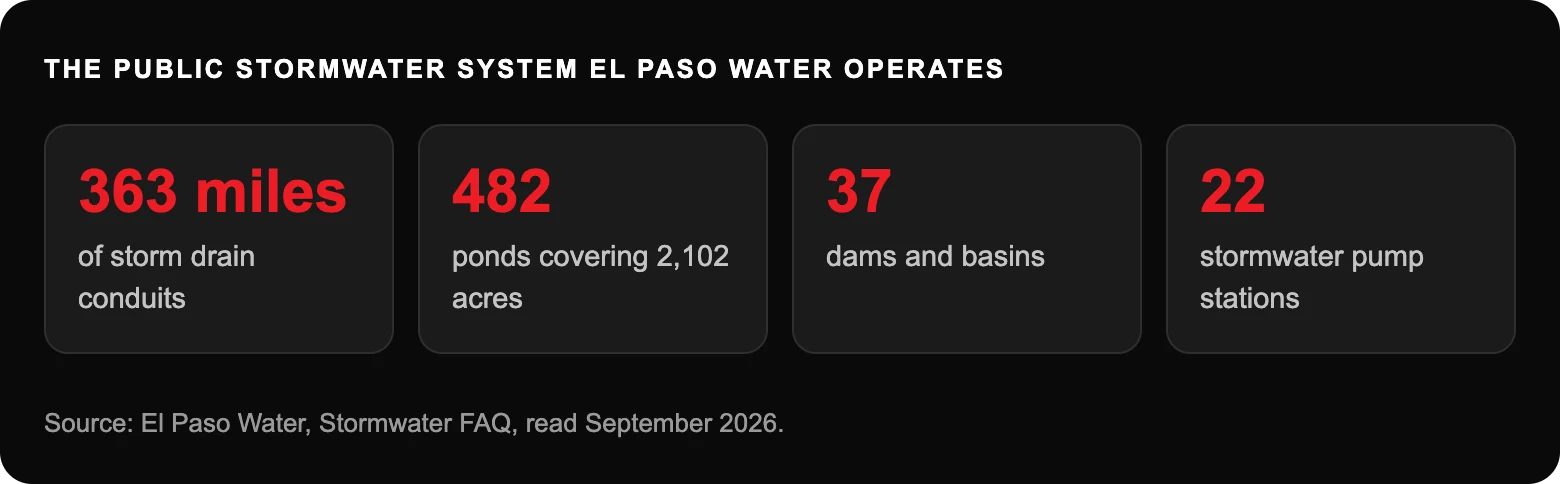
Utility crews clear public street inlets, especially ahead of forecast heavy rain. If a public inlet or channel is blocked, report it to El Paso Water customer service at 915.594.5500 or through 311, and do not try to open a public structure yourself. The utility’s stormwater FAQ lays out what the system includes and how the fee funds it.
What the property owner or HOA maintains
The private side is everything built to serve the parcel itself. On a typical commercial site that means the catch basins in the parking lot, the trench drains across driveways and loading docks, the pipes that connect them, roof drain leaders, and any detention or retention pond built for the development.
The strongest local signal is in El Paso Water’s own rate schedule: nonresidential properties with an onsite pond can earn a 25 percent stormwater credit only if the pond meets design standards and receives maintenance. The utility is rewarding owners for maintaining their own ponds, which tells you whose job it is.
| Feature | Usually maintained by | Notes |
|---|---|---|
| Curb inlet on a public street | El Paso Water | Report blockages; do not open public structures |
| Parking lot catch basin | Property owner | Includes the sump, grate and connecting pipe |
| Trench drain at a driveway or dock | Property owner | Common trouble spot for packed grit |
| Private pipe from lot to street | Property owner | Up to the connection with the public system |
| Onsite detention pond | Property owner | Maintained ponds may qualify for a 25 percent credit |
| Subdivision pond | City or HOA | Check the recorded plat and HOA documents |
| Interstate or state highway drain | TxDOT | Separate from El Paso Water |
If you do not know where your private lines run, pipe locating and mapping will show you, and our storm drain cleaning and maintenance service can clean and camera inspect everything on your side of the line. The same logic applies to sewers, which we explain in who is responsible for the sewer line in El Paso.
Storm Drain Cleaning and Maintenance in El Paso
Want a straight answer about your pipes?
Every U.T. Trenchless job starts with a camera inspection and a photo report, so you see the problem before you decide on a fix. Licensed Master Plumber Ubaldo Torres leads the work.
El Paso stormwater fees: what you pay and what it covers
Paying a stormwater fee does not transfer maintenance of your private drains to the city. El Paso Water says the fees “are used only for stormwater utility expenses,” funding operation, maintenance and capital projects on the public system.
The fee is based on impervious area, meaning roofs, pavement and other surfaces that shed water. El Paso Water measures it using aerial photos, its GIS mapping and appraisal district records. Residential properties pay a flat tier; nonresidential properties pay $7.55 a month for each 2,000 square feet of impervious area.
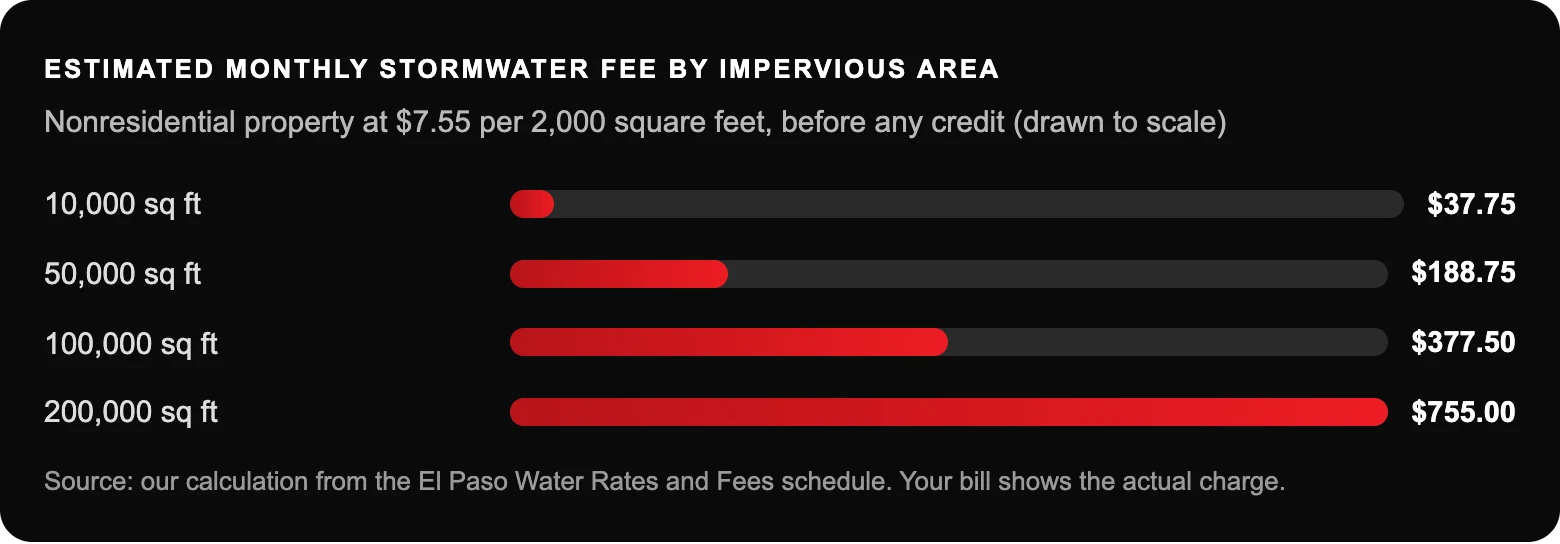
Nonprofit agencies receive a reduced rate, and some public entities such as school districts and state agencies are exempt. For a large retail center or HOA, the 25 percent pond credit can be worth real money every month, provided the pond is actually maintained.
What is illegal to put in a storm drain
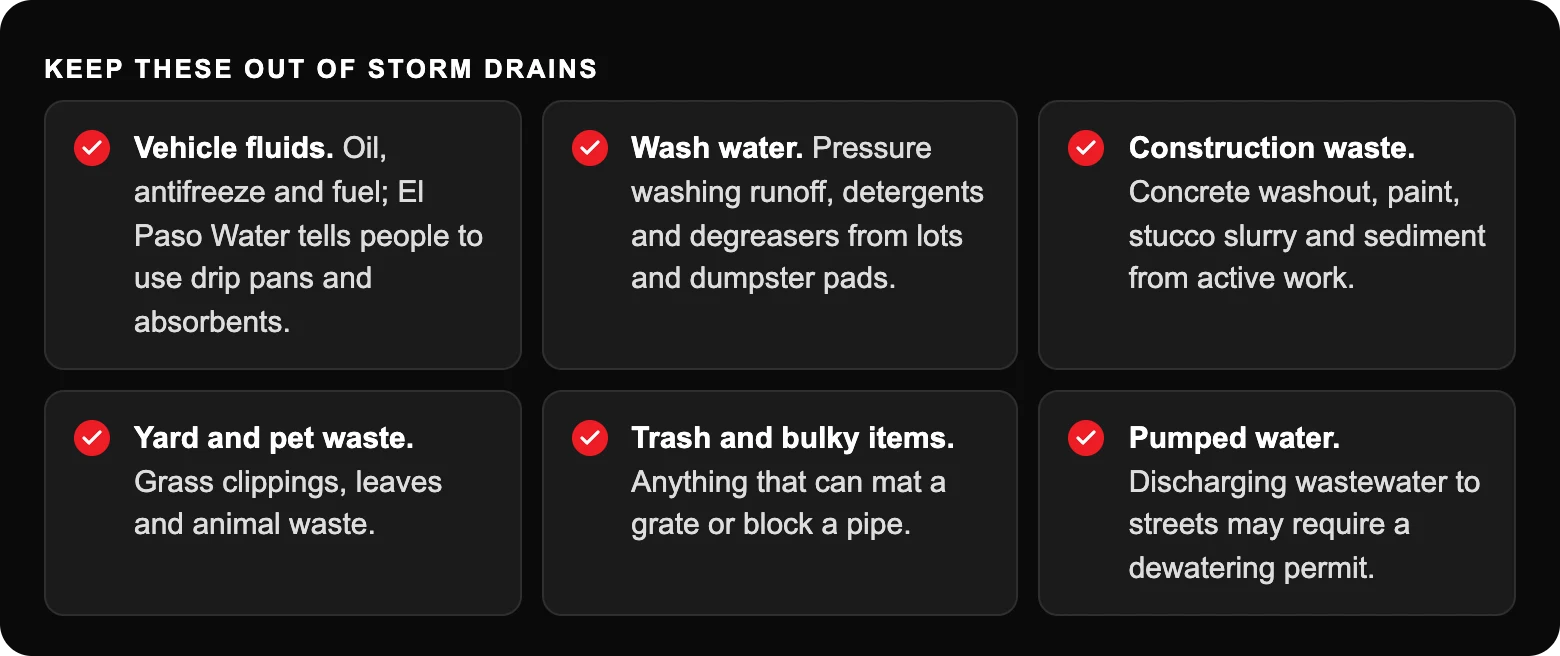
Storm drains are not connected to a treatment plant. Whatever goes into a parking lot inlet heads toward ponds, arroyos and eventually the Rio Grande. El Paso Water warns that “trash in waterways causes drains and channels to become blocked, resulting in flooding,” and states that illegal dumping is a class C misdemeanor with fines up to $4,000.
A strange smell or sheen is a clue
Sewage odor or an oily film in a storm inlet can mean a sanitary line is cross connected to the storm system. Dye testing traces where the flow comes from, as explained in our guide to finding cross connections and illegal hookups.
When your drainage floods a neighbor
Responsibility is not only about maintenance. Texas law also addresses what happens when water from one property damages another. Section 11.086 of the Texas Water Code states:
No person may divert or impound the natural flow of surface waters in this state, or permit a diversion or impounding by him to continue, in a manner that damages the property of another by the overflow of the water diverted or impounded.
The full text is on Texas Water Code Section 11.086. We are plumbers, not lawyers, so talk to an attorney about any specific dispute. The practical point: a neglected drain or blocked pond outlet that pushes water onto a neighbor can become a legal problem.
What to do next
- Walk the property and mark where water enters the public street, channel or pond.
- Pull your plat, site plan and HOA documents to confirm who owns ponds and easements.
- Report blocked public inlets to El Paso Water at 915.594.5500 or 311.
- Schedule cleaning and a camera inspection for everything on the private side, ideally before monsoon season.
- Ask El Paso Water whether a maintained pond qualifies your property for the stormwater credit.
For the seasonal plan, see how commercial properties should prepare storm drains for monsoon season. To schedule work on your private drains, call 915.858.0166 or use our contact page.
Questions El Paso property managers ask about storm drain responsibility
Who do I call about a flooded street in El Paso?
For a blocked public inlet, flooded street or damaged stormwater structure, contact El Paso Water customer service at 915.594.5500 or report it through 311. If water is flooding an interstate or state highway, TxDOT manages that roadway.
Is the storm drain in my HOA common area public or private?
It depends on how the subdivision was platted and accepted. Some ponds and drainage easements were dedicated to the city; others remain HOA property. Check the recorded plat, the HOA declaration and any maintenance agreements, then confirm with El Paso Water if the documents are unclear.
Why do I pay a stormwater fee if I maintain my own drains?
The fee funds the public system that your private drains empty into: street inlets, conduits, channels, dams and city ponds. Nonresidential properties that maintain a qualifying onsite pond can apply for a 25 percent credit, which recognizes the load that pond keeps off the public system.
Can a tenant be responsible for storm drain cleaning?
Yes, if the lease says so. Many commercial leases shift parking lot and drainage maintenance to the tenant or bill it back through common area charges. Owners should still confirm the work is done.
Is it illegal to sweep dirt into a storm drain?
Putting debris, sediment or chemicals into the storm system counts as dumping, and El Paso Water treats illegal dumping as a class C misdemeanor with fines up to $4,000. Sweep material up and dispose of it with the trash instead.
Serving El Paso, Horizon City, Socorro and Las Cruces
Talk to a family owned trenchless team with 40+ years in the trade
Tell us what is going on and we will tell you what the camera shows, what your options are, and what we would do if it were our own property. Learn more about our storm drain cleaning and maintenance service.
Keep reading
Sources
- Stormwater FAQ, El Paso Water.
- Rates and Fees, El Paso Water.
- Report Illegal Dumping, El Paso Water.
- Stormwater Permits, El Paso Water.
- Texas Water Code Section 11.086, Texas Public Law.
- Stormwater Discharges from Municipal Sources, U.S. Environmental Protection Agency.