

Get our plumbing guides firstAdd U.T. Trenchless as a preferred source and see our posts more often in Google Top Stories.
Add as a preferred source on GoogleCommercial properties rehabilitate aging drain and sewer pipes without shutting down by lining them from existing cleanouts in phases, one branch or stack at a time, scheduled around business hours. In El Paso, commercial pipe rehabilitation lets restaurants, retail centers, apartments and schools keep most fixtures running while each section is cleaned, lined, cured and camera verified.
For a restaurant, a closed kitchen means lost covers. For an apartment manager, a shutoff means tenant calls. For a school district, the work has to fit a calendar set months ahead. Open trench replacement inside an occupied building rarely fits any of those constraints.
Below: how phased rehabilitation works in occupied buildings, how plans change by property type, what to tell occupants, and when excavation is still the answer.
What’s in this guide
- How commercial pipe rehabilitation avoids a shutdown
- Why phasing is the whole strategy
- How the plan changes by property type
- Keeping tenants and occupants comfortable
- What drives commercial cost
- When trenchless is not the right answer
- What to do next
- Questions El Paso property managers ask about commercial pipe rehabilitation
- Keep reading
How commercial pipe rehabilitation avoids a shutdown
The key is that trenchless methods work from the inside of the pipe. Instead of opening floors across the building, crews enter through cleanouts, roof vents or small access openings and treat the pipe in place. Only the section being worked on is out of service, and only for the hours it takes to clean, line and cure it.
Our pipe rehabilitation work usually combines cleaning or pipe descaling with a structural liner. The inversion lining method is governed by ASTM F1216, which covers pipes from 2 to 108 inches in diameter, a range that spans small branch lines up through large building sewers.
Why phasing is the whole strategy
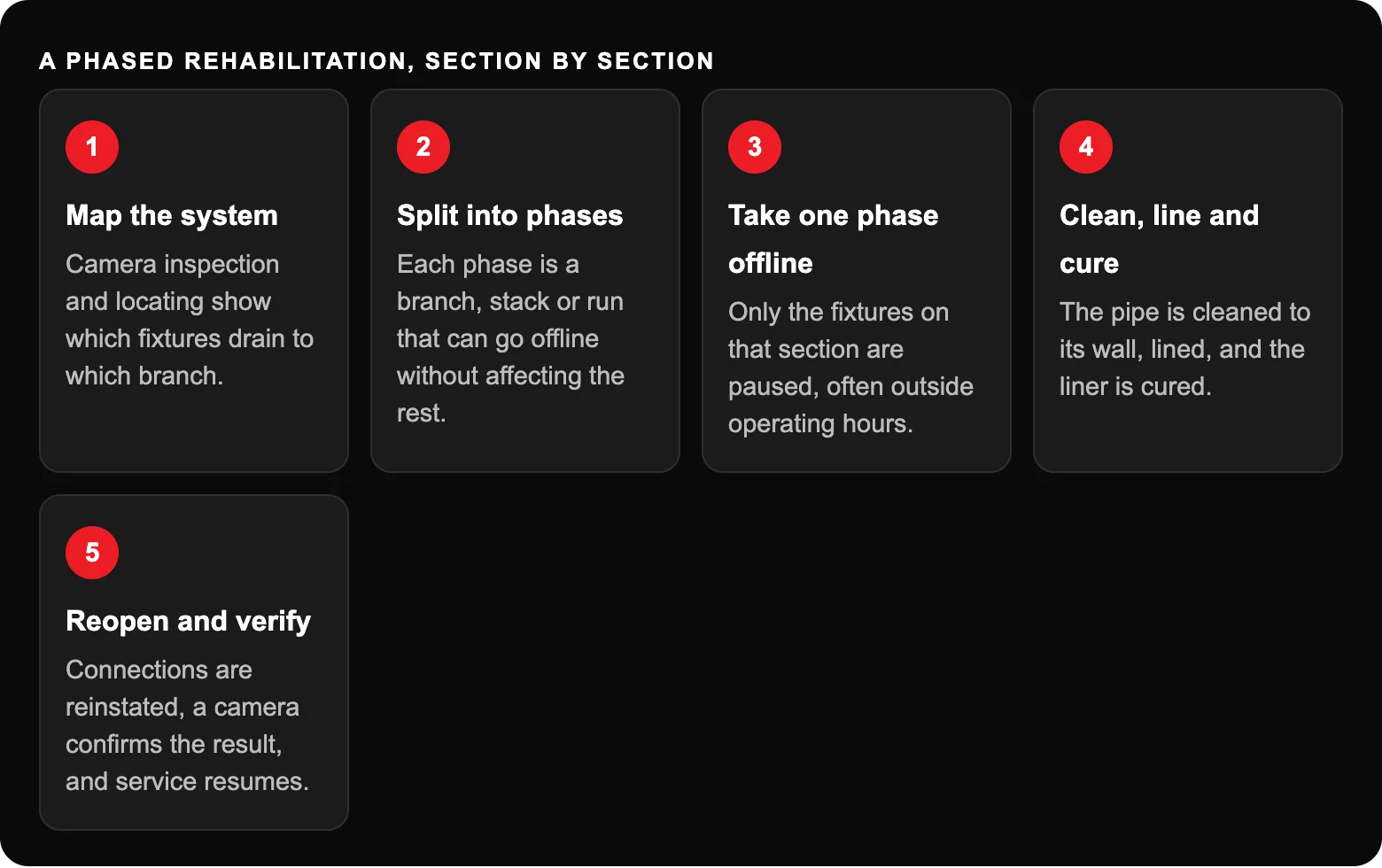
A building’s drain system is a tree: fixture branches feed stacks, stacks feed horizontal mains, and mains feed the building sewer. If you know the tree, you can take one limb offline at a time. That is why the first deliverable on a commercial job is a map, not a liner. A clear camera record and pipe locating and mapping tell everyone which restrooms, sinks and floor drains go quiet in each phase.
Phases are sized to fit a window. A small branch might be done between closing and opening. A long main serving an entire strip center may be split across several nights or a weekend. The goal is that no single phase outlasts the time the business can live without those fixtures.
Plan the calendar first
Give your contractor your hard constraints up front: inspection dates, peak seasons, events, move in days and school breaks. It is far easier to size phases around a known calendar than to squeeze work into gaps after the fact.
How the plan changes by property type
Every commercial building has a different tolerance for downtime. The table below summarizes the patterns we see most often on commercial pipe rehabilitation in El Paso.
| Property | Typical pipe problem | Scheduling approach |
|---|---|---|
| Restaurants | Grease buildup narrowing kitchen lines; corroded cast iron | Work after close; clean grease fully before lining |
| Retail centers | Shared mains serving several tenants | Phase by tenant group; coordinate notices with each tenant |
| Multifamily | Aging stacks serving stacked units | One stack at a time with advance resident notice |
| Schools | Heavy restroom use; long horizontal runs | Breaks, weekends and holidays |
| Offices and medical | Cast iron under slab and in walls | Evenings and weekends by floor or wing |
Restaurants: grease comes out first
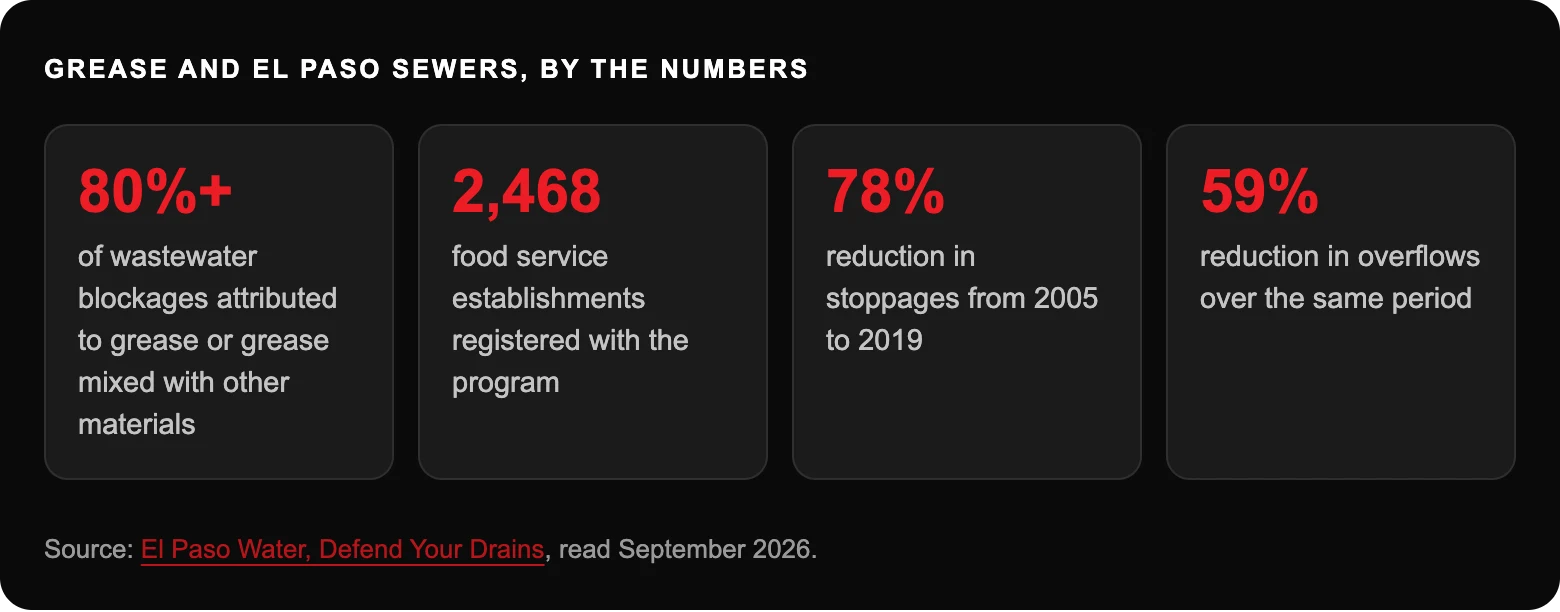
A liner cannot bond to a pipe coated in grease, so kitchen lines are thoroughly cleaned before anything else. El Paso Water takes grease seriously: its Fats, Oils and Grease program requires food service establishments to register and maintain grease recovery devices. Our post on preventing grease related backups covers the daily side.
Multifamily and mixed use: the stack is the unit
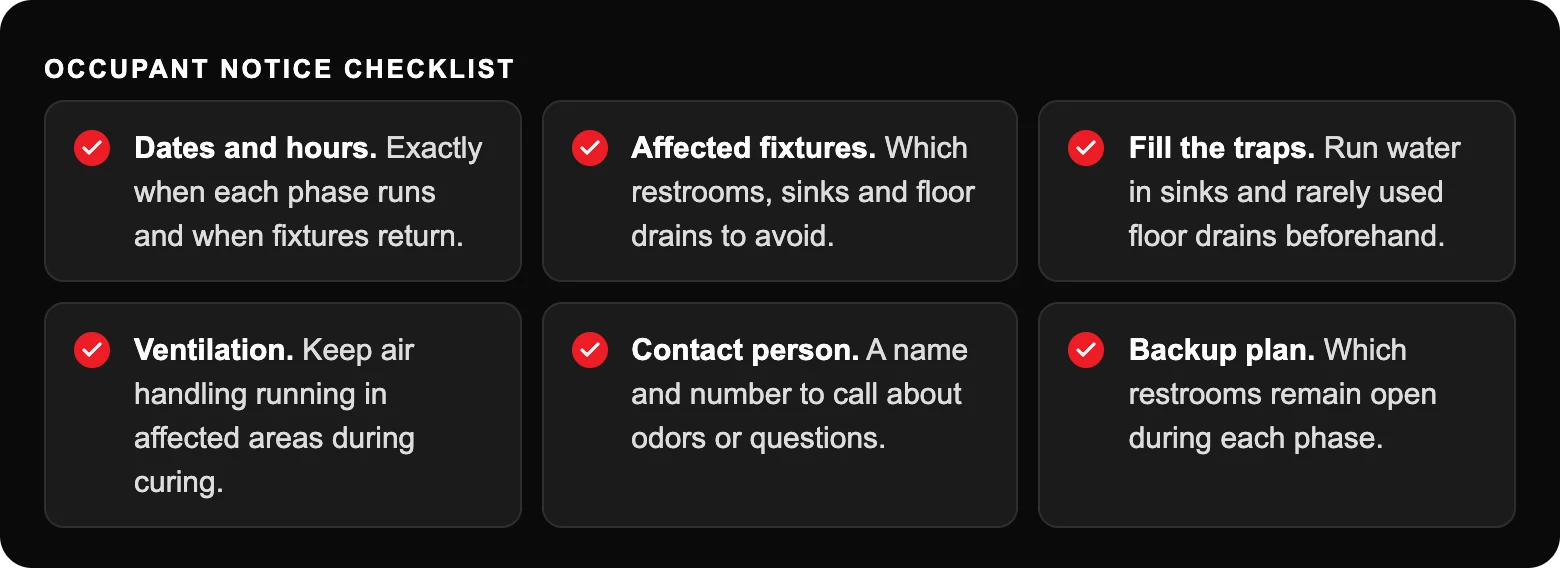
In apartment buildings, each stack typically serves the same kitchen or bath position on every floor. Rehabilitating one stack pauses only those units, and residents on other stacks carry on normally. Clear written notice, with the date, hours and which fixtures to avoid, prevents most of the complaints.
Pipe Rehabilitation in El Paso
Want a straight answer about your pipes?
Every U.T. Trenchless job starts with a camera inspection and a photo report, so you see the problem before you decide on a fix. Licensed Master Plumber Ubaldo Torres leads the work.
Keeping tenants and occupants comfortable
Disruption on a trenchless job is mostly about fixtures being unavailable for a few hours, plus some equipment noise at the access point. The other issue to plan for is odor. Some liner resins give off vapors while curing, and those can travel into a building through dry drain traps.
Keeping water in traps can reduce vapor migration into buildings.
That guidance comes from a California Department of Public Health CIPP safety alert, which also advises running water in sinks, covering floor drains, and giving occupants a contact number if they notice odors.
What drives commercial cost
Commercial pricing is quoted by scope, not a menu. For context, HomeAdvisor lists cured in place lining at $90 to $250 per foot nationally, and notes that trenching under a slab adds $300 to $350 per foot. Those are residential benchmarks. Commercial jobs vary more with pipe diameter, the number of branch connections to reopen, access, and how many phases the schedule requires.
Phasing can add mobilizations, but it usually costs far less than a closure or the demolition an open trench requires inside a finished building. The camera findings turn those variables into a real number.
When trenchless is not the right answer
Know the limits
A collapsed pipe, a section with a significant belly, or a line that is undersized for current use cannot be corrected by lining, because the liner follows the old pipe. Those sections may need pipe bursting or a targeted excavation.
Hybrid plans are common: excavate one failed point during a planned closure and line the rest in phases. Remember too that El Paso Water places responsibility for the sewer service line from the tap at the main into the property on the customer, so the building owner carries the private side. If you are unsure where your problems start, our guide to sewer flow monitoring for commercial properties explains how flow data can narrow it down.
What to do next
- Pull maintenance records: backup dates, fixtures and past repairs.
- Schedule a video camera inspection of the building drains and sewer to document condition.
- Ask for a phased plan listing each section, its affected fixtures and its expected downtime.
- Share your calendar constraints and tenant notice requirements before scheduling.
- Prepare occupant notices using the checklist above.
- Contact our team through the contact page or call 915.858.0166 to request service. Emergency service is available for backups and time sensitive commercial problems.
Questions El Paso property managers ask about commercial pipe rehabilitation
Can a restaurant stay open during pipe lining?
Often yes, if the kitchen lines are phased and worked after closing. The section being lined is out of service for the cleaning, lining and cure window, so the schedule is built around service hours. A thorough grease cleaning comes first because liners need a clean wall.
How long is each section out of service?
It depends on pipe length, diameter, number of connections and cure method. Smaller branches can often be handled within a single overnight window, while long mains may take more than one. Your contractor should give a downtime estimate for each phase before work begins.
Can cast iron under a commercial slab be lined?
In many cases yes, provided the pipe can be cleaned back to its wall and still holds its shape. Badly deteriorated sections may need a spot excavation first. Our guide to lining old cast iron pipes covers what the camera looks for.
Who pays when a tenant’s lines fail?
That is set by your lease, not the plumbing. Many commercial leases assign building sewers and shared mains to the landlord and fixtures to the tenant. Documented camera footage helps settle where a failure actually is.
Do apartment residents need to leave during lining?
Usually not. Residents on the affected stack avoid certain fixtures during the work window; others are unaffected. Filled traps and running ventilation limit curing odor.
Serving El Paso, Horizon City, Socorro and Las Cruces
Talk to a family owned trenchless team with 40+ years in the trade
Tell us what is going on and we will tell you what the camera shows, what your options are, and what we would do if it were our own property. Learn more about our pipe rehabilitation service.
Keep reading
Sources
- ASTM F1216, Rehabilitation of Existing Pipelines and Conduits by the Inversion and Curing of a Resin Impregnated Tube, ASTM International.
- Defend Your Drains: Fats, Oils and Grease, El Paso Water.
- CIPP Safety Alert: Vapor Migration Into Buildings, California Department of Public Health (hosted by Purdue University).
- How Much Does It Cost to Replace or Repair a Sewer Line?, HomeAdvisor.
- Customer Rights and Responsibilities, El Paso Water.