

Get our plumbing guides firstAdd U.T. Trenchless as a preferred source and see our posts more often in Google Top Stories.
Add as a preferred source on GoogleYes. Many under slab drain lines can be repaired without jackhammering by lining them from an existing cleanout, forming a new pipe inside the old one. Under slab drain repair in El Paso works this way when the pipe still holds its shape. Collapsed or badly sagging sections may still need tunneling or a small, targeted floor opening.
Most El Paso homes, and a large share of the city’s commercial buildings, sit on concrete slabs with the drain lines cast beneath them. When one of those lines cracks or separates, the traditional fix meant cutting a trench through tile, cabinets and concrete, then patching everything afterward.
This guide compares the three ways to reach a drain under a slab, what national cost data shows for each, why local soils make these failures common, and how to tell which approach fits your floor.
What’s in this guide
Three ways to reach a drain under a slab
There are only three routes to a pipe buried under concrete: go through the floor, go under the floor, or go inside the pipe. Each has a place, and the camera footage decides which one fits.
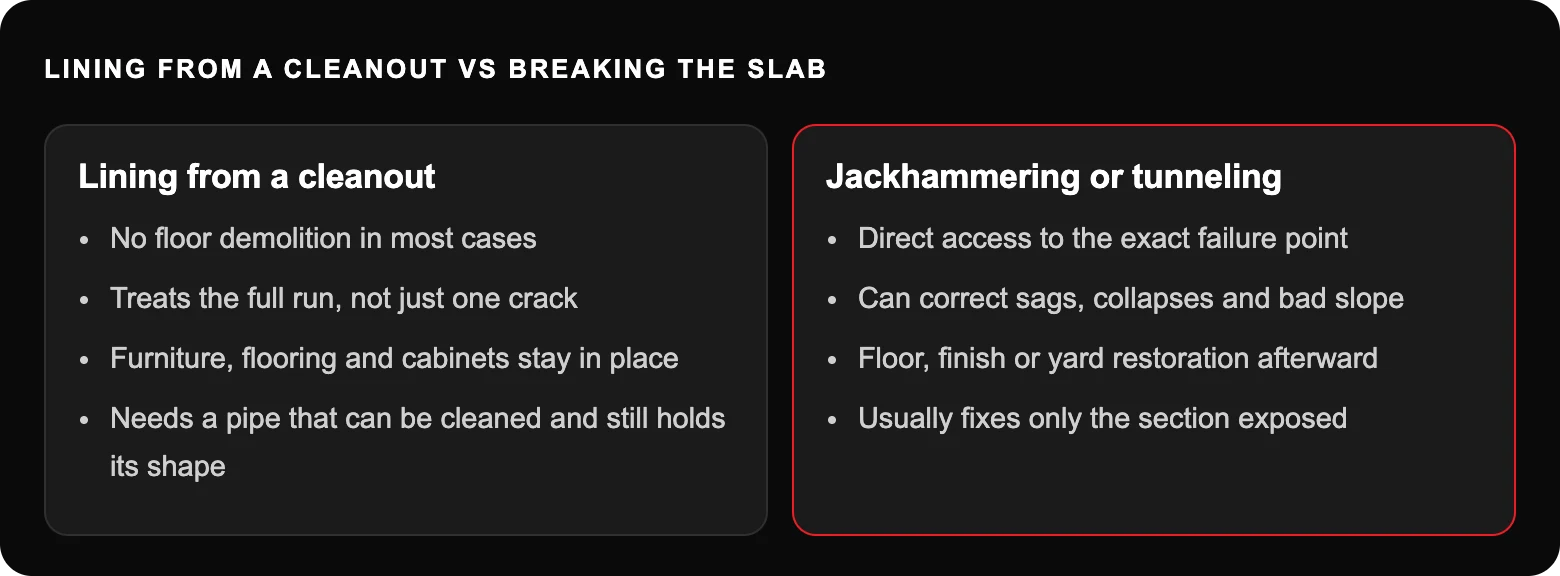
Through the floor: jackhammering
A trench is cut through the slab above the pipe, the damaged section is replaced, and the concrete and flooring are restored. It gives total access and can correct slope problems, but it is loud, dusty, and displaces whoever uses that room.
Under the floor: tunneling
Crews dig a tunnel from outside the foundation and work beneath the slab, leaving interior floors alone. It avoids demolition indoors, but it means substantial excavation next to the house, and the tunnel must be backfilled and compacted properly so the slab keeps its support.
Inside the pipe: lining
The line is cleaned, inspected, and a resin saturated liner is installed from a cleanout and cured to form a jointless pipe within the old one. The inversion method follows ASTM F1216, which applies to pipes from 2 to 108 inches in diameter, a range that includes typical residential drains. Our pipe rehabilitation service is built around this approach.
What each method costs nationally
National cost guides give a useful sense of scale. Fixr’s slab leak repair guide lists lining at $500 to $2,000, breaking the slab at $500 to $3,000, tunnels at $900 to $2,000, and rerouting at $4,000 to $15,000. Those figures cover slab leaks broadly, including water lines, and they typically exclude restoring the floor above.

Restoration is where jackhammering gets expensive. HomeAdvisor notes trenching under a slab adds $300 to $350 per foot to sewer work, before tile, cabinets or flooring are replaced. El Paso pricing depends on pipe length, diameter, the number of branch connections and what the camera finds.
Why drains rarely get rerouted
Rerouting is common for pressurized water lines, which can run through walls or an attic. Drain lines depend on gravity and a steady downward slope, so moving them overhead is rarely practical. For drains, the real choice is usually between lining and opening the floor.
Why El Paso slabs are hard on drain lines
Soil movement is a big part of the story. The Arizona Geological Survey, describing desert Southwest soils much like ours, explains that expansive clay swells when a monsoon storm soaks it and lists ruptured pipelines and cracked floor slabs among the results. It also notes that expansive soils cause more damage to U.S. homes each year than floods, tornadoes and hurricanes combined.
A widely cited paper on foundation damage from expansive soils, hosted by Missouri University of Science and Technology, adds that shallow pipes buried in the zone of seasonal moisture change are exposed to enormous stresses. El Paso’s long dry spells followed by summer storms create exactly that wet and dry cycle.

Pipe Rehabilitation in El Paso
Want a straight answer about your pipes?
Every U.T. Trenchless job starts with a camera inspection and a photo report, so you see the problem before you decide on a fix. Licensed Master Plumber Ubaldo Torres leads the work.
Signs a drain under your slab is failing
Drain leaks under a slab are quieter than water line leaks because the pipe is not pressurized. The warning signs tend to build slowly.

None of these prove a broken pipe. A video camera inspection run from a cleanout shows the actual condition and pinpoints location and depth so any access, if needed, is as small as possible.
Which approach fits your floor
| Camera finding | Likely approach | Why |
|---|---|---|
| Cracks or separated joints, pipe round | Lining from a cleanout | The old pipe can host a new structural liner |
| Heavy scale in cast iron | Descaling, then lining | The liner needs a clean wall to bond |
| Root intrusion at joints | Root removal, then lining | A jointless liner removes entry points |
| Belly holding water | Targeted opening or tunnel | A liner follows the sag and cannot fix slope |
| Collapsed section | Targeted opening, then possibly lining | Nothing can pass a collapse until it is rebuilt |
When lining is the wrong call
If the line has lost its slope or collapsed, lining alone will not solve it. The honest plan may be one small opening to rebuild the failed section, then CIPP pipe repair for the rest of the run.
Cast iron is common under older El Paso slabs, and our guide on lining old cast iron pipes explains what makes it a good or poor candidate. If you are worried about capacity, see whether relining reduces flow.
What to do next
- Note which fixtures back up or drain slowly, and whether symptoms worsen after rain.
- Find your cleanouts, often outside near the foundation or inside near a bathroom or laundry.
- Schedule a camera inspection and ask for the photo report with distances marked.
- Ask whether lining, descaling or a targeted opening fits each problem, and why.
- Request service through our contact page or call 915.858.0166 to talk with the crew that will do the work.
Questions El Paso homeowners ask about under slab drain repair
Does homeowners insurance pay for a broken drain under the slab?
It depends on the policy and the cause. Many policies treat gradual wear differently from sudden damage, and some cover access and floor repair but not the pipe itself. Read your policy and call your agent. Our post on relining and insurance in Texas covers common questions.
Can I stay in the house while an under slab drain is lined?
Usually yes. The drains on that line are out of service during cleaning, lining and curing, but there is typically no floor demolition and no need to move out. You will be told which fixtures to avoid and when.
Is a slab leak the same as a broken drain under the slab?
Not quite. “Slab leak” usually means a pressurized water supply line leaking under the floor, which often shows up as a higher water bill or warm spots. A broken drain line leaks only when water flows, so it shows up as odors, clogs or dampness instead.
Can a broken drain under my slab damage the foundation?
Water escaping under a slab changes soil moisture, and expansive clay swells when wet. Over time that can contribute to movement and cracking. Finding and fixing a leaking drain early limits how much water reaches the soil.
Who is responsible for the sewer line under my house in El Paso?
El Paso Water places responsibility for the sewer service line from the tap at the main into the property on the customer. Drains under your slab are private plumbing, so repairs are the owner’s responsibility.
Serving El Paso, Horizon City, Socorro and Las Cruces
Talk to a family owned trenchless team with 40+ years in the trade
Tell us what is going on and we will tell you what the camera shows, what your options are, and what we would do if it were our own property. Learn more about our pipe rehabilitation service.
Keep reading
Sources
- How Much Does It Cost to Repair a Slab Leak?, Fixr.
- How Much Does It Cost to Replace or Repair a Sewer Line?, HomeAdvisor.
- ASTM F1216, Rehabilitation of Existing Pipelines and Conduits by the Inversion and Curing of a Resin Impregnated Tube, ASTM International.
- Problem Soils, Arizona Geological Survey, University of Arizona.
- Damage to Foundations From Expansive Soils, J. David Rogers, Robert Olshansky and Robert B. Rogers, Missouri University of Science and Technology.
- Customer Rights and Responsibilities, El Paso Water.