Get our plumbing guides firstAdd U.T. Trenchless as a preferred source and see our posts more often in Google Top Stories.
Add as a preferred source on GoogleRestaurants in El Paso prevent grease related sewer backups by keeping fats, oils and grease out of drains, having the grease trap or interceptor fully pumped at least every 90 days (sooner once grease and solids reach 25% of its wetted height), never using enzymes or emulsifiers, keeping manifests and a maintenance log, and jetting the building’s own drain lines on a schedule.
A grease backup during a Friday dinner rush means closed stations, lost sales and possibly a visit from the utility. It is also one of the most preventable problems a commercial kitchen has.
This guide is for restaurant owners, kitchen managers and property managers of food service buildings. It explains what El Paso Water’s grease rules require, where backups actually start, and a maintenance routine that keeps restaurant grease out of El Paso sewers and out of your dining room.
What’s in this guide
- The short answer: manage the trap, the kitchen and the pipes
- What El Paso Water’s grease rules require
- Where restaurant backups actually start
- Kitchen habits that keep grease out of the drain
- A maintenance schedule that prevents backups
- When grease has already damaged the pipe
- What to do next
- Questions El Paso restaurant owners ask about grease and sewer backups
- Keep reading
The short answer: manage the trap, the kitchen and the pipes
Grease backups have three causes working together. Grease gets into drains during prep and dishwashing. The trap or interceptor fills past the point where it can separate grease. And the pipe between your fixtures and the trap slowly coats with grease that hardens.
A trap pumping contract handles the second problem only. Preventing backups takes all three: kitchen habits, pumping on the required schedule, and periodic cleaning of the building’s drain lines.
What El Paso Water’s grease rules require
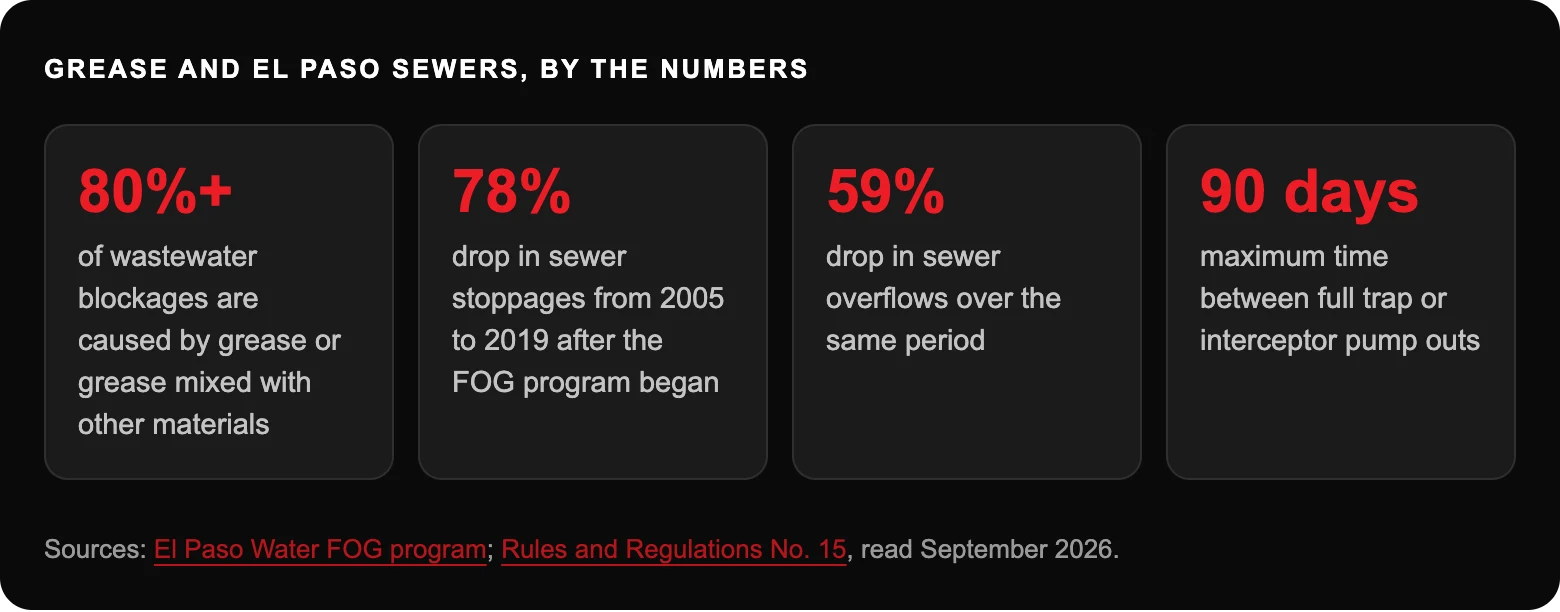
El Paso Water regulates grease through Rules and Regulations No. 15, Fats, Oils and Greases. It applies to food service establishments, which the rule defines broadly: restaurants, food manufacturers and processors, hospitals, schools, hotels, prisons and nursing homes. Limited exemptions exist for places serving only prepackaged food, drinks or snow cones, or bars without food preparation.
| Requirement | What the rule says | Section |
|---|---|---|
| Registration | Obtain a Certificate of Registration and display it; it cannot be transferred to a new owner | VII |
| Pumping frequency | Completely evacuate the trap or interceptor at least every 90 days, sooner if grease and solids reach 25% of wetted height | IV.D |
| Treatment products | Enzymes, surfactants, solvents and emulsifiers are prohibited | IV.E |
| Manifests | Grease waste may leave only with a utility issued manifest; generators keep copies for three years | VI |
| Logbook | Keep a bound logbook with the date and time of all cleaning and maintenance | VIII.B |
| Inspections | The utility may inspect and sample without advance notice | IX |
The enzyme ban surprises people
Products sold as grease eaters are popular because they seem to make the trap look cleaner. The rule is blunt about them:
“Use of alternative treatment products designed to digest and/or emulsify grease is prohibited.”
That language is from Section IV.E of Rule 15. The reason is practical: emulsified grease does not disappear. It passes through the trap and solidifies again farther down the line, often in the public sewer.
Where restaurant backups actually start
Most owners picture the grease trap as the weak point. In our experience the trap is often fine, and the clog sits in the pipe upstream of it, between the three compartment sink, dish machine and floor drains and the trap inlet.
That section carries hot, greasy water that cools as it travels. Grease sticks to the pipe wall and builds in layers until the opening is a fraction of its original size. Older buildings with cast iron drains add rough scale for the grease to grab.
Snaking pokes a hole through that buildup and restores flow for a few weeks. Hydro jetting scrubs the full pipe wall clean, which is why it is the standard method for commercial kitchen lines. Our comparison of hydro jetting versus snaking explains the difference in detail.
Hot water is not a fix
Running hot water or boiling water down a greasy drain only moves the grease a little farther before it cools and hardens again, often somewhere harder to reach.
Sewer Cleaning in El Paso
Want a straight answer about your pipes?
Every U.T. Trenchless job starts with a camera inspection and a photo report, so you see the problem before you decide on a fix. Licensed Master Plumber Ubaldo Torres leads the work.
Kitchen habits that keep grease out of the drain

El Paso Water offers a FOG training session on the third Friday of every month, 10:00 AM to 11:00 AM, at the International Water Quality Laboratory, 4100 Delta Drive. Details are on its commercial FOG page.
A maintenance schedule that prevents backups
Rule 15 sets the minimum for the trap. The drain lines are up to you, and the right interval depends on menu, volume and pipe condition. A high volume fryer operation needs attention more often than a sandwich shop.
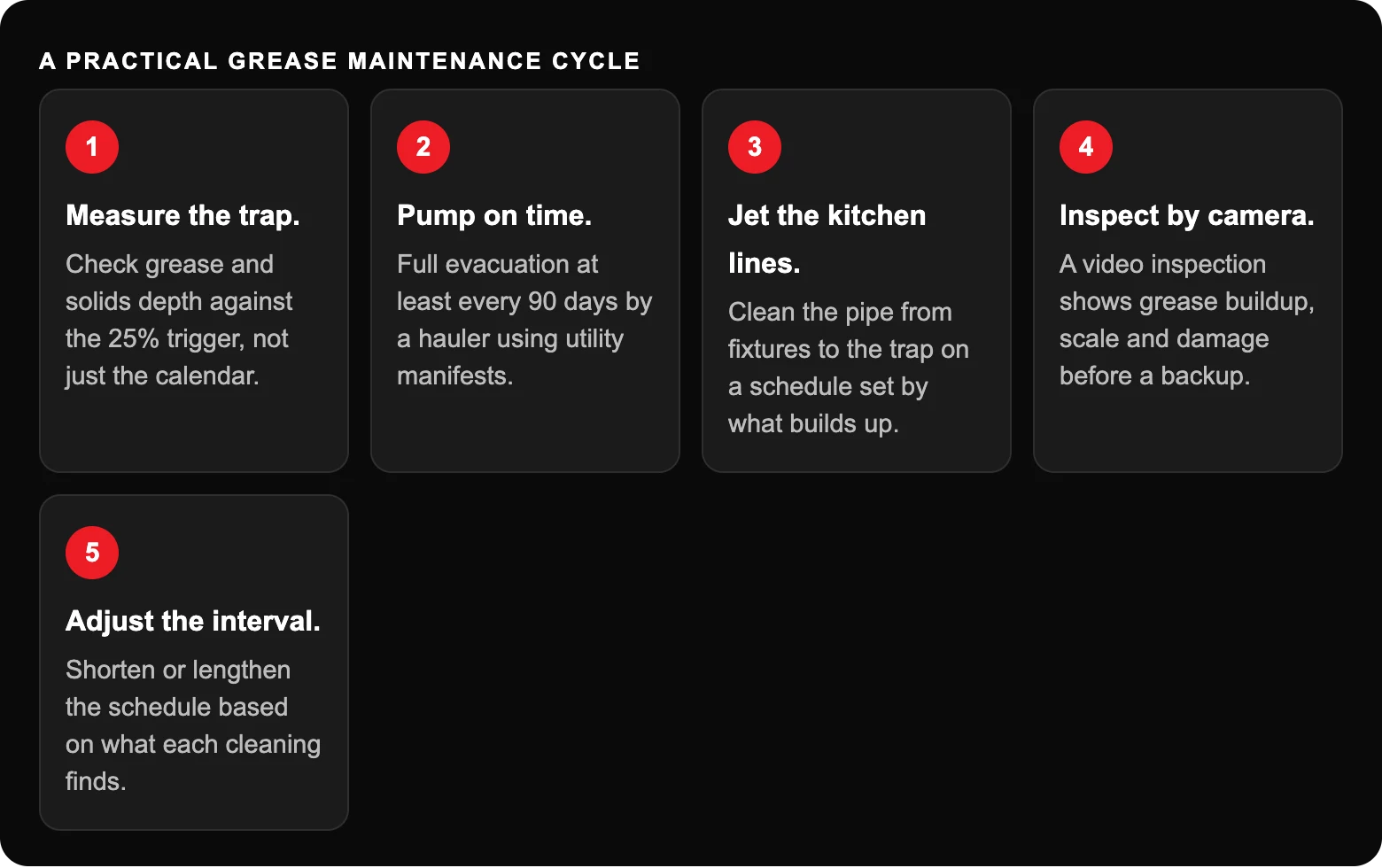
Our commercial sewer cleaning visits start with a high resolution video camera inspection and a photo report, so the schedule is based on the pipe you have. Where a building shares lines among tenants, dye testing and flow monitoring can show which unit a grease problem is coming from.
When grease has already damaged the pipe
Years of grease and hot, acidic kitchen waste can corrode old cast iron until cleaning alone stops working. If the camera shows heavy scale, cracks or sections losing their shape, repair is the next conversation.
Trenchless lining can often restore a kitchen line without breaking up the floor, but it is not the answer for every pipe, such as a badly sagged section that needs regrading. We cover options for keeping a business open during repairs in how commercial properties rehabilitate aging pipes.
What to do next
- Confirm your Certificate of Registration is current and displayed, especially after an ownership change.
- Pull your logbook and manifests and check the last pump out date.
- Remove any enzyme or emulsifier products from the kitchen.
- Sign new staff up for El Paso Water’s monthly FOG training.
- Schedule jetting and a camera inspection of the kitchen lines. Request service or call 915.858.0166.
Questions El Paso restaurant owners ask about grease and sewer backups
What is the difference between a grease trap and a grease interceptor?
Both slow wastewater so grease floats and solids settle. A grease trap is usually a smaller unit under or near a sink inside the kitchen. An interceptor is a larger tank, typically buried outside, serving the whole kitchen. Rule 15’s pumping and record rules apply to both.
Can a new owner keep using the old owner’s grease registration?
No. Rule 15 says the Certificate of Registration cannot be transferred or sold to a new owner under any circumstances. A change of ownership means a new registration with El Paso Water.
Can our grease hauler return the separated water to the trap?
No. Rule 15 prohibits mobile processing vehicles from returning separated water to the interceptor or the sewer, and bars putting any liquid or solids back into a trap after service.
Can we go longer than 90 days between pump outs?
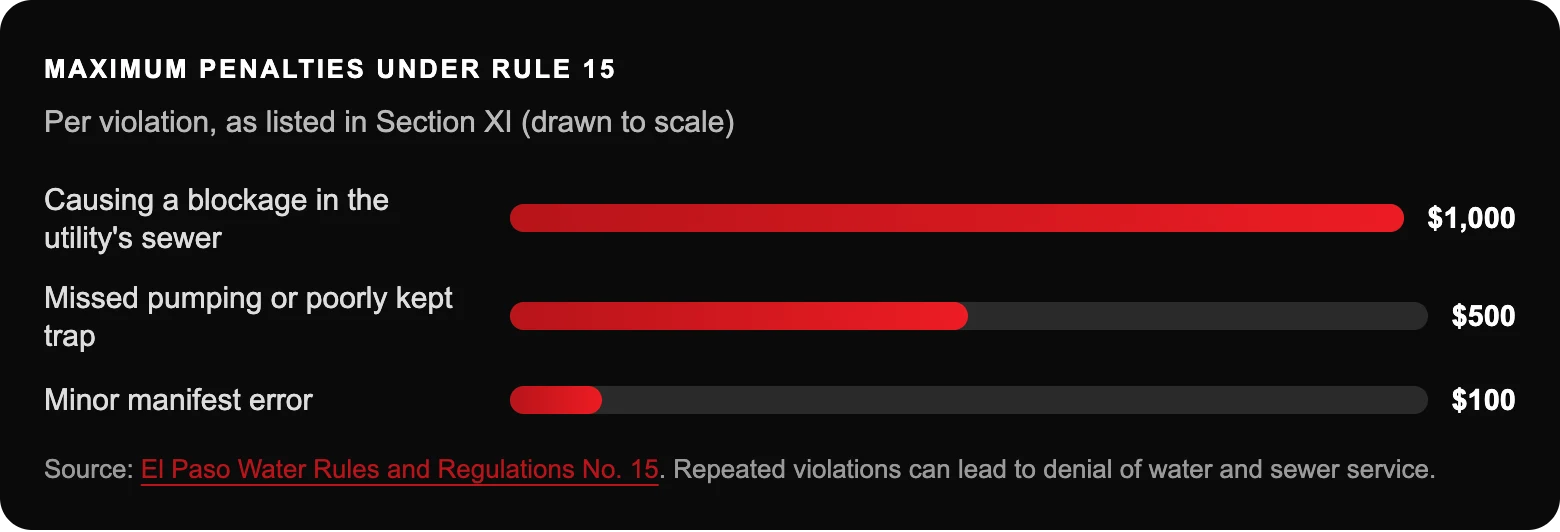
Rule 15 allows written exemption requests. Even with an approved exemption, the trap or interceptor must be fully evacuated, cleaned and inspected at least once every 180 days.
Who do we call with questions about the FOG program?
El Paso Water lists its Industrial Pretreatment Program at 915.594.5729 on its FOG page. For drain line cleaning or camera inspection, call a licensed plumber.
Serving El Paso, Horizon City, Socorro and Las Cruces
Talk to a family owned trenchless team with 40+ years in the trade
Tell us what is going on and we will tell you what the camera shows, what your options are, and what we would do if it were our own property. Learn more about our sewer cleaning service.
Keep reading
Sources
- Rules and Regulations No. 15, Fats, Oils and Greases, El Paso Water.
- FOG (Fats, Oils and Grease), El Paso Water.
- Commercial FOG Program, El Paso Water.
- National Pretreatment Program, U.S. Environmental Protection Agency.