Get our plumbing guides firstAdd U.T. Trenchless as a preferred source and see our posts more often in Google Top Stories.
Add as a preferred source on GooglePipe rehabilitation restores the structure of an existing sewer or drain line along its whole length, usually by lining it from the inside, so the old pipe keeps working without being dug up. Pipe repair fixes one defect at one spot. In El Paso, the camera decides which you need: one break means repair, a line failing everywhere means rehabilitation.
Plumbers often use both words in one sentence, but the difference changes the price, the disruption and how long the fix lasts.
Below: what each term covers, the methods under rehabilitation, national cost data, and how we decide on El Paso properties, where many older homes still drain through cast iron or clay laterals.
What’s in this guide
- The short answer: scope is the difference
- What counts as pipe rehabilitation
- How the camera decides between repair and rehabilitation
- What national cost data says
- When rehabilitation is not the right call
- Why the question comes up so often in El Paso
- What to do next
- Questions El Paso homeowners ask about pipe rehabilitation
- Keep reading
The short answer: scope is the difference
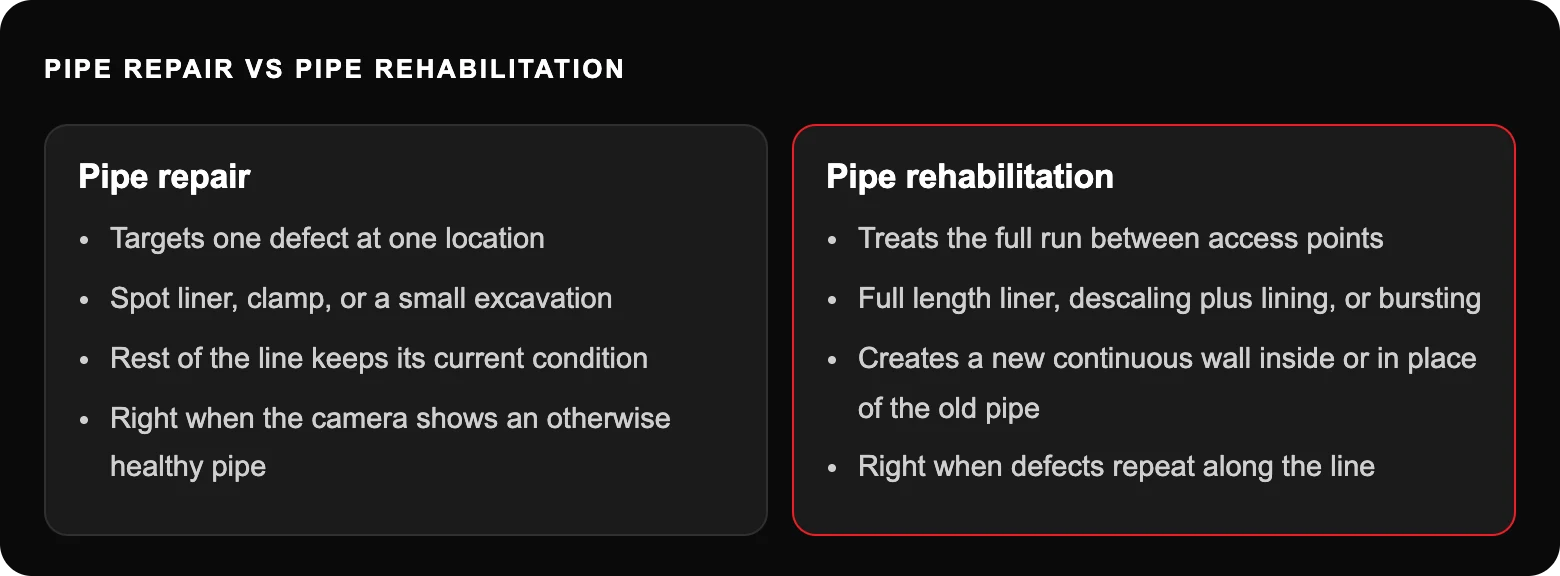
Think of repair as treating a symptom and rehabilitation as treating the whole pipe. A repair addresses a single cracked joint, one offset or one root intrusion point. Rehabilitation assumes the pipe as a whole has aged past its useful life and gives it a new structural wall from access point to access point.
A widely read industry article in Trenchless Technology describes rehabilitation as restoring the structural integrity of an existing pipeline, while replacement means removing the old pipe and installing a brand new one. Repair sits below both: it restores one location and leaves the rest of the line as it was.
What counts as pipe rehabilitation
Rehabilitation is an umbrella term. Our pipe rehabilitation projects use one of three approaches, chosen after the inspection shows how much original pipe is still sound.
Full length lining
A resin saturated liner is pulled or inverted through the old pipe and cured in place, forming a jointless pipe within a pipe. The recognized standard for the inversion method is ASTM F1216, which covers pipes from 2 to 108 inches in diameter used for sanitary sewers, storm sewers and process piping. Our CIPP pipe repair page covers that process in detail.
Cleaning and descaling first
Cast iron that has closed down with scale and tuberculation cannot be lined until it is cleaned back to the pipe wall. Descaling is often the first half of a rehabilitation job, and sometimes the camera shows that descaling alone buys the pipe years.
Pipe bursting
When the old pipe is too broken or too small to line, a new pipe is pulled through the path of the old one as it is fractured outward. Strictly, that is trenchless replacement, but it solves the same whole line problem.
| Factor | Spot repair | Rehabilitation | Full replacement |
|---|---|---|---|
| What it fixes | One defect | The entire run | The entire run |
| Old pipe | Stays, mostly untouched | Stays as a host for the liner | Removed or burst |
| Digging | None to one small pit | Usually access points only | Trench, or pits for bursting |
| Best fit | Isolated crack, offset or root entry | Aging pipe with repeat defects | Collapsed, badly sagged or undersized pipe |
| Main risk | Next weak spot fails soon | Needs a line that can be cleaned and accessed | Most cost and surface disruption |
How the camera decides between repair and rehabilitation
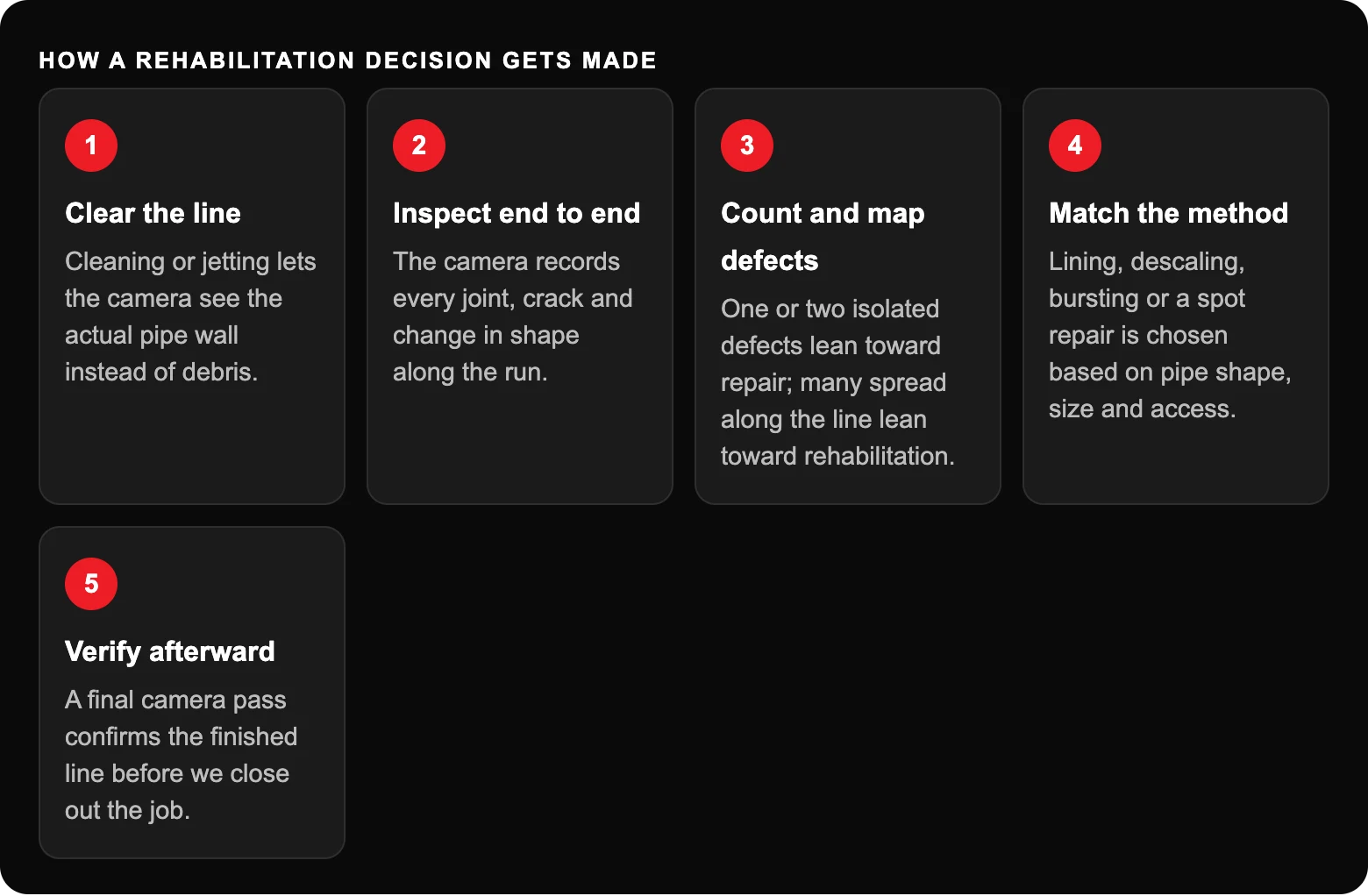
Every job we take starts with a high resolution video camera inspection, and the findings go into a photo report before anyone recommends a fix. The question we are answering on that screen is simple: is this one bad spot in a good pipe, or one visible symptom of a pipe that is worn out everywhere?
One root intrusion in otherwise smooth pipe points to repair. Heavy scale every few feet, cracks at multiple joints, flaking walls in cast iron or a string of offset clay joints points to rehabilitation. You can read more about interpreting that footage in our guide on what a sewer camera inspection shows.
A useful rule of thumb
If the report shows more than a couple of structural defects in one run, pricing several spot repairs usually gets close to the cost of rehabilitating the whole line, without the benefit of a continuous new wall.
Pipe Rehabilitation in El Paso
Want a straight answer about your pipes?
Every U.T. Trenchless job starts with a camera inspection and a photo report, so you see the problem before you decide on a fix. Licensed Master Plumber Ubaldo Torres leads the work.
What national cost data says
Price is where the repair versus rehabilitation choice gets real. HomeAdvisor reports that most homeowners spend between $1,388 and $5,323 on sewer line work, and it lists lining and bursting on a per foot basis. Those are national figures; El Paso pricing depends on length, depth, pipe size, access and what the camera actually finds.
| Approach | Typical national range |
|---|---|
| Sewer line work overall | $1,388 to $5,323 |
| Cured in place pipe lining | $90 to $250 per foot |
| Pipe bursting | $60 to $200 per foot |
| Trenching under a slab | An additional $300 to $350 per foot |
| Video inspection | $100 to $500 |
The takeaway: one spot repair is cheaper today, but once a pipe has several problems, rehabilitation is often cheaper per year of service.
When rehabilitation is not the right call
Trenchless rehabilitation is a strong tool, not a universal one. We will tell you when it does not fit.
Situations where lining falls short
A fully collapsed section, a belly that holds standing water, a line that is too small for the building it serves, or a pipe that cannot be cleaned back to its wall are poor lining candidates. A liner follows the host pipe, so it cannot correct a sag or add capacity.
Then the honest answers are bursting, excavating the bad section, or a hybrid: dig one collapsed point and line the rest.
Why the question comes up so often in El Paso
Many homes in central and east El Paso were built with cast iron drains or clay sewer laterals that are now decades old. Cast iron scales from the inside, which hard water encourages, and clay joints loosen and let roots in. Both fail in many places at once, the exact profile rehabilitation is built for.
Ownership matters too. El Paso Water states that the customer is responsible for the sewer service line from the tap at the main into the property. The utility will not rehabilitate your lateral for you, so the decision and the budget are yours.
What to do next
- Note symptoms: slow drains, gurgling, backups, odors or recurring root clogs.
- Schedule a video camera inspection so the decision is based on footage, not guesses.
- Ask for the photo report and have each defect pointed out, with its location and distance from the cleanout.
- Compare fixing each defect separately against rehabilitating the full run.
- Reach out through our contact page or call 915.858.0166 to talk with the crew that will do the work.
Questions El Paso homeowners ask about pipe rehabilitation
Is pipe relining the same as pipe rehabilitation?
Relining is one method of rehabilitation, and the most common one for residential sewer laterals. Rehabilitation is the broader category, which also includes descaling that restores a pipe’s interior and, in many discussions, trenchless replacement methods like bursting. If someone quotes rehabilitation, ask which specific method they mean.
How long does a rehabilitated pipe last?
Service life depends on the method, the resin and liner system, installation quality and what flows through the pipe. Liners are designed as long term structural pipes, not temporary patches. Ask for the design life of the specific system proposed and how the installer verifies a proper cure. Our guide on how long CIPP lining lasts goes deeper.
Can a spot repair be done with a liner?
Yes. Short sectional liners can seal a single crack or joint without lining the entire line. That is a repair, not a rehabilitation, and it makes sense only when the camera shows the rest of the pipe is in good shape.
Should I rehabilitate before selling a house?
Not automatically. Start with an inspection so you know the condition. Buyers often ask for sewer footage, and a documented, recently rehabilitated line can remove a negotiating point. A healthy line needs nothing.
Is rehabilitation cheaper than digging up the pipe?
Often, especially under driveways, landscaping or slabs, because only access points are opened. It is not cheaper when the pipe must be excavated anyway to fix a collapse, so the camera footage drives the comparison.
Serving El Paso, Horizon City, Socorro and Las Cruces
Talk to a family owned trenchless team with 40+ years in the trade
Tell us what is going on and we will tell you what the camera shows, what your options are, and what we would do if it were our own property. Learn more about our pipe rehabilitation service.
Keep reading
Sources
- How to Develop a Cost Benefit Analysis: Pipeline Rehabilitation vs. Replacement, Trenchless Technology.
- ASTM F1216, Rehabilitation of Existing Pipelines and Conduits by the Inversion and Curing of a Resin Impregnated Tube, ASTM International.
- How Much Does It Cost to Replace or Repair a Sewer Line?, HomeAdvisor.
- Customer Rights and Responsibilities, El Paso Water.