
Get our plumbing guides firstAdd U.T. Trenchless as a preferred source and see our posts more often in Google Top Stories.
Add as a preferred source on GoogleYes, pipe relining makes the inside of your pipe slightly smaller, usually by a few millimeters of wall thickness. But in most El Paso sewer laterals it does not meaningfully reduce flow, because the new liner is far smoother than old clay or cast iron. In many cases a relined pipe carries as much as it did new, or more.
This is the most common objection we hear when a homeowner learns their sewer line can be relined instead of dug up. Put a pipe inside a pipe and you lose space. The worry is fair, and the answer depends on pipe size, liner thickness and what the old pipe looks like inside today.
Below we walk through the hydraulics in plain language, show the numbers for a typical 4 inch line, and flag the cases where the diameter loss does matter. If you are weighing pipe relining in El Paso for a clay or cast iron lateral, this is the math behind the recommendation.
What’s in this guide
- The short answer: smaller inside, but not slower
- How Manning’s roughness coefficient decides the outcome
- The numbers for a 4 inch El Paso sewer line
- Why most households never notice a difference
- When the diameter loss does matter
- Pipe relining in El Paso: getting the best flow result
- What to do next
- Questions El Paso homeowners ask about relined pipe flow
- Keep reading
The short answer: smaller inside, but not slower
A cured in place liner is a resin soaked tube that hardens against the walls of the host pipe. That new wall has thickness, so the finished inside diameter shrinks. On a 4 inch line with a liner wall of roughly 3 millimeters, the opening drops to about 3.76 inches.
Flow, though, is not only about the size of the hole. It is also about friction. Water in a rough, scaled, jointed pipe drags against the walls; water in a continuous, glassy liner has much less to fight. That trade between a smaller opening and a smoother wall is the whole story.
How Manning’s roughness coefficient decides the outcome
Gravity sewers are sized with the Manning equation, which uses a roughness value called Manning’s n. The smoother the surface, the lower the number, and the more water a pipe of a given size can carry. As a Stormwater magazine feature on pipes and liners put it, the smoother the surface, “the lower the coefficient, and the greater the pipe’s or liner’s hydraulic capacity.”
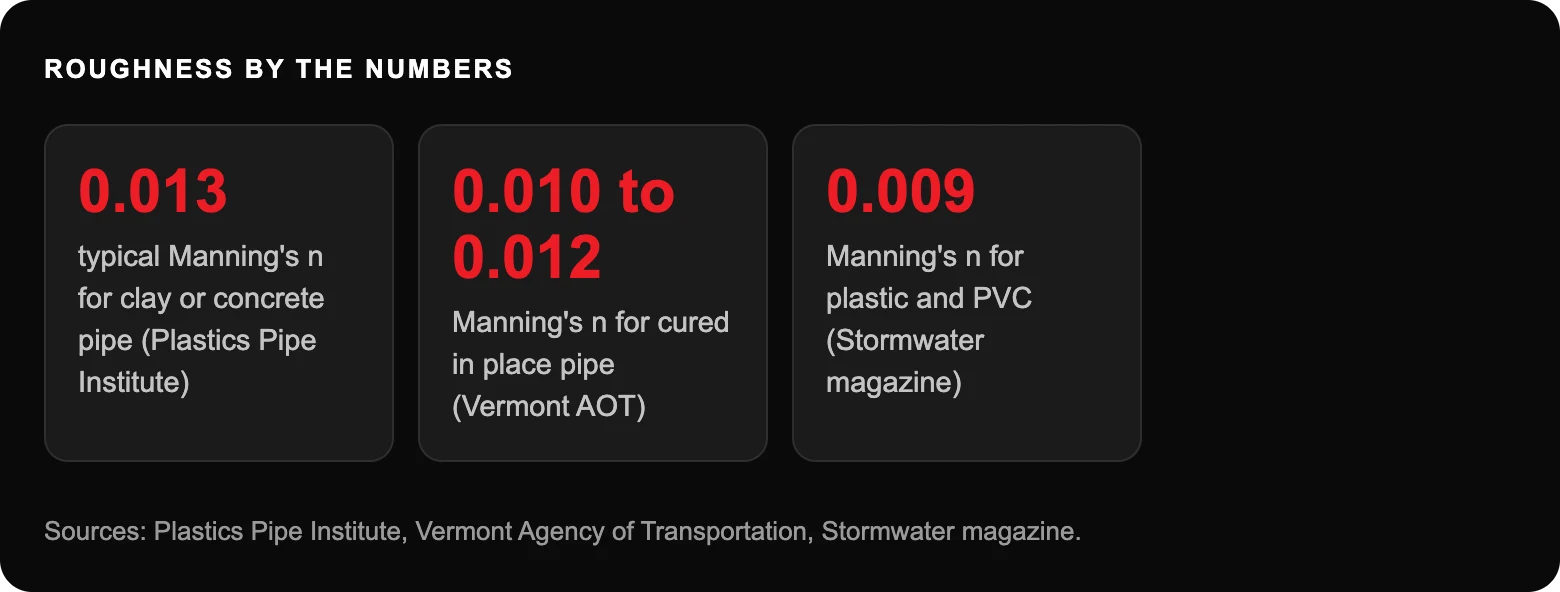
Published values tell the story. The Plastics Pipe Institute design guidance gives clay and concrete an n of 0.012 to 0.015, averaging about 0.013. A Vermont Agency of Transportation research report lists cured in place pipe at 0.010 to 0.012.
“The difference in Manning coefficient makes it possible for the CIPP to have a larger flow capacity than the previously existing pipe, despite the fact that it has a smaller diameter.”
That line comes from the Vermont report on culverts relined with cured in place pipe. The physics is the same in a house lateral.
The numbers for a 4 inch El Paso sewer line
Most El Paso homes drain through a 4 inch lateral. In the Manning equation for a full pipe, capacity scales with diameter to the 8/3 power, divided by n. We compared clean clay at n 0.013 against liners of different thicknesses at both ends of the published range for cured in place pipe.
| Liner wall (approx.) | Finished inside diameter | Open area kept | Capacity at n 0.010 | Capacity at n 0.012 |
|---|---|---|---|---|
| 3 mm | 3.76 in | 89% | 111% | 92% |
| 4.5 mm | 3.65 in | 83% | 102% | 85% |
| 6 mm | 3.53 in | 78% | 93% | 78% |
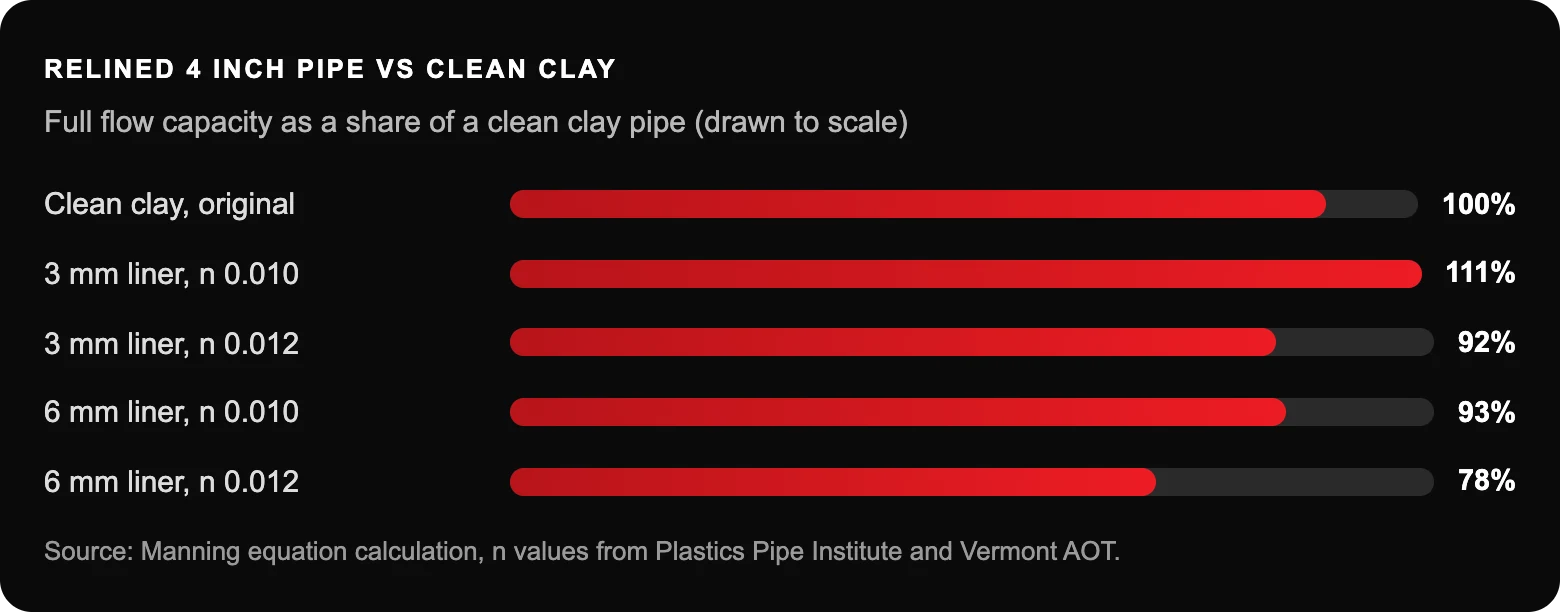
Two takeaways. A thin, well installed liner roughly breaks even with brand new clay and can beat it. And the comparison is generous to the old pipe, because it assumes clean, round clay. Yours probably is not.
Your old pipe is not performing at its rated number
A 60 year old lateral in central or east El Paso rarely behaves like new clay. Offset joints catch paper and roots narrow the opening. Cast iron grows scale inside, which our hard water does not help, leaving the real opening under 4 inches and the wall far rougher than any textbook value. Against that pipe, the relined version usually flows better.
What the camera tells us
Every job we do starts with a high resolution video camera inspection and a photo report. That footage shows whether the pipe is scaled, offset or root bound today, which is the real baseline the liner is competing against.
Pipe Relining in El Paso
Want a straight answer about your pipes?
Every U.T. Trenchless job starts with a camera inspection and a photo report, so you see the problem before you decide on a fix. Licensed Master Plumber Ubaldo Torres leads the work.
Why most households never notice a difference
Capacity figures assume a pipe flowing full. A house lateral almost never does. Fixtures send short surges, and most of the time the pipe carries a shallow stream along the bottom. There, a slick floor with no joints or ledges keeps solids moving, exactly where old pipes snag.
That is also why relined lines tend to clog less. For how long that surface holds up, see our guide on how long CIPP lining really lasts. NASSCO, the trade association for sewer rehabilitation, states that a properly designed, installed and tested lateral liner has a minimum life expectancy of 50 years.
When the diameter loss does matter
Relining is not the right answer for every line, and we will tell you when it is not. The diameter loss becomes a real concern in a few cases:
- Very small lines. On 2 inch branch drains, a few millimeters is a bigger share of the opening. ASTM F1216 covers pipes from 2 to 108 inches, but small sizes need careful design.
- Lines already undersized. A commercial kitchen or a home with added bathrooms may already be pushing a 4 inch line.
- Heavily damaged pipe. A badly deteriorated host may need a thicker structural liner, the bottom rows of the table.
- Bellies and collapses. A liner follows the host pipe. It will not fix a sag, and it cannot pass a crushed section.
In those situations, pipe bursting can replace the line at the same size or larger without an open trench. Our comparison of pipe bursting vs pipe lining covers how to choose.
Do not skip the prep
A liner is only as smooth as the pipe it is set against allows. Heavy scale or roots left in place telegraph through as bumps. Proper cleaning, and for cast iron often pipe descaling first, is part of getting the flow numbers above.
Pipe relining in El Paso: getting the best flow result
For pipe relining in El Paso, a few details decide how well the finished line flows. Ask how the liner thickness is chosen, how the pipe will be cleaned first, and how branch connections will be reopened. Ask for camera footage before and after.
Cast iron is a special case because of internal scale. Our article on whether CIPP lining can fix old cast iron goes deeper, and our pipe relining service page explains our approach.
What to do next
- Get a video camera inspection so the real condition and diameter of your line are on record.
- Review the footage with the person who will do the work.
- Ask whether relining, descaling, bursting or a spot repair fits your pipe, and why.
- Confirm the liner thickness and cleaning plan before work begins.
- Call 915.858.0166 or use our contact page to Request Service.
Questions El Paso homeowners ask about relined pipe flow
How much diameter does pipe relining take away?
It depends on the liner wall thickness, which is designed for the pipe’s condition. As an illustration, a liner about 3 millimeters thick turns a 4 inch opening into roughly 3.76 inches, keeping about 89 percent of the open area. Thicker structural liners take away more.
Will a relined sewer line clog more often?
Usually the opposite. Most clogs in older laterals start at joints, roots and rough scale, and a liner removes all three. Grease and wipes can still cause trouble, but the pipe itself stops catching them.
Can you snake or hydro jet a relined pipe?
Yes, with the right tools and pressure. Tell any plumber who works on your line that it has been relined so they choose cutting heads and jetting settings suited to a liner surface.
Does relining work on a 2 inch drain?
It can. ASTM F1216 covers pipes as small as 2 inches, but on small branch lines the liner takes a larger share of the opening, and sometimes replacement is simpler.
Is a lined pipe as good as a new PVC pipe?
Hydraulically it is close. Cured in place pipe is published at an n of 0.010 to 0.012 and PVC at about 0.009, both far smoother than clay or old cast iron.
Serving El Paso, Horizon City, Socorro and Las Cruces
Talk to a family owned trenchless team with 40+ years in the trade
Tell us what is going on and we will tell you what the camera shows, what your options are, and what we would do if it were our own property. Learn more about our pipe relining service.
Keep reading
Sources
- Pipes and Liners, Stormwater magazine (Janet Aird, 2010).
- Hydraulic Design, Plastics Pipe Institute.
- Insituform Pipe Lining Process research report, Vermont Agency of Transportation.
- ASTM F1216 standard practice, ASTM International.
- Pipe Rehabilitation, NASSCO.