
Get our plumbing guides firstAdd U.T. Trenchless as a preferred source and see our posts more often in Google Top Stories.
Add as a preferred source on GoogleYou likely need pipe relining instead of a spot repair when the camera shows damage in more than one place: cracks or root entry at several joints, corrosion along the length of the pipe, or a history of repeat backups after earlier fixes. A spot repair fits one isolated defect in an otherwise sound pipe. Relining fits a pipe that is worn out end to end but still holds its shape.
Homeowners usually reach this question after a backup, a camera inspection and two very different quotes. One patches a few feet of pipe; the other renews the whole line. The price gap is real, so it pays to know what separates them.
This guide covers the warning signs you can notice at home, the camera findings that point toward relining, and the cases where neither option is right. It is written for El Paso property owners, where many older laterals are clay or cast iron and the owner is responsible for the line.
What’s in this guide
- The short answer: count the defects, not the symptoms
- Warning signs you can notice at home
- What the camera shows that points to relining
- Spot repair vs relining: what each one actually fixes
- When relining is not the right answer
- Signs you need pipe relining in El Paso homes
- What to do next
- Questions El Paso homeowners ask about relining vs spot repair
- Keep reading
The short answer: count the defects, not the symptoms
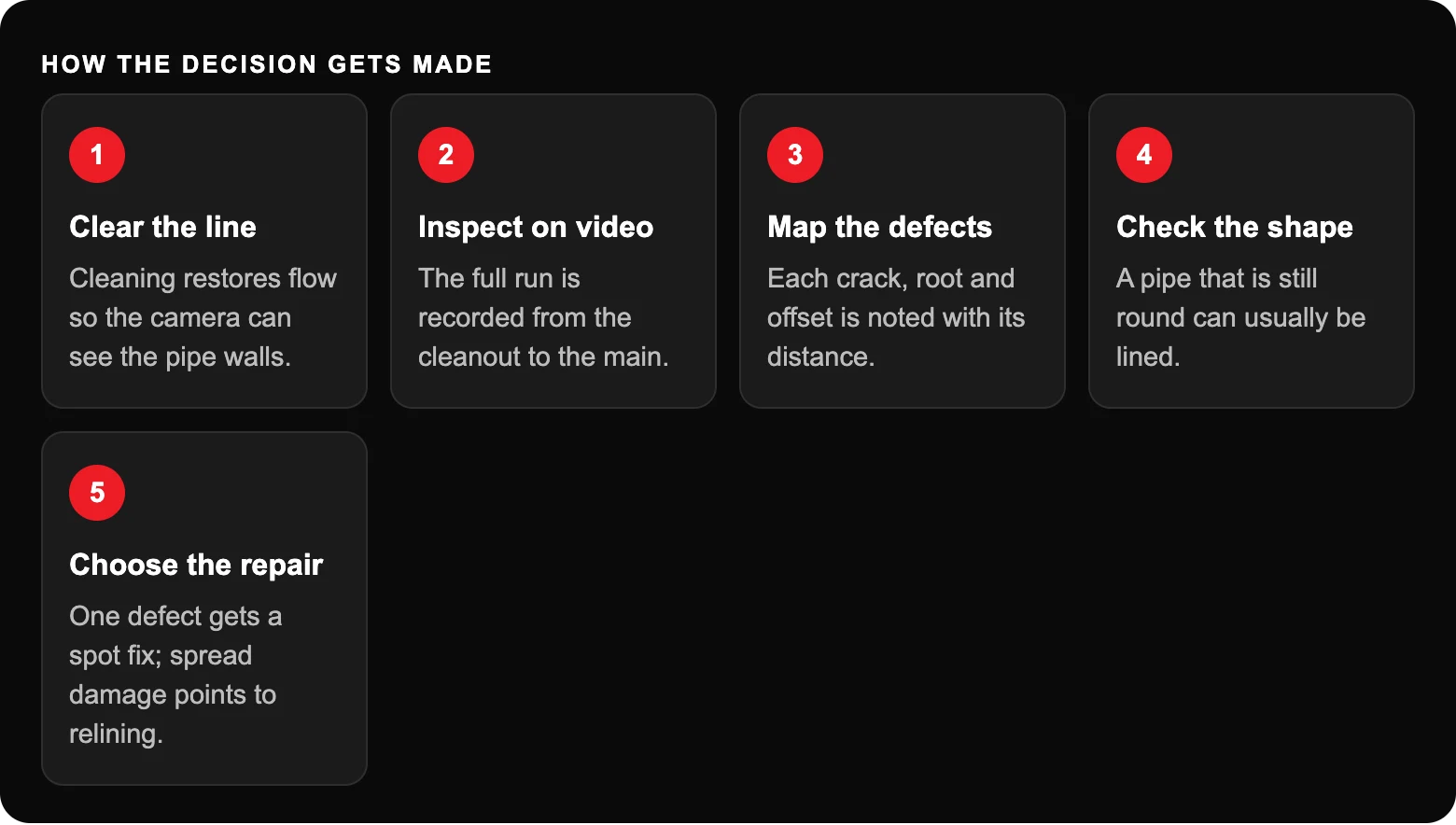
Symptoms tell you something is wrong, not how much of the pipe is wrong. One root intrusion and a line full of cracked joints can cause the same backup.
The deciding factor is how the damage is distributed. One break, one offset joint or one crushed section in a pipe that is otherwise in good shape is a textbook spot repair. Damage that shows up again and again along the run means the pipe is aging as a whole, and fixing one point simply moves the failure to the next weak joint.
You own more pipe than you think
El Paso Water’s customer responsibilities state that the customer is responsible for “the sewer service line from the tap at the main into the property.” That usually includes the section under the yard and sometimes under the street.
Warning signs you can notice at home
No single sign proves you need relining. The pattern matters: how often, how many fixtures, and whether it returns after the line is cleared.

If several apply, look inside the pipe. Our guide to the signs your main sewer line is clogged helps separate a simple blockage from a line that is deteriorating.
Why storms matter in El Paso
The EPA lists “sewer defects that allow stormwater and groundwater to overload the system” among the causes of sewer overflows. When a private lateral backs up mostly during the summer monsoon, that is a hint that water is getting in through more than one opening.
What the camera shows that points to relining
The camera is where the decision gets made. Every job we take starts with a high resolution camera and a photo report, because guessing from symptoms leads to the wrong repair.
| Camera finding | Spot repair | Relining | Replace or burst |
|---|---|---|---|
| One cracked or broken section | Good fit | Possible | Rarely needed |
| Roots at one joint | Good fit | Possible | No |
| Roots at many joints | Poor fit | Good fit | Possible |
| Cracks along much of the length | Poor fit | Good fit | Possible |
| Heavy scale or corrosion in cast iron | Poor fit | Good fit after descaling | Possible |
| Collapsed or crushed section | Good fit if short | Not until opened | Good fit if long |
| Belly or sag holding water | Good fit if short | Poor fit | Good fit if long |
The key test comes from NASSCO, the trade association for sewer rehabilitation. It describes cured in place lining as suited to pipe that “has experienced cracks, fractures or holes but has generally maintained its original shape.” That phrase is the dividing line. A cracked but round pipe is a relining candidate. A pipe that has lost its shape is not.
For a walkthrough of what each defect looks like on screen, read how to read your sewer camera report, or learn more about our video camera inspections.
Spot repair vs relining: what each one actually fixes
A spot repair, sometimes called a point or sectional repair, addresses a few feet of pipe. It can be done by digging one small pit or with a short sectional liner. The rest of the pipe is left exactly as it was.
Relining renews the full run with a continuous, jointless wall inside the old pipe. Installation follows standards such as ASTM F1216 for inverted cured in place pipe, and NASSCO states that a properly designed, installed and tested lateral liner has a minimum life expectancy of 50 years.
A useful question to ask
Ask your plumber what the rest of the pipe looks like beyond the damaged spot. If the answer is “about the same,” one patch is unlikely to be the last one.
Pipe Relining in El Paso
Want a straight answer about your pipes?
Every U.T. Trenchless job starts with a camera inspection and a photo report, so you see the problem before you decide on a fix. Licensed Master Plumber Ubaldo Torres leads the work.
When relining is not the right answer
Relining is not a cure for everything, and we will say so when the footage shows it. A liner takes the shape of the host pipe. It cannot straighten a sag, open a crushed section or fix a badly offset pipe.
- Bellies. A low spot that holds water will still hold water after lining. A short belly may be fixed with a spot repair; a long one points to replacement.
- Collapses. The collapsed section must be opened or excavated before any liner can pass.
- Undersized lines. Relining trims a few millimeters off the inside. Our article on whether relining reduces flow explains when that matters.
In those cases, pipe bursting or conventional replacement may be the better long term value. Our comparison of CIPP lining vs pipe replacement walks through the tradeoffs.
Signs you need pipe relining in El Paso homes
A few local conditions shape how often El Paso lines reach the relining stage. Older neighborhoods in central and east El Paso often have clay or cast iron laterals with many joints. Clay joints give roots a way in, while cast iron corrodes and builds scale from the inside, which our very hard water does nothing to slow.
Root problems deserve special attention. Cutting roots clears the line, but if they return at joint after joint, the openings are the real problem. Root cutting and removal buys time; sealing the joints is what stops the cycle. That pattern is one of the most common signs you need pipe relining in El Paso rather than another cleaning.
What to do next
- Note how often your line backs up and whether it worsens after storms.
- Have the line cleaned and inspected on camera, and ask for the video and a photo report.
- Ask how many defects were found and where they are along the pipe.
- Ask whether the pipe still holds its shape, and whether there are bellies or collapses.
- Compare a spot repair and relining against the full footage. Our pipe relining page explains the process.
- Call 915.858.0166 or visit our contact page to Request Service.
Questions El Paso homeowners ask about relining vs spot repair
Can pipe relining be done on just part of a sewer line?
Yes. Short sectional liners are a form of spot repair that covers a few feet at a damaged point. Full relining covers the whole run. The choice depends on whether the rest of the pipe is sound or showing the same kind of wear.
How long does pipe relining last?
NASSCO states that a properly designed, installed and tested lateral liner using cured in place pipe has a minimum life expectancy of 50 years. Real results depend on preparation, installation quality and what goes down the drain.
Will relining stop tree roots for good?
Relining seals the joints and cracks roots use to get in, creating one continuous wall. Roots cannot enter a pipe without an opening, which is why relining often ends the cycle of repeat root cutting.
Can a pipe be too far gone to reline?
Yes. If the pipe has collapsed, lost its shape, sags badly or is severely offset, a liner cannot correct it. Those lines usually need bursting or excavation.
Is it worth relining if only one spot is broken?
Often not. If the camera shows one defect and the rest of the pipe is in good shape, a spot repair is usually the sensible, lower cost fix. Relining earns its cost when damage is spread along the line.
Serving El Paso, Horizon City, Socorro and Las Cruces
Talk to a family owned trenchless team with 40+ years in the trade
Tell us what is going on and we will tell you what the camera shows, what your options are, and what we would do if it were our own property. Learn more about our pipe relining service.
Keep reading
Sources
- Pipe Rehabilitation, NASSCO.
- Sanitary Sewer Overflows, US Environmental Protection Agency.
- Customer Rights and Responsibilities, El Paso Water.
- ASTM F1216 standard practice, ASTM International.