

Get our plumbing guides firstAdd U.T. Trenchless as a preferred source and see our posts more often in Google Top Stories.
Add as a preferred source on GoogleMost parking lot catch basins should be inspected at least twice a year and cleaned at least once a year, plus any time sediment fills a third to half of the sump. Busy retail lots, restaurants and fuel or auto sites often need quarterly or monthly service. In El Paso, schedule the main catch basin cleaning in spring, before monsoon season.
A catch basin is a box under a grate with a sump below the outlet pipe. The sump is supposed to fill up: it traps sand, gravel, trash and oily grit so they do not travel into the pipe. The trouble starts when nobody empties it and the next storm pushes that material straight into the line.
There is no single federal schedule for private parking lots, so this guide pulls together what EPA and state stormwater programs actually require, then turns it into a practical catch basin cleaning frequency for El Paso commercial properties, HOAs and facility managers.
What’s in this guide
- The short answer: clean on fill level, not the calendar alone
- The fill line rules regulators use
- Catch basin cleaning frequency by property type
- What speeds up buildup in El Paso
- What a proper catch basin cleaning includes
- Signs a catch basin is overdue
- What to do next
- Questions facility managers ask about catch basin cleaning
- Keep reading
The short answer: clean on fill level, not the calendar alone
Regulators rarely set a fixed date. They say clean the basin before it gets too full. A calendar still matters because it forces someone to lift the grate and look.
Two thresholds show up again and again in stormwater guidance. The stricter one, used by the Oregon Department of Environmental Quality, calls for cleaning when sediment exceeds one third of the sump depth. The more common municipal standard, found in plans written for EPA’s Massachusetts small MS4 permit, says a basin should never be more than 50 percent full.
The fill line rules regulators use

The Massachusetts plan adds a smart rule: a basin found more than half full on two consecutive inspections means finding the sediment source or cleaning more often. That is a good habit for any property.
| Source | Cleaning trigger or frequency | Applies to |
|---|---|---|
| Oregon DEQ catch basin fact sheet | Clean when sediment passes one third of the depth to the water line; industrial areas monthly | Industrial and commercial sites |
| Central Massachusetts MS4 O&M plan | Keep sumps no more than 50 percent full; increase frequency after two full findings | Municipal systems under EPA’s permit |
| Weber County, Utah BMP | At least annual inspection; clean high load areas just before the wet season | Public and private facilities |
| EPA storm drain cleaning fact sheet | Routine cleaning; one city cleans 20 percent of its system each year | Municipal storm drain systems |
Notice the timing advice from Weber County: clean high load basins “just before the wet season.” In El Paso, the wet season is monsoon season, which the National Weather Service dates from June 15 to September 30.
Catch basin cleaning frequency by property type
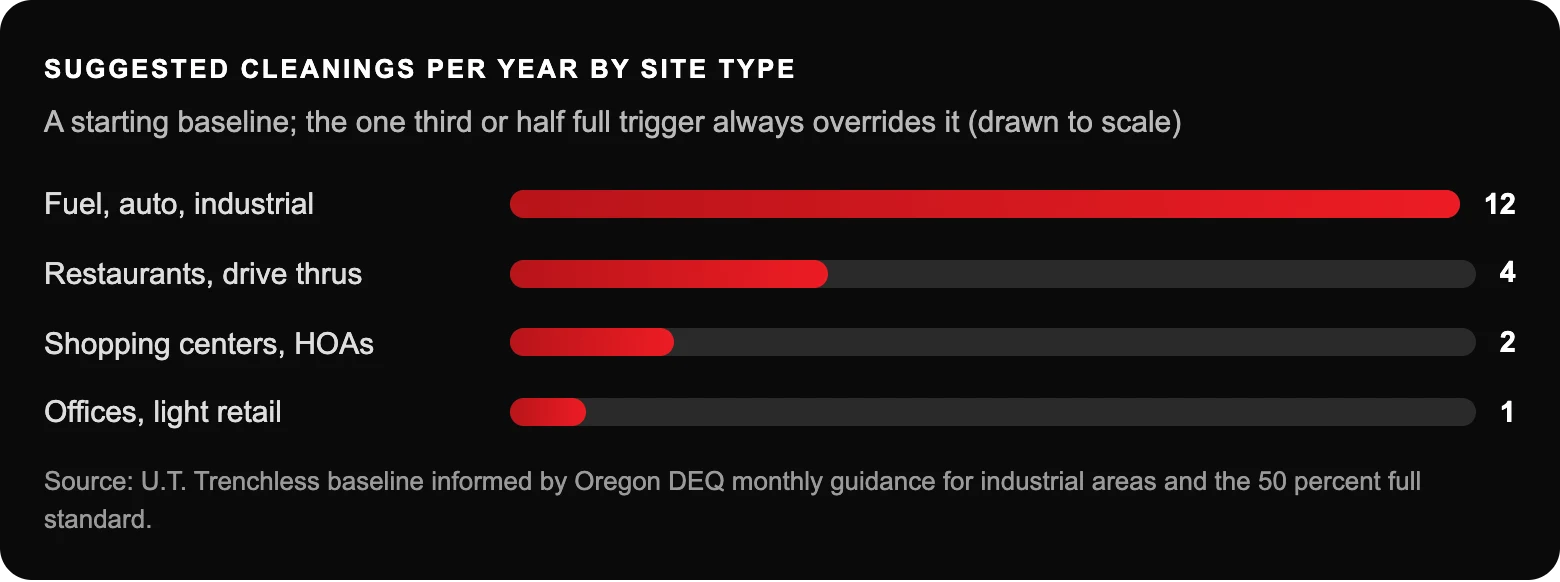
Here is the baseline we suggest for El Paso properties. Inspect on this schedule, then adjust once you see how fast your own basins fill.
Why restaurants and fuel sites need more
Food service lots collect grease, food waste and litter that turn sump sediment into a sticky mat. Fuel and auto sites add oil and fluid drips. Both load a basin faster and make the material harder to remove. Restaurants have a parallel problem on the sanitary side, covered in our guide on preventing grease related sewer backups in El Paso.
Sites near construction
A basin downhill from construction, a dirt lot or a desert slope can fill in one storm. Check those after every significant rain.
Storm Drain Cleaning and Maintenance in El Paso
Want a straight answer about your pipes?
Every U.T. Trenchless job starts with a camera inspection and a photo report, so you see the problem before you decide on a fix. Licensed Master Plumber Ubaldo Torres leads the work.
What speeds up buildup in El Paso
El Paso lots fill with material that many cities never see in quantity. Wind carries sand and fine caliche dust across pavement for months, decorative rock migrates out of landscape beds, and tumbleweeds and plastic bags mat across grates. Then a monsoon storm delivers most of the year’s runoff in a few short bursts.
That pattern argues for a firm spring cleaning even on low traffic sites. Our guide on preparing storm drains for El Paso monsoon season lays out the full calendar. A second check in October catches whatever the summer storms deposited.
Cut the load at the source
Regular sweeping, edging that keeps landscape gravel in place, and fixing eroding slopes next to pavement all mean less dirt reaches the drain, which is the cheapest schedule there is.
What a proper catch basin cleaning includes
Scooping the top layer out of a sump is not a cleaning. A complete service removes all the material, clears the outlet pipe and confirms the line downstream is open. Our storm drain cleaning and maintenance work follows these steps.
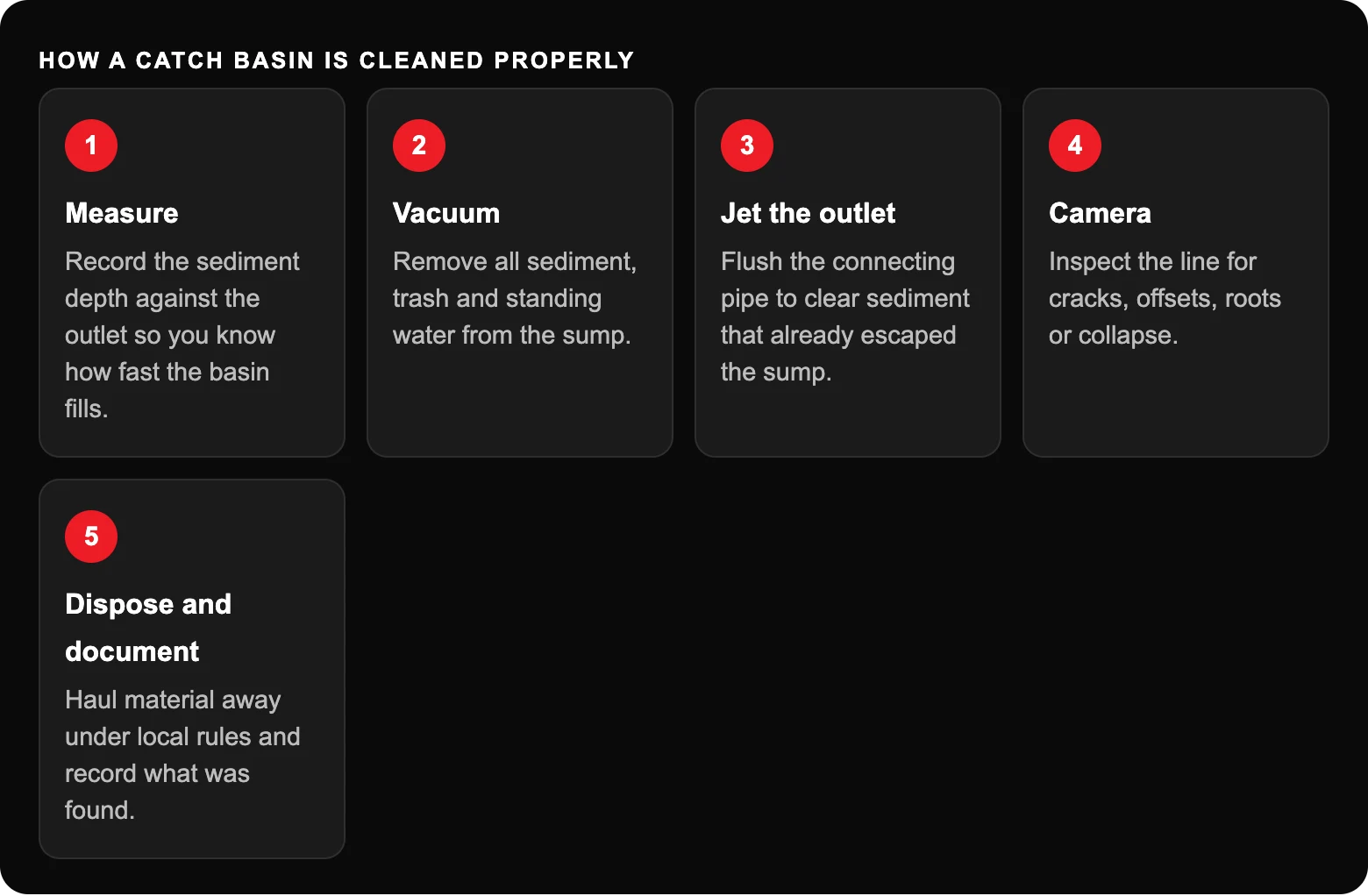
Clearing the outlet line is where drain hydro jetting earns its keep, because a high pressure water jet scours packed grit off the full pipe wall. For how that compares with a cable machine, see hydro jetting vs. snaking. A video camera inspection afterward confirms the line is actually clear and structurally sound.
The sediment may be regulated waste
The EPA notes that rinse water from wet cleaning must be contained and that storm drain sediment “may qualify as hazardous waste,” especially from fuel and industrial sites. Never wash it back into the drain or leave it on the pavement.
On cost, the EPA fact sheet cites municipal program figures of about $170 per catch basin and $8 per linear foot of line. Private jobs price differently, and in El Paso the price depends on how full the basins are, how many there are, and what the camera finds in the pipes.
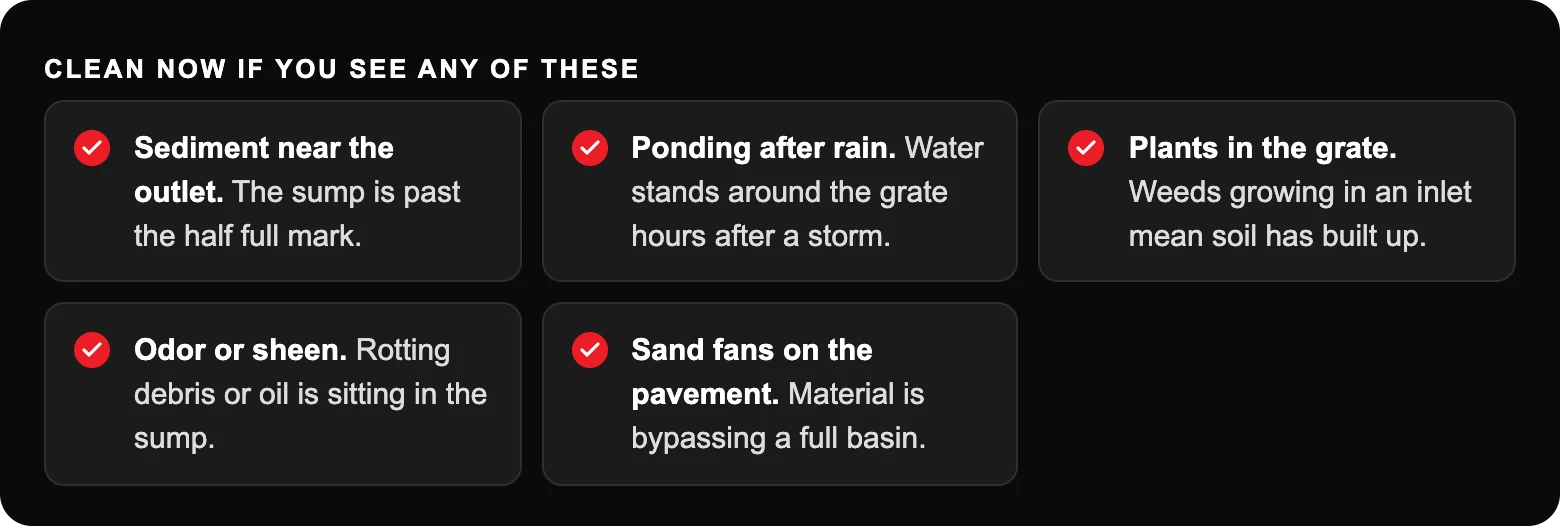
Signs a catch basin is overdue
What to do next
- Count and map every catch basin, inlet and trench drain on the property.
- Lift each grate and record the sediment depth against the outlet pipe.
- Assign a baseline frequency by site type and put inspections on the calendar.
- Book a full cleaning and camera inspection in spring, before June 15.
- Recheck in October and shorten the interval for any basin found half full twice.
To set up a cleaning schedule, call 915.858.0166 or reach us on our contact page.
Questions facility managers ask about catch basin cleaning
What is the difference between a catch basin and a storm drain?
A storm drain is the whole system of inlets and pipes that carries runoff away. A catch basin is one structure in that system: an inlet box with a sump below the outlet pipe that traps sediment and debris.
Can maintenance staff clean catch basins themselves?
Staff can safely clear trash off grates and check sediment depth from the surface. Full cleaning usually needs a vacuum truck, and entering a basin is confined space work that requires training and equipment. Sediment also has to be disposed of properly, so most owners hire the vacuum and jetting portion.
Do catch basin filter inserts reduce cleaning?
Inserts can capture oil, trash and fine sediment before they reach the sump, which helps water quality on fuel and restaurant sites. They also clog, so they add a maintenance task rather than removing one. An insert that is not emptied can block the inlet and cause ponding.
Does a clean catch basin mean the pipe is fine?
Not necessarily. Sediment that escaped a full sump may already be sitting in the connecting pipe, and joints can crack or shift under traffic loads. A camera inspection is the only way to know the line downstream is clear and intact.
Serving El Paso, Horizon City, Socorro and Las Cruces
Talk to a family owned trenchless team with 40+ years in the trade
Tell us what is going on and we will tell you what the camera shows, what your options are, and what we would do if it were our own property. Learn more about our storm drain cleaning and maintenance service.
Keep reading
Sources
- Portland Harbor: Catch Basins Fact Sheet, Oregon Department of Environmental Quality.
- Municipal Stormwater Infrastructure Operation and Maintenance Plan, Central Massachusetts Regional Stormwater Coalition.
- Massachusetts Small MS4 General Permit, U.S. Environmental Protection Agency Region 1.
- BMP: Catch Basin Cleaning, Weber County, Utah.
- Stormwater Best Management Practice: Storm Drain System Cleaning, U.S. Environmental Protection Agency.
- Monsoon Season Records, National Weather Service El Paso.