

Get our plumbing guides firstAdd U.T. Trenchless as a preferred source and see our posts more often in Google Top Stories.
Add as a preferred source on GooglePlumbers locate underground pipes without digging by tracing a signal instead of the pipe itself. A small transmitter called a sonde rides on a sewer camera head, an electromagnetic receiver follows metal pipe or tracer wire, and ground penetrating radar reads echoes in the soil. Good pipe locating in El Paso usually combines two of these, then confirms the result on camera.
Knowing where a line runs matters before you trench for a fence, plant a tree, pour a patio or plan a sewer repair. A guess that is off by three feet can crack a lateral.
This guide explains how each tool works, what it misses, why popular shortcuts fail, and how caliche, dry desert soil and older clay laterals affect the job in El Paso.
What’s in this guide
- How plumbers locate underground pipes: trace a signal, not the pipe
- Sonde transmitters on sewer camera heads
- Electromagnetic locators and tracer wire
- Ground penetrating radar
- What does not work, and why people keep trying it
- How accurate is a pipe locate?
- Pipe locating in El Paso: what local conditions change
- What to do next
- Questions El Paso homeowners ask about locating pipes
- Keep reading
How plumbers locate underground pipes: trace a signal, not the pipe
No tool lets a plumber look through dirt and see a pipe the way an X ray shows a bone. Every method depends on something the pipe gives off or carries: a radio signal from a transmitter inside it, a current running along it, or an echo bouncing off it.
So the right method depends on the pipe material and whether we can get inside it. A PVC sewer lateral with a cleanout is easy to trace from the inside. A buried plastic water line with no tracer wire and no access point is one of the hardest things in plumbing to find.
Sonde transmitters on sewer camera heads
For drain and sewer lines, the workhorse is the sonde, a small transmitter built into or clipped behind the head of an inspection camera. As the camera travels down the pipe, the sonde broadcasts a steady low frequency signal. A technician above ground follows it with a handheld receiver that shows where the camera head sits and roughly how deep.
Pipe material does not matter. Clay, cast iron, Orangeburg, ABS and PVC all work, because the signal comes from inside the line. The camera also shows the pipe at the exact spot being marked, so a crack or root intrusion can be pinned to a place on the surface. That is the core of our video camera inspections.
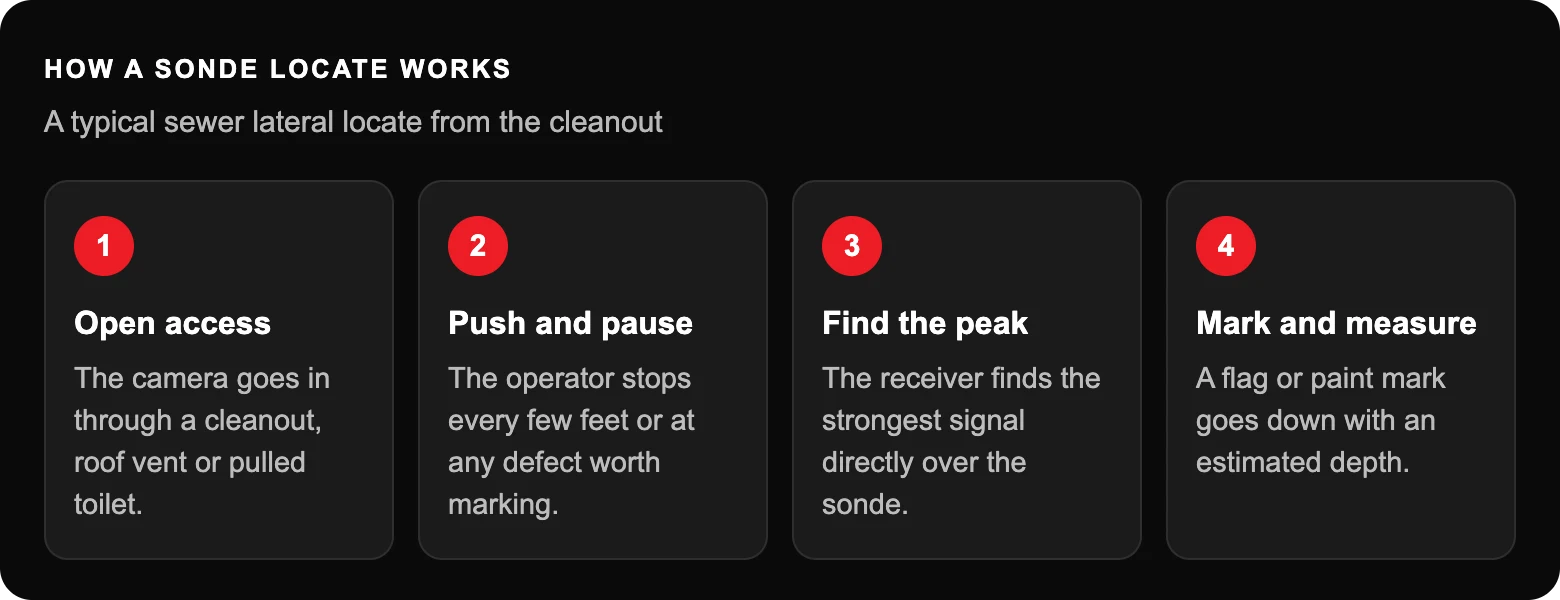
A sonde only works where the camera can travel, so a collapse or heavy root mass can stop the trace short. Depth readings get less precise on deeper lines, and power lines, metal fences or slab rebar can distort the signal. Careful operators take readings from more than one direction before painting.
Electromagnetic locators and tracer wire
When a pipe is metal, such as copper water service, steel gas pipe or cast iron, a technician can put a current on it. A transmitter clamps to an exposed part of the line or induces a signal from the surface, and the receiver follows the magnetic field around the energized pipe.
Plastic pipe does not carry current, which is where tracer wire comes in: a coated copper wire laid in the trench beside a plastic line so it can be found later. Federal pipeline rules at 49 CFR 192.321(e) require plastic gas pipe that is not encased to have an electrically conducting wire or other means of locating it underground.
Ground penetrating radar
Ground penetrating radar, or GPR, sends radio pulses into the ground and records echoes from anything with different electrical properties: pipes, voids, rocks, old footings. It can detect plastic lines no other surface tool can find.
The catch is soil. The U.S. Environmental Protection Agency notes that GPR is most useful in less conductive materials, that ideal conditions are rare because of groundwater and clay minerals, and that in saturated clay the depth of investigation may be limited to centimeters. A scan also shows reflections, not labels, so an operator still has to judge whether a line is sewer, water or an abandoned pipe.
| Method | Works on | Needs pipe access? | Main limitation |
|---|---|---|---|
| Sonde on camera | Any drain or sewer material | Yes, a cleanout or opening | Stops where the camera stops |
| Electromagnetic, direct connect | Metal pipe or intact tracer wire | Yes, a point to clamp | Useless on plastic without wire |
| Electromagnetic, induction | Long metal lines | No | Signal can jump to nearby lines |
| Ground penetrating radar | Metal and plastic | No | Weak in wet, clay or salty soil |
Pipe Locating and Mapping in El Paso
Want a straight answer about your pipes?
Every U.T. Trenchless job starts with a camera inspection and a photo report, so you see the problem before you decide on a fix. Licensed Master Plumber Ubaldo Torres leads the work.
What does not work, and why people keep trying it
A metal detector will not find a PVC sewer line and rarely reads cast iron deeper than about a foot. Phone apps that claim to detect pipes rely on the phone’s magnetometer, which cannot sense buried plastic. Dowsing rods have never held up in a controlled test.
The most common mistake is drawing a straight line from the cleanout to the street. Laterals bend around trees and foundations and change direction at fittings. Old drawings help only so much: the FHWA’s subsurface utility engineering guidance ranks information from records or verbal recollections as its lowest quality level and calls those sources typically unreliable.
Do not dig by the old site plan
A builder drawing shows where a line was meant to go. Repairs, additions and past owners change that. Treat it as a starting point to verify.
How accurate is a pipe locate?
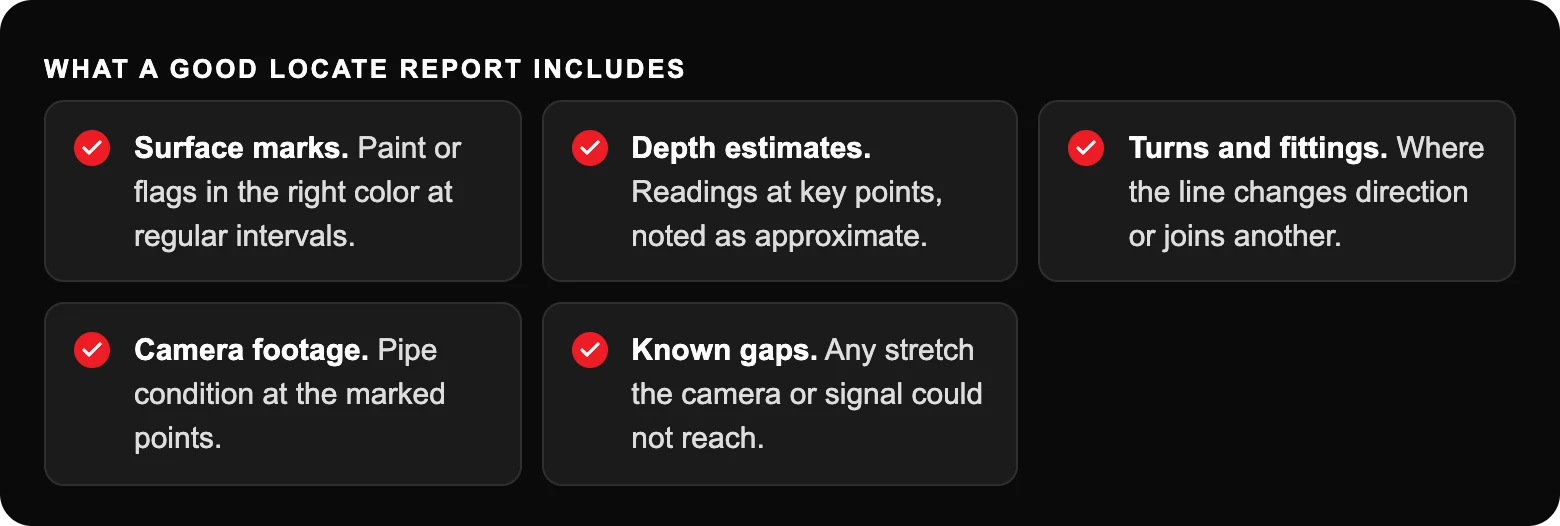
In reasonable conditions, a careful sonde or electromagnetic locate puts the mark within inches of the pipe’s center, but accuracy drops with depth and interference, and depth readings are estimates. Professionals treat paint on the ground as the zone where a line runs and hand dig to expose it before heavy equipment gets close.
Private lines are marked with the same colors utilities use. The Texas811 color code assigns green to sewer and drain lines, blue to potable water, purple to irrigation and yellow to gas.
Pipe locating in El Paso: what local conditions change
Our dry climate often helps GPR, but caliche, rocky fill and damp irrigated clay can weaken the signal, so we rarely rely on radar alone. In older central and east El Paso neighborhoods, laterals are often clay or cast iron laid long before tracer wire was common, so a sonde inside the line is usually the most dependable way to follow them.
El Paso Water makes the customer responsible for the sewer service line from the tap at the main into the property, and utility locators do not mark those private lines. We explain why in our guide to whether Texas 811 marks your private sewer line. Our pipe locating and mapping service fills that gap, and because every job starts with a high resolution camera inspection, you get the location and the pipe’s condition in one visit.
What to do next
- Decide what you need found: sewer, water, gas to an outbuilding or irrigation.
- Contact Texas 811 for public utility lines at least two working days before digging.
- Find and uncover your sewer cleanout, usually a capped pipe near the foundation.
- Book a camera locate for private lines and keep the marks visible until work is done.
- If the camera shows damage, read what a sewer camera inspection shows before choosing a repair.
When you are ready, Request Service online or call 915.858.0166.
Questions El Paso homeowners ask about locating pipes
Can a metal detector find a sewer line?
Usually not. Most newer laterals are PVC or ABS plastic, which a metal detector cannot sense. Older cast iron is metal, but typical detectors read only about a foot deep, and laterals are often deeper. A sonde on a camera head works on any pipe material.
How deep is a residential sewer line?
There is no single answer. Depth depends on the slope needed to reach the main and the house elevation, and it usually increases toward the street. A sonde receiver gives a depth estimate at each marked point, which beats any rule of thumb.
How do you find a PVC water line with no tracer wire?
It is one of the hardest locates. Options include ground penetrating radar, pushing a small transmitter into the line from an access point, or exposing it at a known point by hand and following it. Soil conditions often decide which approach works.
Can you locate pipes under a concrete slab?
Yes. A sonde camera can run under a slab through a cleanout, and the receiver reads its signal through the concrete, though rebar can distort readings. It is a common first step before under slab drain repair.
Serving El Paso, Horizon City, Socorro and Las Cruces
Talk to a family owned trenchless team with 40+ years in the trade
Tell us what is going on and we will tell you what the camera shows, what your options are, and what we would do if it were our own property. Learn more about our pipe locating and mapping service.
Keep reading
Sources
- Ground Penetrating Radar (GPR), U.S. Environmental Protection Agency.
- 49 CFR 192.321, Installation of plastic pipe, Electronic Code of Federal Regulations.
- Subsurface Utility Engineering, Federal Highway Administration.
- Utility Color Code, Texas811.
- Customer Rights and Responsibilities, El Paso Water.