Get our plumbing guides firstAdd U.T. Trenchless as a preferred source and see our posts more often in Google Top Stories.
Add as a preferred source on GooglePipe descaling is the mechanical removal of rust, tuberculation, mineral scale and hardened buildup from the inside of a drain or sewer pipe. Cast iron drains need it because the iron itself corrodes from the inside, growing rough nodules that snag waste and shrink the pipe. Pipe descaling in El Paso restores flow and exposes the real condition of the pipe.
If your home was built before the 1970s, part of its drain system is likely cast iron. That pipe was built to last, and much of it still works. The problem is what grows on the inside wall after decades of sewage, sewer gas and mineral rich water.
This guide explains what descaling removes, why cast iron needs it most, how the work is done, and when it is the wrong answer, with the El Paso conditions that matter along the way.
What’s in this guide
- The short answer: descaling scrapes cast iron back to a clean bore
- What builds up inside a cast iron drain
- Why cast iron drains need descaling more than plastic pipe
- How mechanical descaling works, step by step
- Descaling versus hydro jetting and snaking
- When pipe descaling in El Paso makes sense, and when it does not
- What to do next
- Questions El Paso homeowners ask about pipe descaling
- Keep reading
The short answer: descaling scrapes cast iron back to a clean bore
Descaling is not ordinary drain cleaning. A snake punches a hole through a clog; descaling cuts the buildup off the full circumference of the pipe wall.
The goal is a pipe close to its original inside diameter, smooth enough that waste slides through. A descaled line also lets the camera see the actual iron, so cracks and thin spots are no longer hidden under crust.
We handle this work through our pipe descaling service, and every job starts with a camera inspection so the decision is based on what is really inside the line.
What builds up inside a cast iron drain
Several materials collect inside old cast iron, often in layers. Some respond to water pressure; others only yield to cutting tools.
Tuberculation
Tuberculation is the lumpy, orange and black rust growth that looks like barnacles on the pipe wall. The pipe manufacturer McWane Ductile describes it as a bacterial, oxygen driven form of corrosion that deposits iron oxide nodules, called tubercles, on the inside surface. In a drain line those nodules can grow large enough to catch paper and grease, and they keep growing as long as bare iron is exposed.
Hydrogen sulfide corrosion
Sewer lines produce their own acid. According to Trenchlesspedia, bacteria in low oxygen wastewater produce sulfides, the resulting hydrogen sulfide gas rises into the air space of the pipe, and other bacteria convert it into sulfuric acid. That acid attacks the upper part of the pipe. It works fastest in warm conditions and in slow flowing lines, both common in a hot climate like ours.
Mineral scale and hardened grease
El Paso Water describes local water as moderately hard to hard in its water quality FAQ, meaning it carries calcium and magnesium. On a rough rusted surface, those minerals, soap residue and kitchen grease bind together into a crust that is much tougher than a normal clog. Our guide to what El Paso hard water does to your plumbing covers the supply side of the same problem.

Why cast iron drains need descaling more than plastic pipe
PVC and ABS do not rust, so buildup in plastic pipe usually rinses away with jetting. In cast iron the wall is part of the problem: the iron corrodes, corrosion creates roughness, and roughness catches more debris.
The InterNACHI life expectancy chart estimates 50 to 60 years for below ground cast iron waste pipe. Plenty of El Paso homes built in the 1950s and 1960s are past that mark. Age alone does not condemn a pipe, but the inside deserves a look.
Scale hides damage
A heavily scaled pipe can look solid on camera because the crust covers the wall. Only after descaling can you see whether the iron underneath is sound, pitted, cracked or worn through along the bottom.
How mechanical descaling works, step by step
Most descaling uses a high speed cable machine that spins a cutting head inside the pipe. The most common heads are chain knockers: lengths of chain, sometimes carbide tipped, that fling outward as they spin and knock scale off the wall. Sizes are matched to the pipe diameter and the hardness of the deposits.
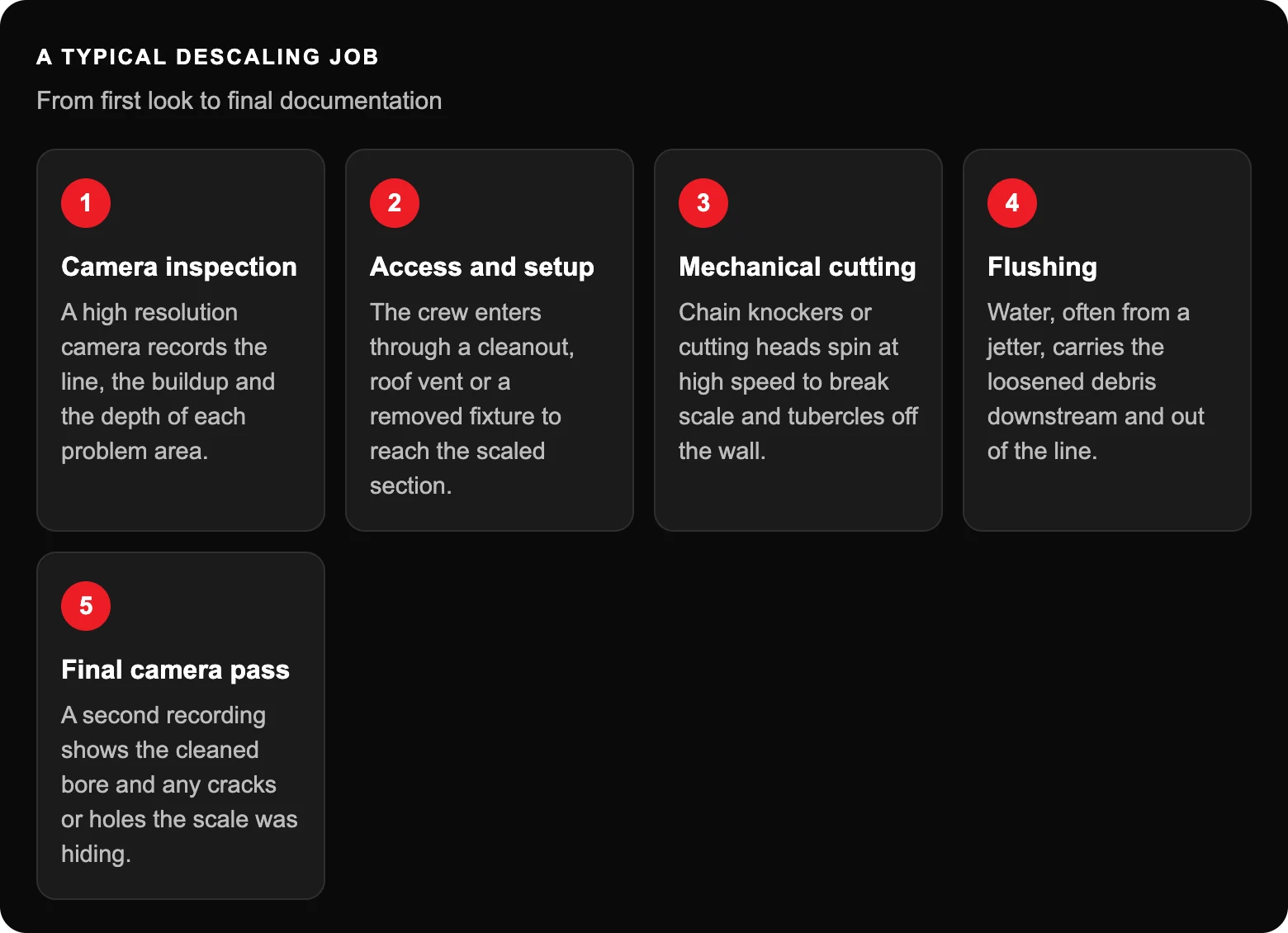
A good crew descales in stages. Old iron can be thin, and a head that is too large or run too hard can break through a weak spot, so the camera goes back in during the job, not only at the end.
Pipe Descaling in El Paso
Want a straight answer about your pipes?
Every U.T. Trenchless job starts with a camera inspection and a photo report, so you see the problem before you decide on a fix. Licensed Master Plumber Ubaldo Torres leads the work.
Descaling versus hydro jetting and snaking
Why not simply jet the line? High pressure water is excellent for grease and sludge, but on hard tuberculation it often slides over the nodules. Many jobs use both: cutting tools to break the scale and jetting to flush it out. Our article on whether hydro jetting is safe for older pipes explains where water pressure fits.
| Method | How it works | Best for | Limits on old cast iron |
|---|---|---|---|
| Drain snake | Small cable bores a path through a blockage | Quick relief of a single clog | Leaves scale on the walls, so clogs return |
| Hydro jetting | High pressure water scours the pipe | Grease, sludge, soft buildup | May not remove hard tuberculation |
| Mechanical descaling | Spinning chains or cutters remove scale | Tuberculation, rust, hardened crust | Needs a skilled operator and camera checks |
When pipe descaling in El Paso makes sense, and when it does not
Descaling is the right call when the pipe is structurally sound but choked with buildup, and the camera shows heavy nodules on otherwise intact iron.
It is also the standard preparation step before lining. A cured in place liner needs a clean, round host pipe to bond to, so we descale before any pipe relining work. Our post on whether CIPP lining can fix old cast iron goes deeper into that pairing.
When descaling is not enough
If the camera shows the bottom of the pipe rotted through, sections missing, a collapsed run or offset joints letting soil in, cleaning will not save it. At that point the choice is lining, pipe bursting or conventional replacement.
What to do next
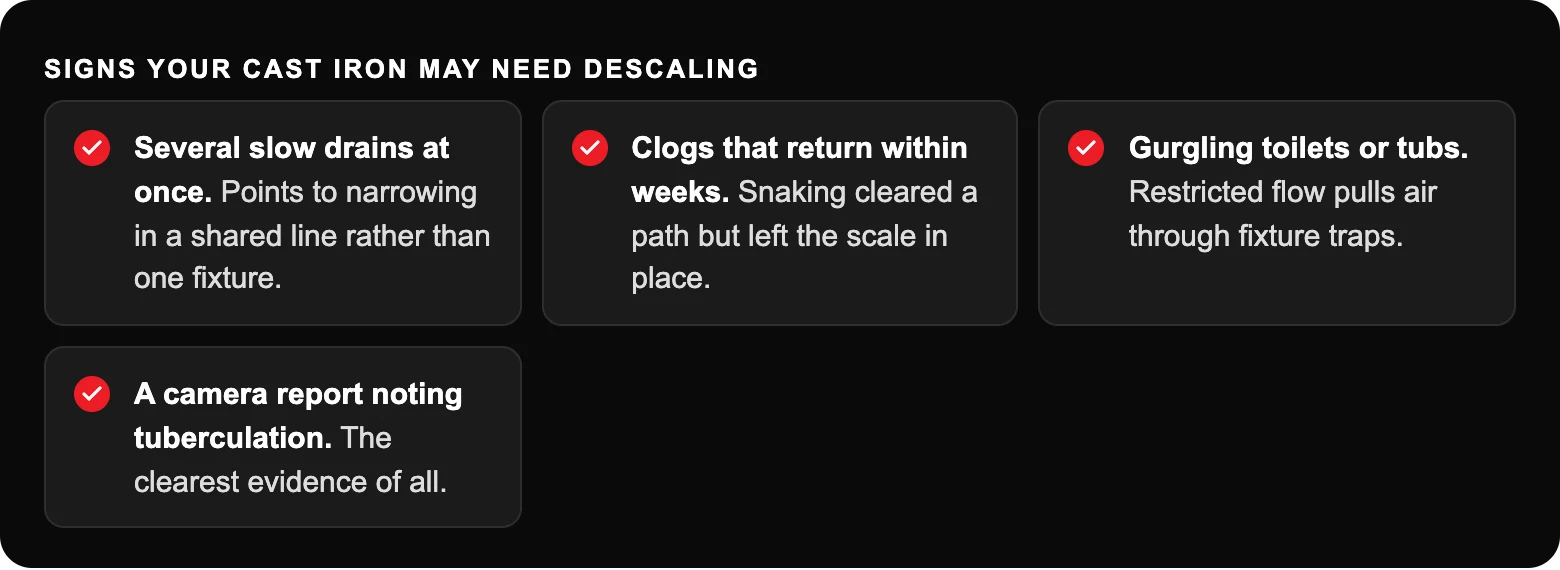
- Note which drains are slow and how often clogs return; patterns help pinpoint the problem section.
- Avoid pouring chemical drain openers into cast iron, since they add heat and corrosive stress without removing scale.
- Schedule a video camera inspection to see whether you are dealing with scale, roots, a belly or a break. Our guide on what a sewer camera inspection shows helps you read the report.
- If descaling is recommended, ask for before and after footage.
- Call 915.858.0166 or contact our team to Request Service anywhere from El Paso and Horizon City to Las Cruces.
Questions El Paso homeowners ask about pipe descaling
Does descaling damage cast iron pipes?
Done correctly, descaling removes buildup, not sound iron. The risk comes from pipe that is already paper thin: aggressive tools can break through a weak spot that was only being held together by scale. That is why the job should start with a camera inspection, use heads sized to the pipe, and include camera checks during the work.
How long does descaling last?
It depends on the iron and how the line is used. Descaling removes buildup but does not stop corrosion. Lines in good shape can stay clear for years; pitted pipe rescales faster. Many owners follow descaling with lining for a long term fix.
Can I descale cast iron pipes myself?
Rental drain machines are built to clear clogs, not cut scale off the full pipe wall. Descaling heads can do real damage in inexperienced hands, and without a camera you cannot see what the tool is doing. For a main line or under slab drain, this is professional work.
Will descaling fix a sewer smell?
Sometimes. Buildup traps rotting waste that causes odors, and removing it helps. But a smell can also come from a cracked pipe, a dry trap or a failed vent, which the camera pass after descaling will reveal.
Serving El Paso, Horizon City, Socorro and Las Cruces
Talk to a family owned trenchless team with 40+ years in the trade
Tell us what is going on and we will tell you what the camera shows, what your options are, and what we would do if it were our own property. Learn more about our pipe descaling service.
Keep reading
Sources
- What Is Tuberculation and Why Did It Happen in Iron Pipe?, McWane Ductile.
- Controlling Hydrogen Sulfide Corrosion in Sewer Pipelines, Trenchlesspedia.
- Water Quality FAQ, El Paso Water.
- Standard Estimated Life Expectancy Chart for Homes, InterNACHI.