

Get our plumbing guides firstAdd U.T. Trenchless as a preferred source and see our posts more often in Google Top Stories.
Add as a preferred source on GoogleHydro jetting is high pressure water cleaning that scours grease, scale, sludge and roots off the inside of a drain. It is safe for most older pipes in El Paso when a camera inspection comes first and the pressure and nozzle are matched to the pipe. It is not safe for a line that is already cracked, collapsed or badly corroded.
That last sentence is the one most sales pitches skip. The same water that cuts through a grease plug can push through a weak joint in a 60 year old clay lateral.
This guide is for El Paso owners of older homes and buildings with cast iron or clay sewer lines. It covers how jetting works, which pipes tolerate it, the warning signs that rule it out, and what to do instead.
What’s in this guide
- What hydro jetting actually does inside a pipe
- Is hydro jetting safe for older pipes?
- How each old pipe material handles jetting
- Signs your old pipe should not be jetted yet
- What to do when an old pipe cannot take jetting
- What to do next
- Questions El Paso homeowners ask about hydro jetting older pipes
- Keep reading
What hydro jetting actually does inside a pipe
A jetter pumps water through a reinforced hose to a nozzle. Forward jets break into the blockage, while rear facing jets pull the hose up the line and scour the pipe wall. The result is a pipe scrubbed close to its original diameter, not a hole punched through a clog.
Operators balance two numbers: pressure, measured in psi, and flow, measured in gallons per minute. Pressure does the cutting and flow does the flushing. The trade magazine Cleaner calls the relationship between flow and pressure the least understood area of sewer jetting, and it is exactly where careful technicians and careless ones part ways on an older line.

Is hydro jetting safe for older pipes?
For a structurally sound old pipe, yes. A scaled cast iron line or a greasy clay line with tight joints can usually be jetted with good results, and many 50 year old laterals have years of service left once cleared.
The risk sits with pipes that are already failing. Angi’s cost guide says plainly that hydro jetting can potentially damage pipes, particularly if they are old or weakened, and Bob Vila’s guide notes that fragile materials such as clay or certain types of cast iron may be more prone to damage. Jetting rarely creates those weaknesses. It exposes them.
When jetting is the wrong call
If the camera shows a collapsed section, a large offset joint, missing pipe bottom, or cast iron corroded through to the soil, do not jet it. The honest recommendation at that point is a repair or rehabilitation method, and a good contractor will tell you so before running any water.
Why the camera is not optional
You cannot judge an old sewer line from the cleanout. At U.T. Trenchless, a family owned team led by Licensed Master Plumber Ubaldo Torres, every job begins with a high resolution video camera inspection and a photo report before we recommend anything. If you want to know what the footage means, our guide on how to read a sewer camera report walks through the common defect codes.
How each old pipe material handles jetting
Material, age and condition all matter, and the same material can be fine in one yard and failing in the next.
| Pipe material | Typical concern | Jetting outlook |
|---|---|---|
| PVC or ABS plastic | Grease and debris buildup | Generally well suited when joints are intact |
| Cast iron, sound wall | Tuberculation and hard water scale | Usually suitable with the right nozzle and pressure |
| Cast iron, thin or channeled | Corrosion along the bottom of the pipe | Often better suited to descaling or lining |
| Vitrified clay, tight joints | Root entry at joints | Usually suitable at controlled pressure |
| Clay, cracked or offset | Soil entry and broken pieces | Poor candidate until repaired |
| Orangeburg fiber pipe | Deformed or blistered walls | Generally not a jetting candidate |
Cast iron and El Paso hard water
El Paso water is hard, and over decades the minerals and corrosion inside cast iron form rough, lumpy growths called tuberculation. Those ridges catch grease, paper and wipes, so a cast iron line clogs again and again. Jetting can clear soft buildup, but thick, rock hard scale often calls for mechanical pipe descaling instead. Our explainer on why cast iron drains need descaling covers that process in detail.
Clay pipe and roots
Clay resists water pressure well. Its weak points are the joints, where roots get in. A root cutting nozzle clears fine roots, but if roots have split a joint, the fix is repair, not more pressure.
Drain Hydro Jetting in El Paso
Want a straight answer about your pipes?
Every U.T. Trenchless job starts with a camera inspection and a photo report, so you see the problem before you decide on a fix. Licensed Master Plumber Ubaldo Torres leads the work.
Signs your old pipe should not be jetted yet
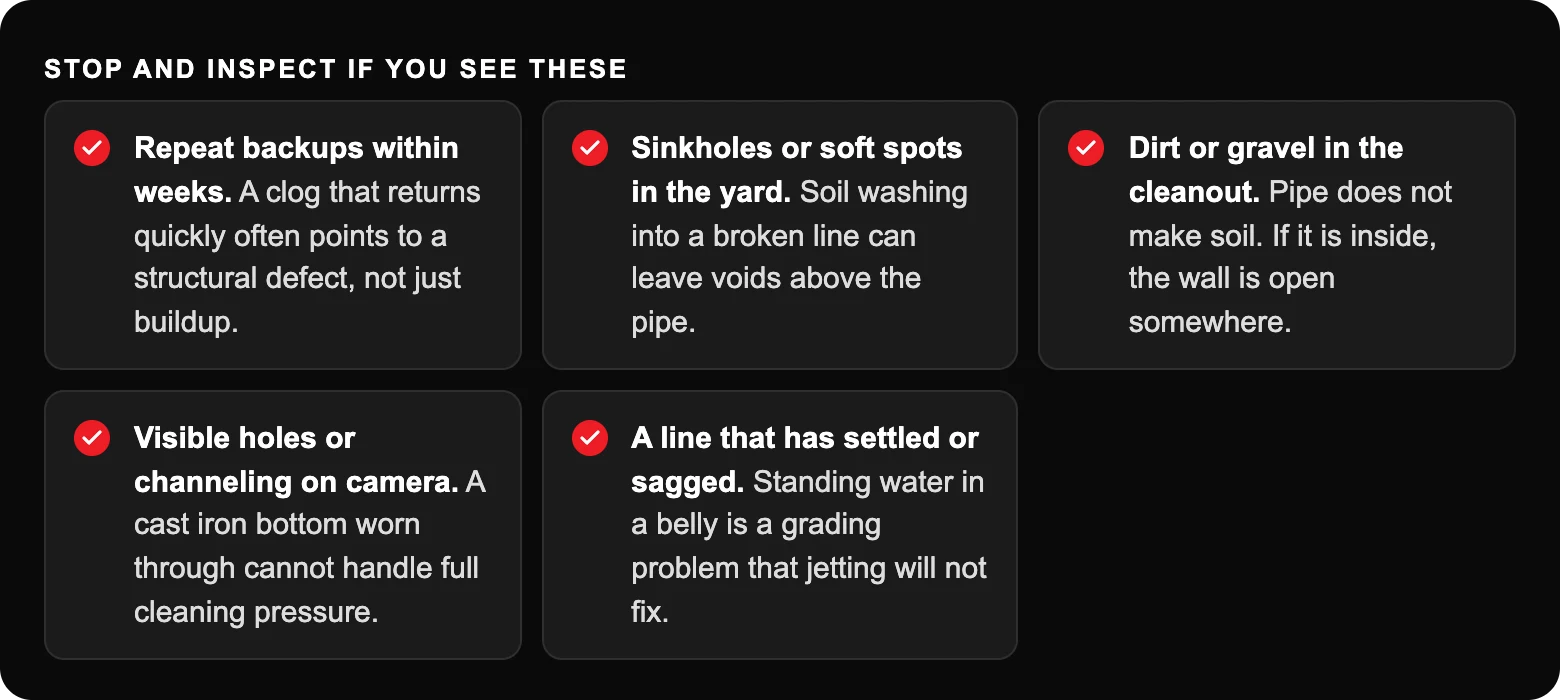
The EPA lists blockages, line breaks and sewer defects among the main causes of sewage overflows, and a private lateral can suffer from all three at once.
What to do when an old pipe cannot take jetting
A pipe too weak to jet needs structural attention anyway, and most of those fixes no longer mean trenching the whole yard.
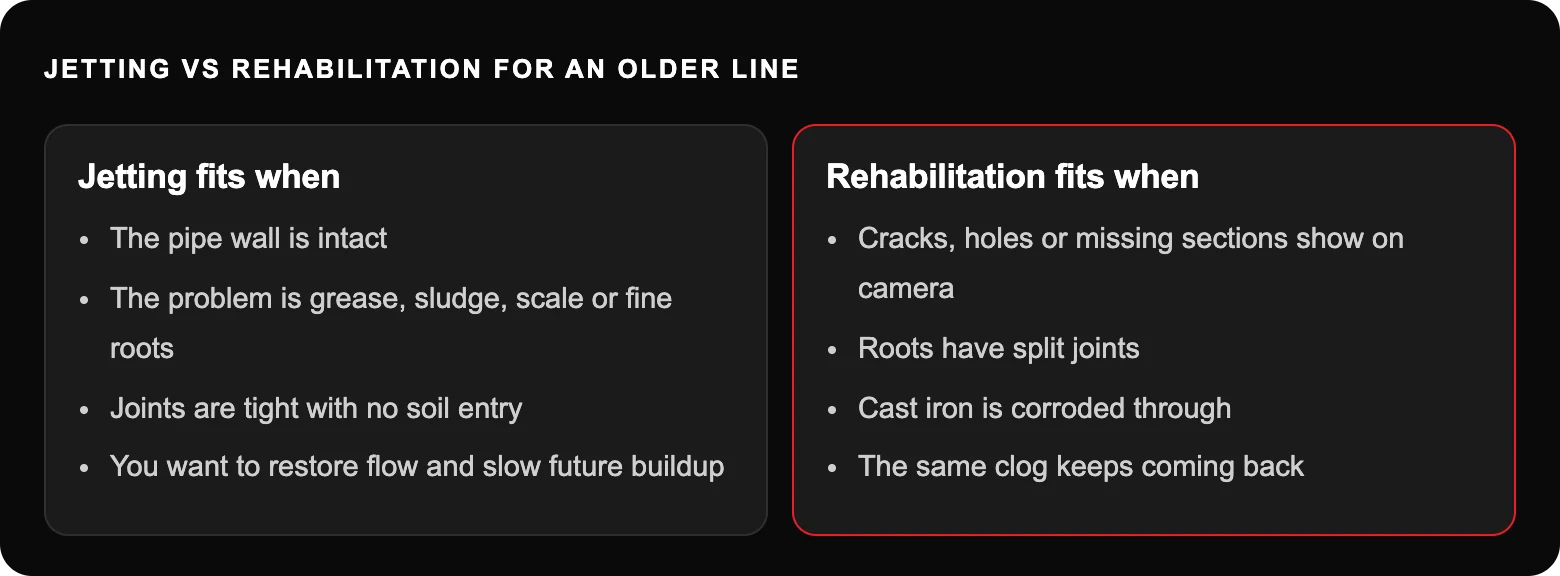
For many damaged lines, a cured in place liner creates a new pipe inside the old one. Our article on whether CIPP lining can fix old cast iron sewer pipes explains when that works. Liners need a clean host pipe, so gentle cleaning is often the first step.
Snaking is not automatically gentler
A cable can also snag a fragile section, and it leaves buildup behind. For a sound old pipe, a properly set jetter is often the more controlled option. The comparison in our hydro jetting vs snaking guide goes deeper.
What to do next
- Note how often drains back up and which fixture goes first.
- Find your sewer cleanout, usually a capped pipe near the foundation or in the front yard.
- Schedule a camera inspection before agreeing to any jetting on a line older than about 40 years.
- Confirm the contractor’s license with the Texas State Board of Plumbing Examiners, then review the footage and photo report with the technician who shot it.
- Choose jetting, descaling or rehabilitation based on the pipe’s condition, not a package price.
- Learn more about our drain hydro jetting service, or Request Service and call 915.858.0166.
Questions El Paso homeowners ask about hydro jetting older pipes
Can hydro jetting cause a leak in an old pipe?
It can reveal one. If a cast iron wall is paper thin or a clay joint is already cracked, the scale sealing the gap may wash away and water can escape. That is why the inspection comes first. A leak found after jetting usually existed before the cleaning started.
Is hydro jetting safe for 100 year old cast iron?
Age alone does not decide it. Some very old cast iron still has thick, sound walls, while younger pipe can be badly corroded in wet soil. A camera inspection shows wall condition. If the pipe is sound, controlled jetting is often fine. If the bottom is channeled or holed, descaling with care or lining is the better route.
How often should an older sewer line be jetted?
HomeAdvisor suggests many homes benefit from preventive jetting every 18 to 24 months. Older lines near trees or with a grease history may need it sooner. Let camera footage of how fast buildup returns set your schedule.
Should I rent a jetter for an old pipe myself?
For an older line, we advise against it. Rental units come with no camera, so you cannot see cracks or joint damage, and a pressure mistake on a fragile pipe can turn a clog into a repair. A small hand auger on a fixture drain is a lower risk DIY step.
Serving El Paso, Horizon City, Socorro and Las Cruces
Talk to a family owned trenchless team with 40+ years in the trade
Tell us what is going on and we will tell you what the camera shows, what your options are, and what we would do if it were our own property. Learn more about our drain hydro jetting service.
Keep reading
Sources
- How Much Does Hydro Jetting Cost?, Angi.
- How Much Does Hydro Jetting Cost?, Bob Vila.
- How Much Does Hydro Jetting Cost?, HomeAdvisor.
- Successful Jetting, Cleaner Magazine.
- Sanitary Sewer Overflows, U.S. Environmental Protection Agency.
- Texas State Board of Plumbing Examiners, State of Texas.