
Get our plumbing guides firstAdd U.T. Trenchless as a preferred source and see our posts more often in Google Top Stories.
Add as a preferred source on GoogleChemical drain cleaners are labeled safe for plastic and metal pipes when used as directed, but they are a poor fix for most clogs. They rarely clear hair or roots, they sit in the pipe when the drain is fully blocked, and they create a burn hazard for anyone who opens the line. For recurring clogs, professional drain cleaning with a camera check is safer and lasts longer.
Almost every homeowner has poured a bottle of drain opener into a slow sink. Often it runs slow again a week later, and the plumber who comes next has to work through a pipe full of caustic water.
This guide explains what is actually in those bottles, what they can and cannot do to your pipes, when they are simply the wrong tool, and what we recommend instead. Our team is led by Licensed Master Plumber Ubaldo Torres, and the advice below reflects how we handle clogs in El Paso homes every day.
What’s in this guide
- The short answer: safe on the label, risky in practice
- What is inside chemical drain cleaners
- How chemical drain cleaners can hurt your plumbing
- The safety risk nobody mentions on the label
- What we recommend instead
- When to skip the store and call a plumber
- What to do next
- Questions El Paso homeowners ask about chemical drain cleaners
- Keep reading
The short answer: safe on the label, risky in practice
Manufacturers stand behind their products. The Drano FAQ says its products “can be used safely with plastic pipes or metal pipes” and tells users not to put its clog removers in toilets. We take that at face value for a sound pipe and a single use.
The trouble is that real drains are rarely ideal. A 60 year old cast iron line already thinned by corrosion, a fully blocked drain where the chemical cannot move, or a clog made of roots are all situations where a bottle does little good and some harm.
What a clog is made of matters
Chemical openers work best on soft organic buildup like soap scum and some grease. They do almost nothing to tree roots, wipes, toys, mineral scale or a pipe that has sagged or collapsed.
What is inside chemical drain cleaners
Most store bought drain openers fall into a few chemical families. MedlinePlus, the National Library of Medicine’s health site, lists lye (sodium hydroxide), potassium hydroxide, sulfuric acid and hydrochloric acid as the poisonous ingredients in drain openers.
| Type | Typical active ingredient | How it works | Main concern |
|---|---|---|---|
| Caustic (gels, liquids) | Sodium or potassium hydroxide | Turns grease into a soapy sludge and generates heat | Severe skin and eye burns; heavy, slow to rinse |
| Acid (professional strength) | Sulfuric or hydrochloric acid | Dissolves organic matter fast, releasing strong heat | Violent reaction with water or other cleaners |
| Oxidizing | Bleach type compounds | Breaks down organic material by oxidation | Toxic gas if mixed with acids or ammonia |
| Enzyme or bacterial | Live cultures or enzymes | Slowly digests organic buildup over days | Too slow for a real blockage; best as maintenance |
The same page warns that burns in the airway or digestive tract “can lead to tissue death.” That is why plumbers ask what you have put in a drain before opening it.
How chemical drain cleaners can hurt your plumbing
They stall on a full blockage
If water is not moving, the chemical sits on top of the clog and soaks the fittings above it. Caustic products create heat as they react, and that heat stays concentrated in one spot instead of flowing away.
They find the weak spots in old pipe
Many homes in central and east El Paso still drain through cast iron. Decades of corrosion leave thin walls, pinholes and rough scale. A product that is fine on new pipe can speed up a leak in pipe that was already near the end of its life. If you have older iron drains, our guide on why cast iron drains need descaling explains a better way to restore flow.
They move the problem downstream
Liquefied grease can travel farther down the line, cool and harden again where you cannot reach it. El Paso Water reports that more than 80% of wastewater blockages involve grease, so shifting it deeper into your lateral just delays the backup.
They can upset septic systems
For rural properties around Horizon City, San Elizario and southern New Mexico, the EPA is direct:
“Avoid chemical drain openers for a clogged drain. Instead, use boiling water or a drain snake.”
That guidance comes from the EPA’s page on caring for your septic system.
Drain Cleaning in El Paso
Want a straight answer about your pipes?
Every U.T. Trenchless job starts with a camera inspection and a photo report, so you see the problem before you decide on a fix. Licensed Master Plumber Ubaldo Torres leads the work.
The safety risk nobody mentions on the label
When a chemical does not clear the clog, the next step is usually a plunger or a snake. That is when injuries happen. Plunging a sink full of caustic water can splash it onto your face and arms, and the MedlinePlus entry notes that eye contact can cause permanent vision loss.
Never mix products
Do not follow one drain opener with another, and never pour bleach into a drain that has an acid or ammonia based product in it. The reaction can release toxic gas or boil violently. If you already used a chemical, tell your plumber before any work starts.
What we recommend instead
Most household clogs can be cleared without chemicals at all. Here is the order we suggest before calling anyone.
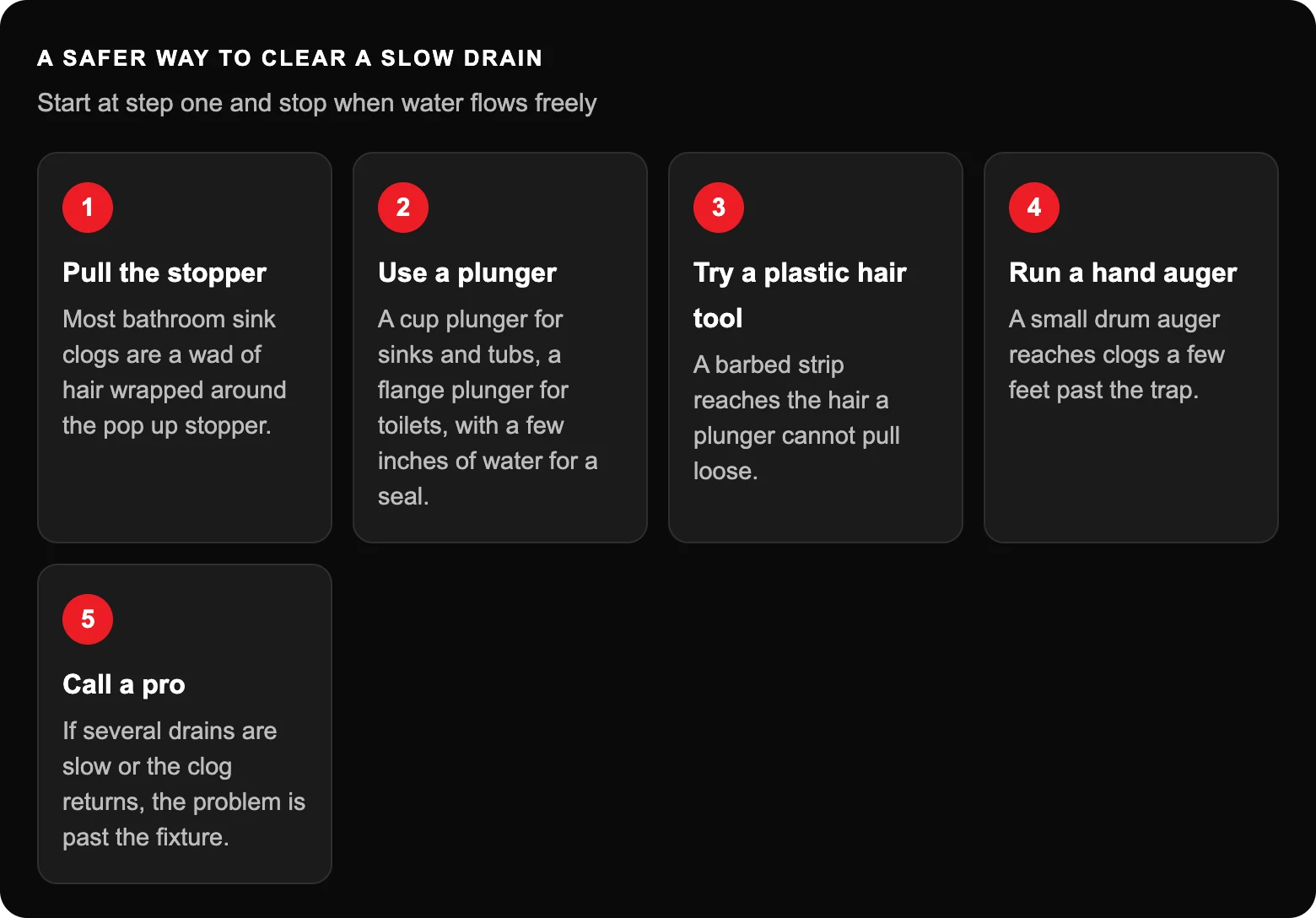
Enzyme products are a reasonable choice for monthly maintenance in a kitchen drain. They are not strong enough to clear a real blockage, and they will not touch roots or wipes.
The best drain cleaner costs nothing
Wipe grease out of pans before washing, keep a mesh strainer in every tub, and follow El Paso Water’s rule that only pee, poo and toilet paper go in the toilet.
When to skip the store and call a plumber
Call for professional drain cleaning when more than one fixture is slow, a toilet gurgles when the tub drains, or you have used a chemical and the drain is still blocked. Those point to a main line problem, and our list of signs your main sewer line is clogged can help you confirm it.
Every job we do starts with a high resolution video camera inspection and a photo report, so you see the clog and the pipe before any repair is suggested. From there, a cable machine handles most blockages, and drain hydro jetting scours away grease and scale that keep coming back. Our comparison of hydro jetting vs. snaking explains which fits which problem.
What to do next
- Stop adding chemicals if the first dose did not work.
- Write down what product you used and when, and keep the bottle for the label.
- Try a plunger or hand auger only if no chemical is sitting in the drain.
- If multiple drains are slow, call 915.858.0166 or request service.
- Ask for camera footage so you know whether the problem is a clog, roots or damaged pipe.
Questions El Paso homeowners ask about chemical drain cleaners
Do plumbers use chemical drain cleaners?
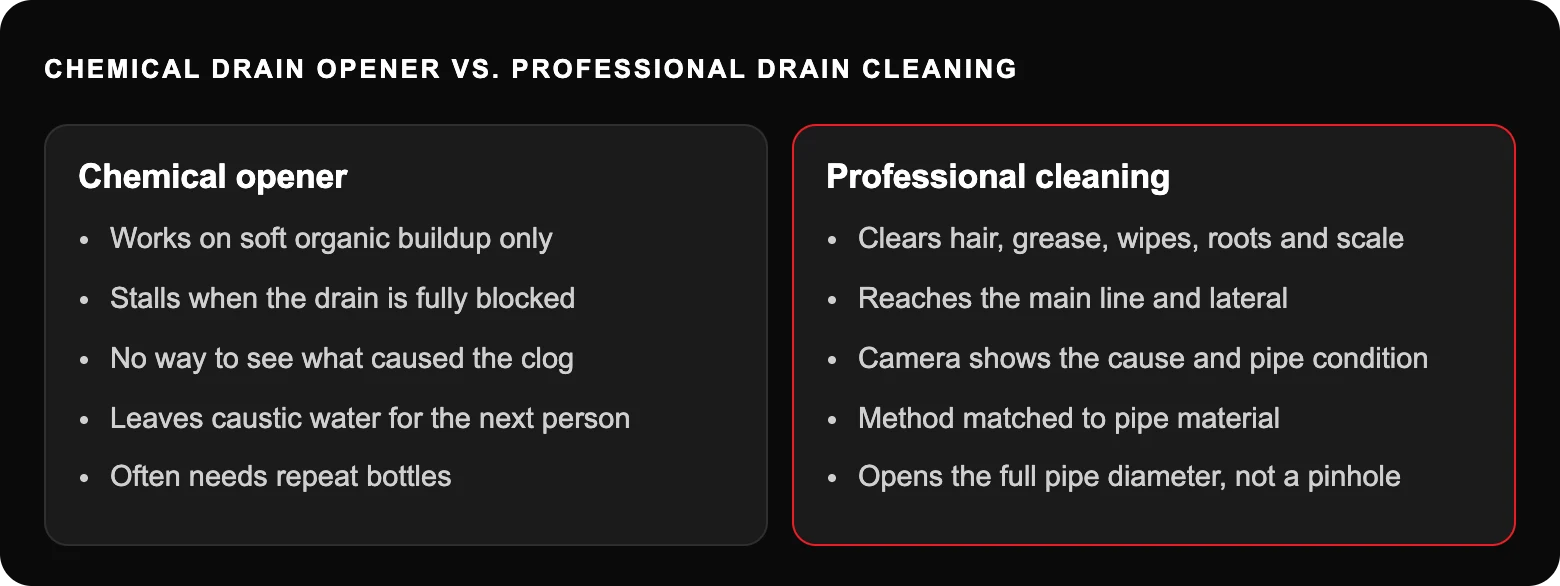
Rarely as a first choice. Plumbers prefer mechanical tools like cable machines and water jetting because they clear the full pipe and do not leave hazardous liquid behind. Enzyme treatments are sometimes suggested for maintenance after a line has been cleaned.
Is it safe to use a drain cleaner in a toilet?
Most gel and liquid clog removers are not meant for toilets, and Drano’s own FAQ says not to use its clog removers there. A flange plunger or a closet auger is the right tool for a clogged toilet.
Can chemical drain cleaners make a clog worse?
They can. Partly dissolved grease can move farther down the pipe and harden again in a spot you cannot reach. A fully blocked drain can also end up holding a sink of caustic water, which makes clearing it more dangerous.
How often is it okay to use a chemical drain opener?
If you find yourself reaching for a bottle every month, the drain has a problem a chemical will not solve. A recurring clog usually means buildup deeper in the line, a belly, roots or a damaged section that needs a camera inspection.
Is baking soda and vinegar a good alternative?
It is gentle and safe for pipes, and it can freshen a slow drain, but it does not have the strength to clear a true blockage. Treat it as mild maintenance, not a fix.
Serving El Paso, Horizon City, Socorro and Las Cruces
Talk to a family owned trenchless team with 40+ years in the trade
Tell us what is going on and we will tell you what the camera shows, what your options are, and what we would do if it were our own property. Learn more about our drain cleaning service.
Keep reading
Sources
- Drain opener poisoning, MedlinePlus, U.S. National Library of Medicine.
- How to Care for Your Septic System, U.S. Environmental Protection Agency.
- Drano Frequently Asked Questions, SC Johnson.
- Defend Your Drains, El Paso Water.