
Get our plumbing guides firstAdd U.T. Trenchless as a preferred source and see our posts more often in Google Top Stories.
Add as a preferred source on GoogleIn El Paso, the homeowner is responsible for the sewer line on their own property, from the house out to the cleanout or property line. El Paso Water owns and repairs the short section in the public right of way that connects to the city main, plus the main itself. That split comes from El Paso Water’s Rules and Regulations No. 1.
This question usually comes up at a bad moment: sewage in the tub and a repair quote in hand. Knowing where the line is drawn saves money and arguments.
Below we cover what the rules say about sewer line responsibility in El Paso, why the cleanout matters, how clogs differ from broken pipe, and what changes outside city limits.
What’s in this guide
- The short answer: your side is yours, the right of way is theirs
- What El Paso Water’s rules actually say
- Why the cleanout is the line that matters
- Clogs versus broken pipe
- Backups, damage and who pays
- If you live outside El Paso city limits
- What to do next
- Questions El Paso homeowners ask about sewer line responsibility
- Keep reading
The short answer: your side is yours, the right of way is theirs
Think of your sewer connection as two pipes joined end to end: one from your house across your lot, and one from about the property line, under the sidewalk or street, to the public main.
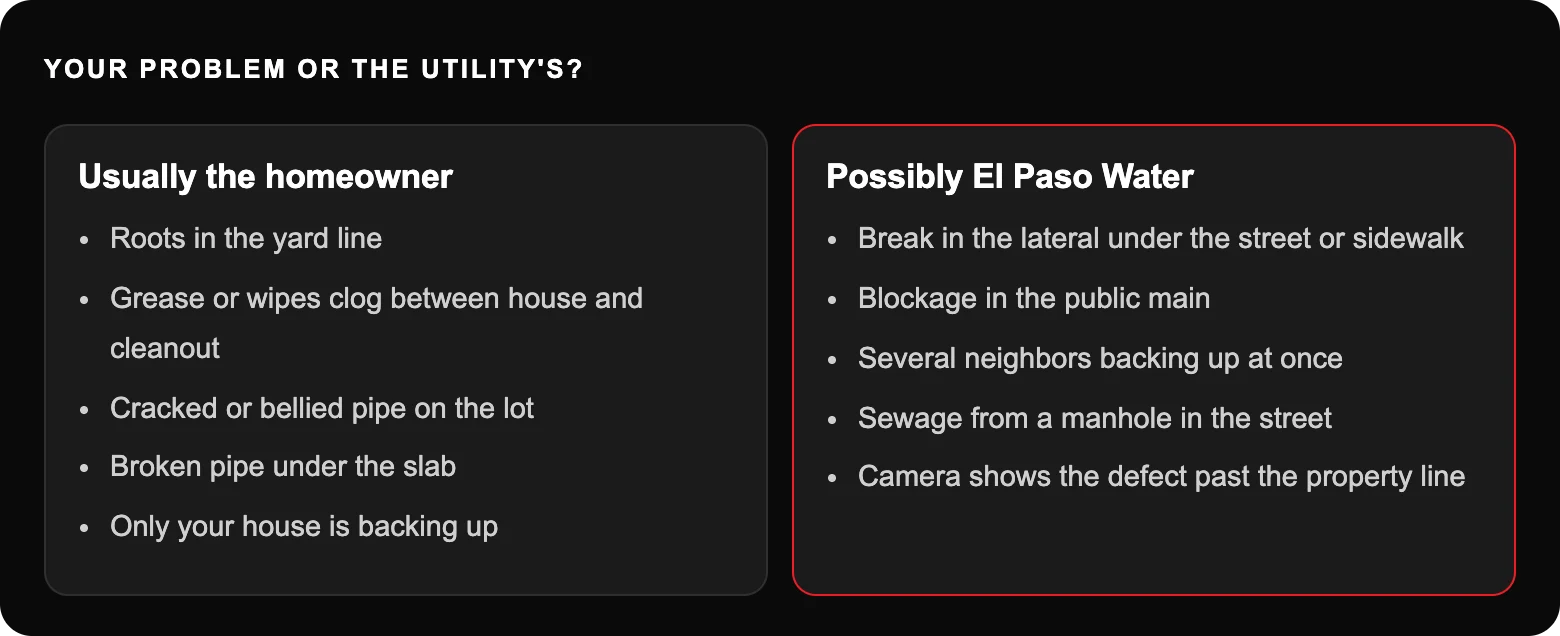
The first pipe is yours to maintain and repair. The second, along with the main, belongs to the utility. Most roots, grease clogs and cracked pipe turn up on the homeowner’s section, because it is the longer run and sits under yards and trees.
What El Paso Water’s rules actually say
Rules and Regulations No. 1, which covers water and sewer service inside El Paso city limits, defines two separate pieces of pipe.
The utility’s piece, called the Sewer Service Lateral EPWU, is the pipe and fittings connected to the utility’s collector line and running within the public right of way “up to the clean out or property line.” The customer’s piece, the Sewer Service Lateral Customer, is the pipe and fittings within the property that connect to it.
Section VIII.A.2 states that ownership of the utility’s lateral in the public right of way remains with El Paso Water and that “The Utility is responsible for the repair” of that section. The utility’s customer rights and responsibilities page adds that the customer is responsible for maintaining the customer’s lines “in good, serviceable and safe condition.”
| Section of pipe | Owner | Who repairs | Rule reference |
|---|---|---|---|
| Building drain and pipe under the slab | Property owner | Property owner | Private plumbing |
| Yard line from house to cleanout or property line | Property owner | Property owner | Sewer Service Lateral Customer, Section I.B |
| Lateral in the public right of way to the main | El Paso Water | El Paso Water | Sewer Service Lateral EPWU, Section VIII.A.2 |
| Sewer main and manholes | El Paso Water | El Paso Water | Utility collection system |
| New connection, installation cost | Customer pays | Tap installed or inspected by utility staff | Section VII.C.3 |
Installation is a different question
For a new connection, Section VII.C.3 puts the furnishing, cost and installation of both laterals, from the tap at the main into the property, on the customer. Once in service, repair of the right of way section falls to the utility.
Why the cleanout is the line that matters
The rule text draws the boundary at “the clean out or property line.” In practice, the cleanout is the easiest place to tell whose problem you have. It is a capped pipe rising from the sewer line, often near the front of the lot, and it gives a plumber direct access to both directions of pipe.
When the cleanout is found, a video camera inspection from that point shows whether a blockage or break sits upstream toward your house or downstream toward the street. That footage is what El Paso Water will want to see if you believe the problem is theirs.
Many older central and east El Paso homes have no accessible cleanout, or one buried under landscaping. Pipe locating and mapping can trace the line, and adding a cleanout makes every future cleaning faster and cheaper.
Clogs versus broken pipe
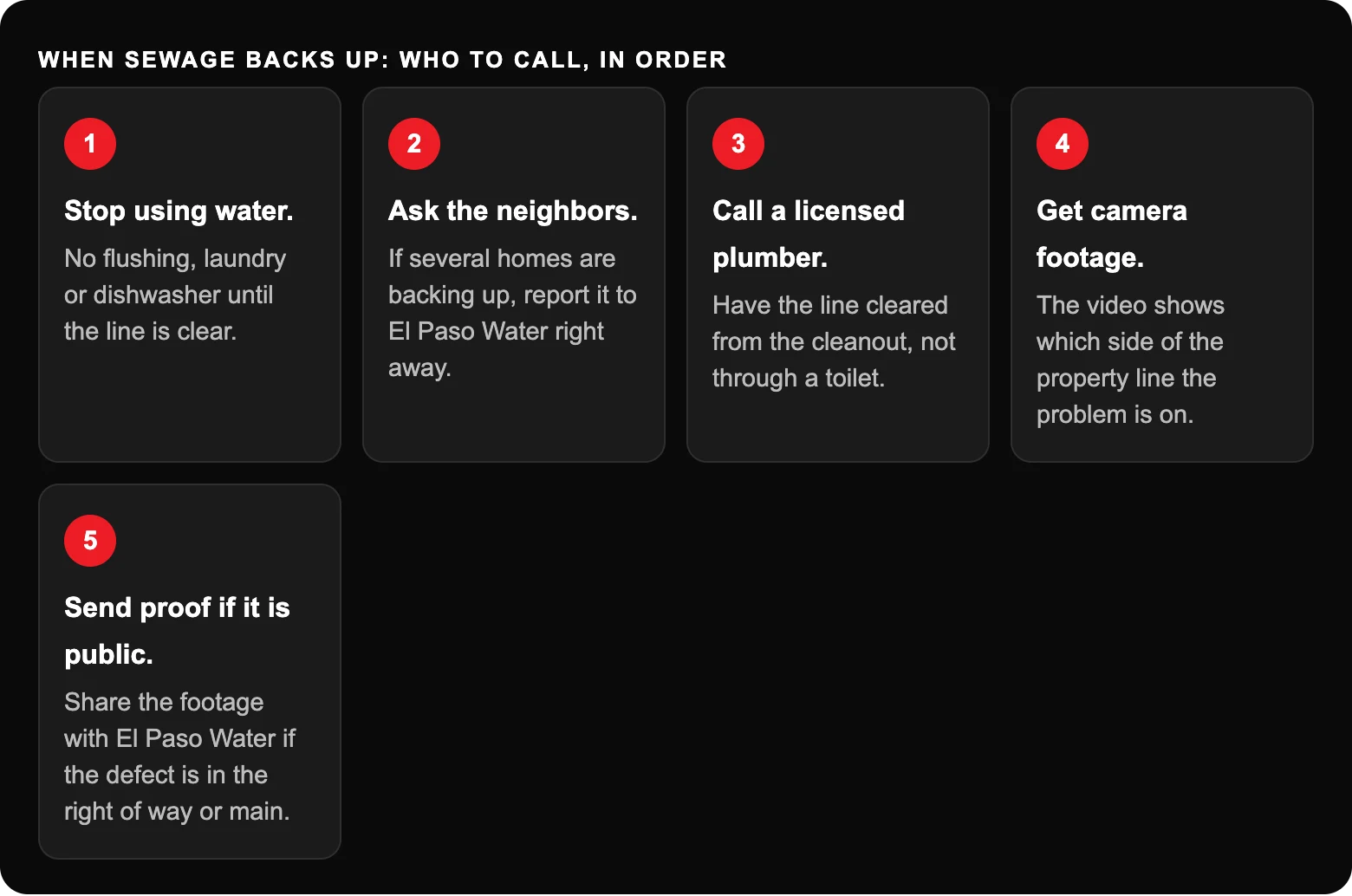
The rules are explicit about ownership and repair of the utility’s section, but they do not spell out a separate procedure for clearing a stoppage. So the practical sequence in El Paso is simple: a homeowner with a backup calls a plumber, the plumber clears the line from the cleanout, and a camera shows where the trouble was.
If the blockage or defect is on your side, the cost is yours. If the footage shows a break or obstruction beyond the property line, or in the main, contact El Paso Water customer service at 915.594.5500 with the video and photos. Having documentation makes that conversation much shorter.
If neighbors report backups the same day, the main may be blocked and the utility should hear about it quickly. For symptoms of a private clog, see signs your main sewer line is clogged.
Sewer Cleaning in El Paso
Want a straight answer about your pipes?
Every U.T. Trenchless job starts with a camera inspection and a photo report, so you see the problem before you decide on a fix. Licensed Master Plumber Ubaldo Torres leads the work.
Backups, damage and who pays
The same rule addresses sewage backups directly. Section VII.E says customers whose drain or fixture outlets sit lower than the top of the nearest downstream sewer manhole must protect their property with backflow or other devices. Customers who do not install them “accept responsibility for any damages caused by a sewage backup.”
A backwater valve on the building sewer lets wastewater leave but closes if the main surcharges. If your lowest drains sit near street level, ask a plumber whether you need one.
Insurance is the other half. The Texas Department of Insurance lists backup of sewers or drains as an endorsement, not a standard feature, so a basic homeowners policy may not pay for cleanup. We cover repair coverage in whether pipe relining is covered by insurance in Texas.
If you live outside El Paso city limits
Rules and Regulations No. 1 covers service inside city limits. El Paso Water has a separate rule, No. 11, for service outside corporate limits, and many homes in Horizon City, Socorro and San Elizario are served by other water and sewer districts. Las Cruces has its own city utility.
The exact boundary and paperwork can differ, so check your provider’s current rules on the El Paso Water rules and regulations page or your district’s website before assuming anything.
What to do next
- Find your cleanout and make sure it is accessible.
- If sewage is backing up, stop using water and check whether neighbors are affected.
- Have a licensed plumber clear the line and record camera footage.
- Report problems in the right of way or main to El Paso Water with that footage.
- Review your insurance for a sewer backup endorsement.
- Buying a home? The private lateral comes with it, so read why a sewer scope before buying in El Paso is worth it.
- For sewer cleaning or inspection on your side of the line, request service or call 915.858.0166.
Questions El Paso homeowners ask about sewer line responsibility
Does the city pay if tree roots from a street tree get into my sewer line?
The rules assign responsibility by where the pipe is, not where the roots came from. Roots in the lateral on your property are generally yours to clear; roots or a break under the right of way should go to the utility with footage.
Who pays to replace a sewer line from the house to the street?
The homeowner pays for the portion on private property. Under Section VIII.A.2 of Rules and Regulations No. 1, El Paso Water is responsible for repairing the lateral in the public right of way. Contractors should coordinate with the utility before touching anything past the property line.
What if my house has no cleanout?
The rules then point to the property line as the boundary. Without a cleanout, a plumber must work through a roof vent or toilet, so installing an exterior cleanout is a worthwhile upgrade.
Do I need a permit to repair my private sewer line in El Paso?
Sewer pipe repair is plumbing work that typically calls for a permit and inspection. Confirm requirements for your job with the City of El Paso and your licensed plumber before work begins.
Will Texas 811 mark my private sewer line?
Usually not. Utility locators mark public lines, and a private lateral on your lot is typically your responsibility to locate. Our article on Texas 811 and private sewer lines explains the details.
Serving El Paso, Horizon City, Socorro and Las Cruces
Talk to a family owned trenchless team with 40+ years in the trade
Tell us what is going on and we will tell you what the camera shows, what your options are, and what we would do if it were our own property. Learn more about our sewer cleaning service.
Keep reading
Sources
- Rules and Regulations No. 1, Water and Sewer Service Within Corporate Limits, El Paso Water.
- Customer Rights and Responsibilities, El Paso Water.
- Rules and Regulations, El Paso Water.
- Home Insurance Guide, Texas Department of Insurance.