Get our plumbing guides firstAdd U.T. Trenchless as a preferred source and see our posts more often in Google Top Stories.
Add as a preferred source on GoogleYes, in most cases. CIPP lining can fix old cast iron pipes in sewer lines that are cracked, corroded or leaking, as long as the pipe still holds its shape and is fully descaled first. Cast iron pipe lining in El Paso fails when crews skip the descaling or line over collapsed sections, sags or badly shifted joints.
Cast iron was the standard drain and sewer pipe for much of the last century, and a lot of it is still working under older El Paso homes and commercial buildings. Much of it is now reaching the end of its expected life.
This guide explains how cast iron fails, why preparation decides whether a liner succeeds, when cast iron is too far gone to line, and what the pipe industry’s critics say about lining so you can weigh both sides.
What’s in this guide
The short answer: yes, if the prep is right
Cast iron is one of the most common pipes we line. Its failures, such as corrosion, cracking and leaking joints, are exactly the problems a jointless resin liner solves. The liner is designed to carry loads on its own, so it does not need the old iron to stay strong.
What cast iron demands is preparation. Decades of corrosion leave a rough, lumpy interior that a liner cannot conform to until it is ground back to the pipe wall. Skip that step and the liner inherits every bump.
How old cast iron pipes fail
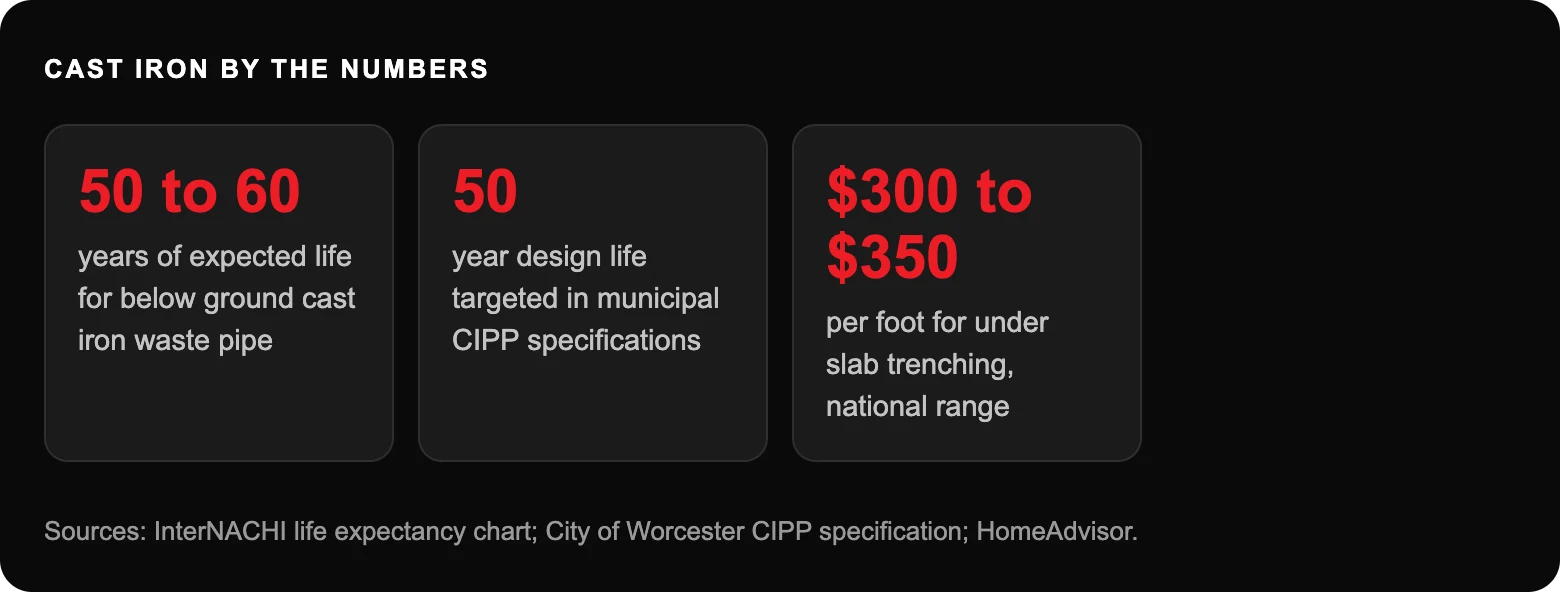
The InterNACHI life expectancy chart lists below ground cast iron waste pipe at 50 to 60 years. Plenty of homes built before the 1970s are past that window.
Scale and tuberculation
As iron corrodes, it forms hard mounds of rust and scale on the inside wall. These narrow the pipe, catch paper and grease, and cause repeat clogs that snaking only clears for a while.
Channel rot and cracks
Wastewater sits along the bottom of the pipe, so the bottom often wears thin first, a pattern plumbers call channel rot. Lengthwise cracks, pinholes and failed joints follow. Roots then find those openings, especially in yards with thirsty trees.
Why descaling comes first
A liner takes the shape of whatever it is pressed against. If scale mounds are left in place, the finished liner has the same lumps, which can snag waste and create thin spots in the resin wall.
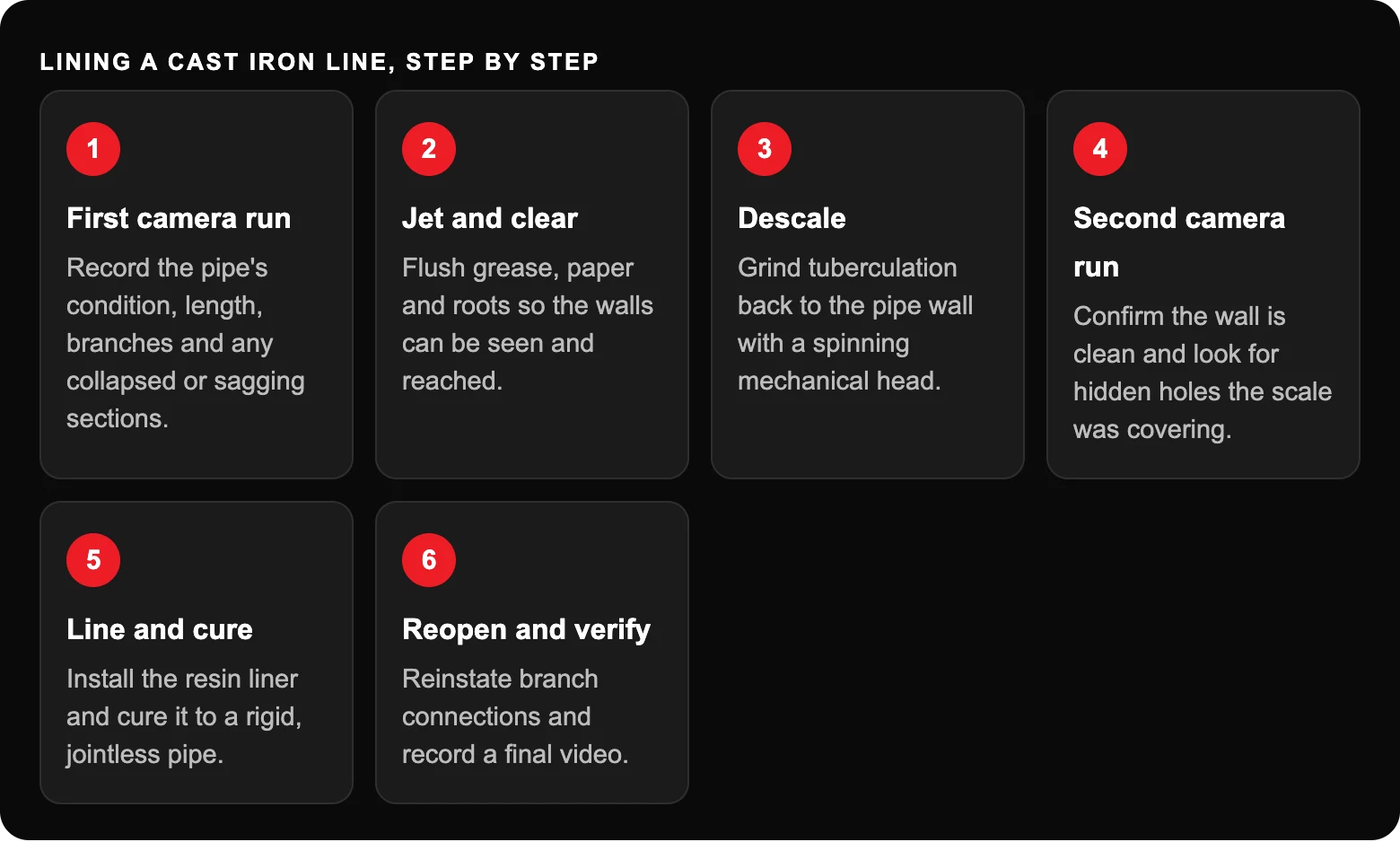
A trade guide in Cleaner magazine notes that cast iron takes longer to prepare than other materials: jet out debris first, then use a mechanical spinning head to descale the walls. That matches how we approach it with pipe descaling before any liner goes in.
Descaling can reveal surprises
Sometimes scale is the only thing sealing a rotted section. When descaling uncovers a hole, that is useful information: the liner will span it, and if the damage is too severe, you learn it before lining rather than after.
CIPP Pipe Repair in El Paso
Want a straight answer about your pipes?
Every U.T. Trenchless job starts with a camera inspection and a photo report, so you see the problem before you decide on a fix. Licensed Master Plumber Ubaldo Torres leads the work.
When cast iron cannot be lined
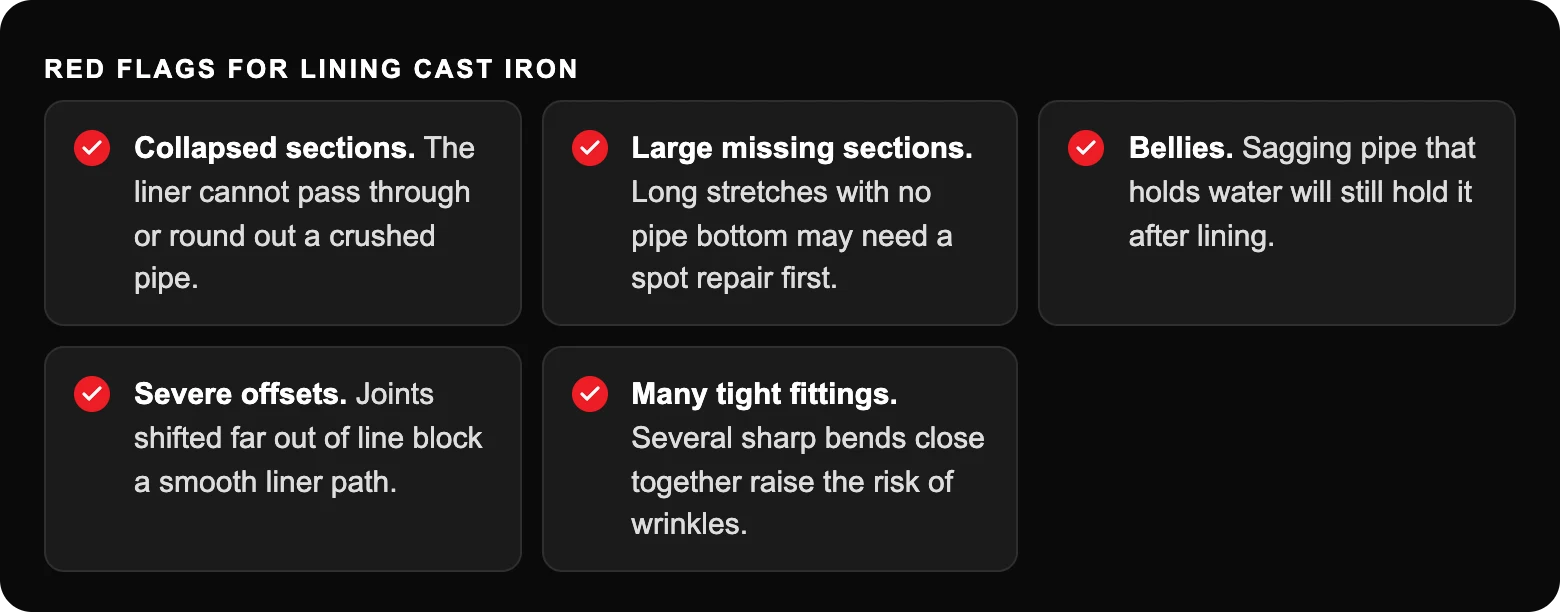
Some cast iron is simply too far gone. These are the conditions that push us toward replacing the pipe instead.
When lining is off the table, pipe bursting can often replace the line without a full trench. Our comparison of CIPP lining vs. pipe replacement covers how to decide.
What lining critics say, and our view
Not everyone favors lining cast iron. Charlotte Pipe, which manufactures cast iron pipe, recommends replacing damaged cast iron rather than lining it. It points to reduced inside diameter, wrinkling at bends, cleaning limits and chemical emissions during curing.
Some of those concerns are fair, and they are exactly why prep and inspection matter. A liner does take up some diameter, bends do need the right liner material, and cleaning a lined pipe calls for equipment suited to it. Emissions have been studied by Purdue University’s CIPP Solutions Group, so ask any installer which resin they use and how they ventilate.
Where we differ is the conclusion. For a buried sewer lateral or a line under a slab, replacement often means tearing up floors or driveways. Lining engineered under ASTM F1216 gives a new structural pipe without that damage. The right answer depends on what the camera shows.
Cast iron pipe lining in El Paso homes and buildings
Older central and east El Paso neighborhoods often still drain through original cast iron, sometimes under slab floors. Opening a slab is costly: HomeAdvisor puts under slab trenching at $300 to $350 per foot, before flooring and finishes.
| Factor | CIPP lining | Replacement |
|---|---|---|
| Access needed | Cleanouts or small pits | Trench, slab cut or bursting pits |
| Prep required | Full descaling and camera check | Excavation and removal |
| Fixes corrosion and cracks | Yes | Yes |
| Fixes sags and collapses | No | Yes |
| National cost range | $90 to $250 per foot | $50 to $250 per foot, plus restoration |
For properties in El Paso, Horizon City, Socorro or Las Cruces, our CIPP pipe repair work starts with a camera inspection and a photo report, so you see the pipe’s condition before any recommendation. For how long a finished liner lasts, see what CIPP lining is and how long it lasts.
What to do next
- Have the cast iron line inspected by camera and keep the video and photo report.
- Look for collapses, bellies and offsets, which rule lining out for that section.
- Ask exactly how the pipe will be descaled and whether a second camera run follows.
- Ask which resin and liner will be used, especially through bends.
- Contact us or call 915.858.0166 to review the footage with a licensed plumber.
Questions El Paso homeowners ask about lining cast iron
Can cast iron under a slab be lined?
Often, yes. If the line can be reached through a cleanout and still holds its shape, it can usually be descaled and lined without breaking the floor. Collapsed or badly sagging sections under a slab may still need a targeted repair.
Should I replace cast iron before selling my house?
Not automatically. A camera inspection shows whether the line is sound, needs lining, or needs replacement. Buyers and inspectors increasingly ask for sewer scopes, so documented condition helps either way.
Can a pipe with a hole in the bottom be lined?
Usually, if the hole is limited and the pipe keeps its overall shape. A structural liner is designed to stand on its own and can span missing sections of modest size. Long stretches with no bottom may need a spot repair first.
Is descaling alone enough to fix cast iron?
Descaling restores flow by removing buildup, but it does not seal cracks or holes. For pipe that is still solid, descaling may be enough for now. For pipe that is cracked or thin, lining after descaling adds a new structural wall.
How do I know if my sewer pipe is cast iron?
Homes built before about the 1970s often have cast iron drains. Look where the main drain exits the house or at a cleanout: cast iron is dark, heavy and often rusty. A camera inspection confirms the material underground.
Serving El Paso, Horizon City, Socorro and Las Cruces
Talk to a family owned trenchless team with 40+ years in the trade
Tell us what is going on and we will tell you what the camera shows, what your options are, and what we would do if it were our own property. Learn more about our cipp pipe repair service.
Keep reading
Sources
- Standard Estimated Life Expectancy Chart for Homes, InterNACHI.
- A How To Guide on Pipe Cleaning Before CIPP Rehabilitation, Cleaner.
- Examining the Consequences of Cured in Place Pipe Lining, Charlotte Pipe and Foundry.
- CIPP Solutions Group, Purdue University.
- ASTM F1216 standard practice for CIPP, ASTM International.
- How Much Does It Cost to Replace or Repair a Sewer Line?, HomeAdvisor.
- What Does Sewer Line Replacement Cost?, Angi.
- CIPP Sewer Line Repairs Specification, City of Worcester, Massachusetts.