Get our plumbing guides firstAdd U.T. Trenchless as a preferred source and see our posts more often in Google Top Stories.
Add as a preferred source on GoogleChoose CIPP lining when the old sewer line still holds its shape and slope but leaks, cracks or lets in roots. Choose replacement when the pipe has collapsed, sags, or is badly offset. For CIPP lining vs pipe replacement in El Paso, a camera inspection decides it, and national per foot costs for the two land in similar ranges.
Most property owners come to this decision after a backup, a failed sewer scope during a home sale, or a plumber’s recommendation that sounds expensive either way. The good news is that the choice is less of a coin flip than it feels.
Below we compare the two approaches on condition, cost, disruption and lifespan, then look at the El Paso factors that tip the balance: driveways and slabs, caliche, older cast iron laterals, and commercial downtime.
What’s in this guide
The short answer: the pipe’s shape decides
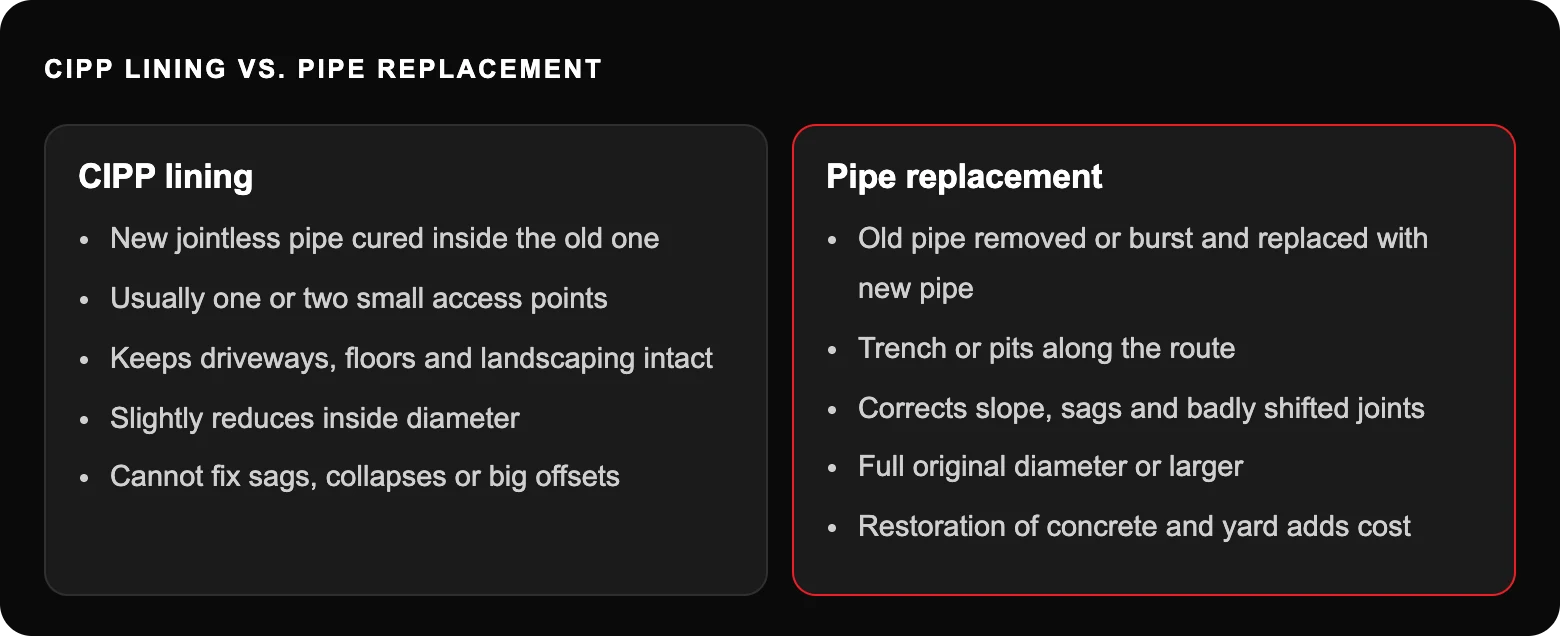
Lining builds a new pipe inside the old one, so it needs a host pipe that is still round, continuous and sloped correctly. If the camera shows cracks, pinholes, root intrusion at joints or corrosion without major deformation, lining is usually the stronger value.
If the camera shows a crushed section, a belly holding standing water, or joints shifted far out of line, a liner will simply copy those defects. That calls for replacing the pipe, either by digging or by pipe bursting, which pulls a new pipe through the path of the old one.
What each option costs
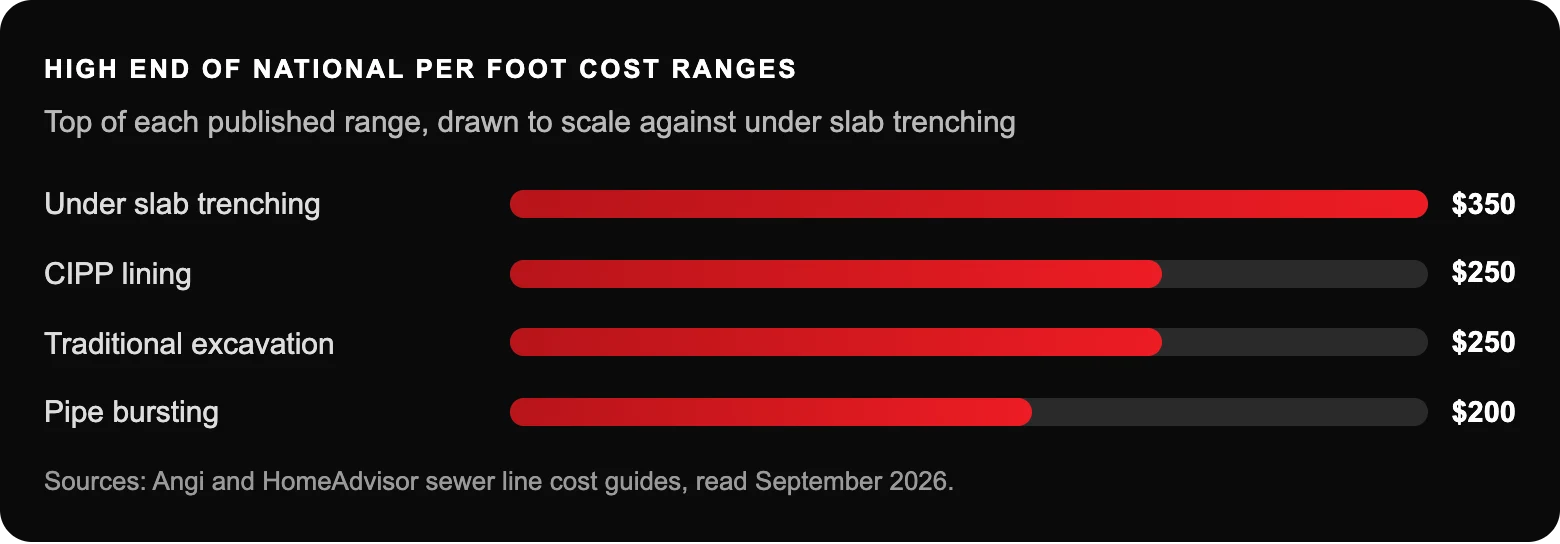
People expect trenchless work to cost more. Per foot, the national figures overlap. Angi lists CIPP lining at $90 to $250 per linear foot, pipe bursting at $60 to $200, and traditional excavation at $50 to $250, with an average sewer line project around $3,319.
The gap opens up when you add what digging destroys. HomeServe puts landscaping restoration at $4 to $12 per square foot and driveway repair anywhere from $100 to over $3,000. When the pipe runs under a slab, HomeAdvisor lists under slab trenching at $300 to $350 per foot.
| Method | Typical national range | Restoration on top? |
|---|---|---|
| CIPP lining | $90 to $250 per foot | Minimal, access points only |
| Pipe bursting | $60 to $200 per foot | Small entry and exit pits |
| Traditional excavation | $50 to $250 per foot | Yard, driveway or sidewalk |
| Under slab trenching | $300 to $350 per foot | Concrete floor and finishes |
| Video sewer inspection | $100 to $500 | None |
These are national figures, not our prices. Actual El Paso pricing depends on what the camera finds: pipe length, depth, diameter, number of branch connections and how much cleaning or descaling the line needs first.
When lining is the better choice
Lining shines when the pipe is structurally present but failing as a seal. Typical examples are hairline cracks, joints leaking or letting in roots, and cast iron that has corroded but not crushed. A liner seals the whole run at once, so you are not chasing the next bad joint in a few years.
It is also the clear choice when the line runs under something expensive to break: a finished basement, a slab foundation, a mature tree, a stamped driveway, or a business floor that cannot close. Our guide on how long CIPP lining lasts explains why a good liner carries a 50 year design life.
Line the whole problem, not just the worst spot
If the camera shows several weak joints, lining the full run usually costs less over time than repeated spot repairs. Ask to see where each defect sits on the video before choosing a length.
CIPP Pipe Repair in El Paso
Want a straight answer about your pipes?
Every U.T. Trenchless job starts with a camera inspection and a photo report, so you see the problem before you decide on a fix. Licensed Master Plumber Ubaldo Torres leads the work.
When replacement is the better choice
We will tell you plainly when a liner is the wrong tool. These conditions point toward replacing the pipe, whether by bursting or by digging.
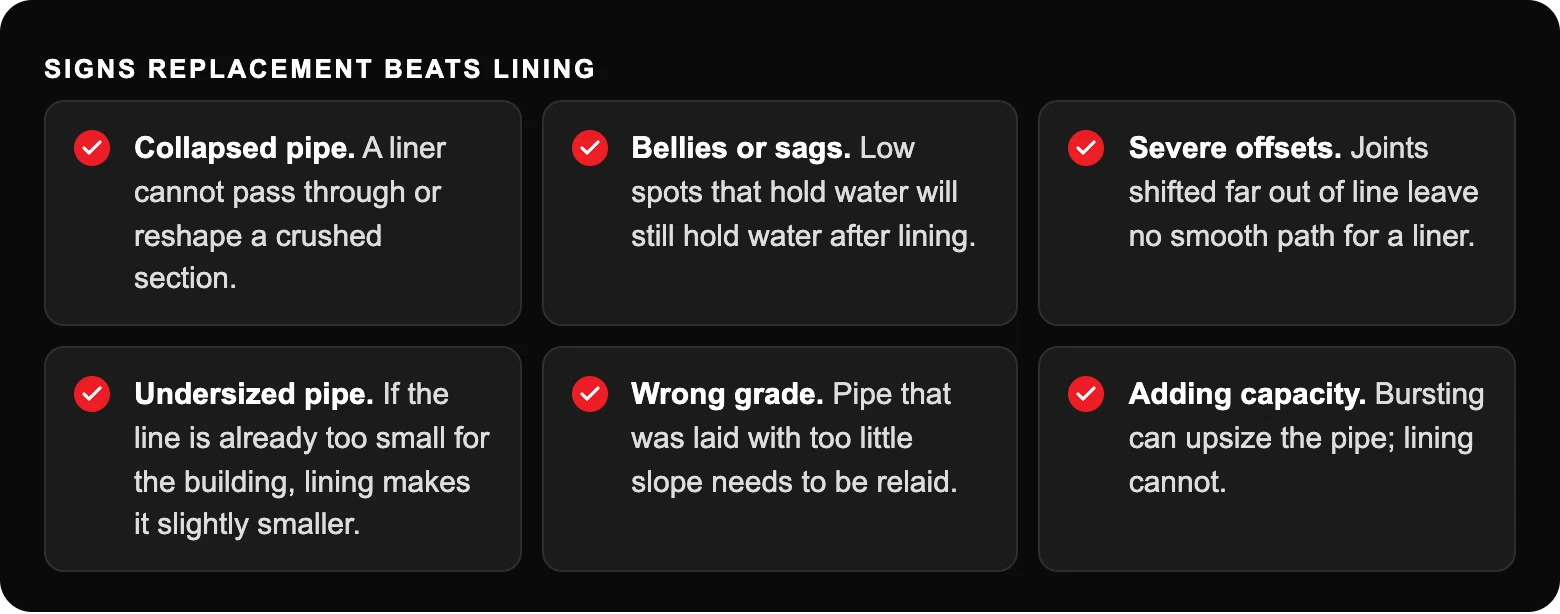
Replacement by digging also makes sense when the line is short, shallow and under open dirt with nothing to restore. In that case the extra cost of trenchless equipment may not buy you much.
CIPP lining vs. pipe replacement for El Paso properties
Local conditions push many El Paso jobs toward trenchless. Hard caliche layers make trenching slow and costly, and many homes have sewer laterals running beneath concrete driveways, patios or slab floors.
Older central and east El Paso neighborhoods often have original cast iron or clay laterals. Cast iron frequently qualifies for lining after thorough descaling, as our article on lining old cast iron sewer pipes explains. Clay with root filled joints is often a good lining candidate too, once roots are cut.
Two rules apply whichever way you go. El Paso Water makes the property owner responsible for the sewer service line from the tap at the main into the property. And if digging is involved, Texas811 says state law requires contacting 811 at least two business days before excavating.
For commercial properties
For restaurants, retail and multifamily buildings, downtime often outweighs the repair itself. Lining through existing cleanouts can keep parking lots, storefronts and interior floors open. Our CIPP pipe repair team plans access around business hours so you know when drains will be offline.
Check who is doing the work
Sewer repair in Texas should be done by licensed plumbers. You can verify a license through the Texas State Board of Plumbing Examiners before approving any quote.
What to do next
- Schedule a video camera inspection and ask for the full recording and a photo report.
- Look at the footage for collapses, sags and offsets, the three defects lining cannot fix.
- Note what sits above the pipe: driveway, slab, trees, landscaping or a business entrance.
- Ask for lining and replacement options priced for the same length so you compare fairly.
- Contact us or call 915.858.0166 to go over the video with the people who will do the work.
Questions El Paso property owners ask about lining vs. replacement
Is pipe lining cheaper than replacing a sewer line?
Per foot, national ranges for lining and digging overlap. Lining usually wins on total cost when the pipe runs under concrete, landscaping or a building, because there is little to restore. Digging can be cheaper for a short, shallow run under open ground.
Can you line a pipe that has a belly in it?
Not effectively. A liner follows the shape of the existing pipe, so a sag that holds water and waste will still hold it afterward. A mild dip may be acceptable; a significant belly usually needs that section replaced first.
Does lining reduce the size of my pipe?
Yes, slightly, because the liner wall takes up room. For most household laterals the loss is small, and the smooth jointless wall can help flow. It matters more on pipes that were already undersized.
Is lining just a temporary fix?
No. A properly designed liner is structural and engineered for a 50 year design life under ASTM F1216 based specifications. Problems come from poor cleaning or installation, not from lining being temporary.
Is pipe bursting better than pipe lining?
Neither is better everywhere. Bursting replaces the pipe and can fix sags or upsize the line, but needs entry and exit pits. Lining needs less access and suits pipes that still hold their shape. See our comparison of pipe bursting vs. pipe lining for details.
Serving El Paso, Horizon City, Socorro and Las Cruces
Talk to a family owned trenchless team with 40+ years in the trade
Tell us what is going on and we will tell you what the camera shows, what your options are, and what we would do if it were our own property. Learn more about our cipp pipe repair service.
Keep reading
Sources
- What Does Sewer Line Replacement Cost?, Angi.
- How Much Does It Cost to Replace or Repair a Sewer Line?, HomeAdvisor.
- How Much Does Trenchless Sewer Line Repair Cost?, HomeServe.
- Customer Rights and Responsibilities, El Paso Water.
- Texas811 Facility Notification Center, Texas811.
- Texas State Board of Plumbing Examiners, State of Texas.