
Get our plumbing guides firstAdd U.T. Trenchless as a preferred source and see our posts more often in Google Top Stories.
Add as a preferred source on GoogleCommercial properties should finish storm drain maintenance before El Paso monsoon season opens on June 15. That means inspecting and cleaning every catch basin, inlet grate, trench drain and underground line in April or May, confirming that outlets and onsite ponds actually drain, and setting a routine to check the system after every heavy storm through September 30.
Monsoon storms in El Paso do not build slowly. A cell can drop more rain in an hour than a typical month brings, and a parking lot drain half full of sand cannot take it. The overflow finds storefronts, loading docks and elevator pits.
This guide is for owners, HOA boards and facility managers responsible for drainage on their own parcels: what the season brings, what fails, a prep timeline, and when cleaning is not enough.
What’s in this guide
- The short answer: finish the work before June 15
- Why El Paso monsoon season is hard on commercial drainage
- What actually fails in a commercial drain system
- Storm drain maintenance before El Paso monsoon season: a timeline
- Checks to run during the season
- When cleaning is not enough
- What to do next
- Questions property managers ask about monsoon storm drain prep
- Keep reading
The short answer: finish the work before June 15
NWS El Paso defines monsoon season as June 15 to September 30, so the cleaning belongs on the calendar in spring, not after the first flood.
A complete preparation has four parts: clear debris from sumps and trench drains, flush the connecting lines, verify outlets and ponds, and document the condition of everything. Our storm drain cleaning and maintenance service follows that same order, starting with a camera look at the lines before anything is recommended.
Why El Paso monsoon season is hard on commercial drainage
According to long term averages from NWS El Paso, June through September bring about 5.3 inches of the city’s roughly 8.7 inch annual rainfall. That is around 60 percent of the year’s rain in four months, much of it in short, intense bursts.
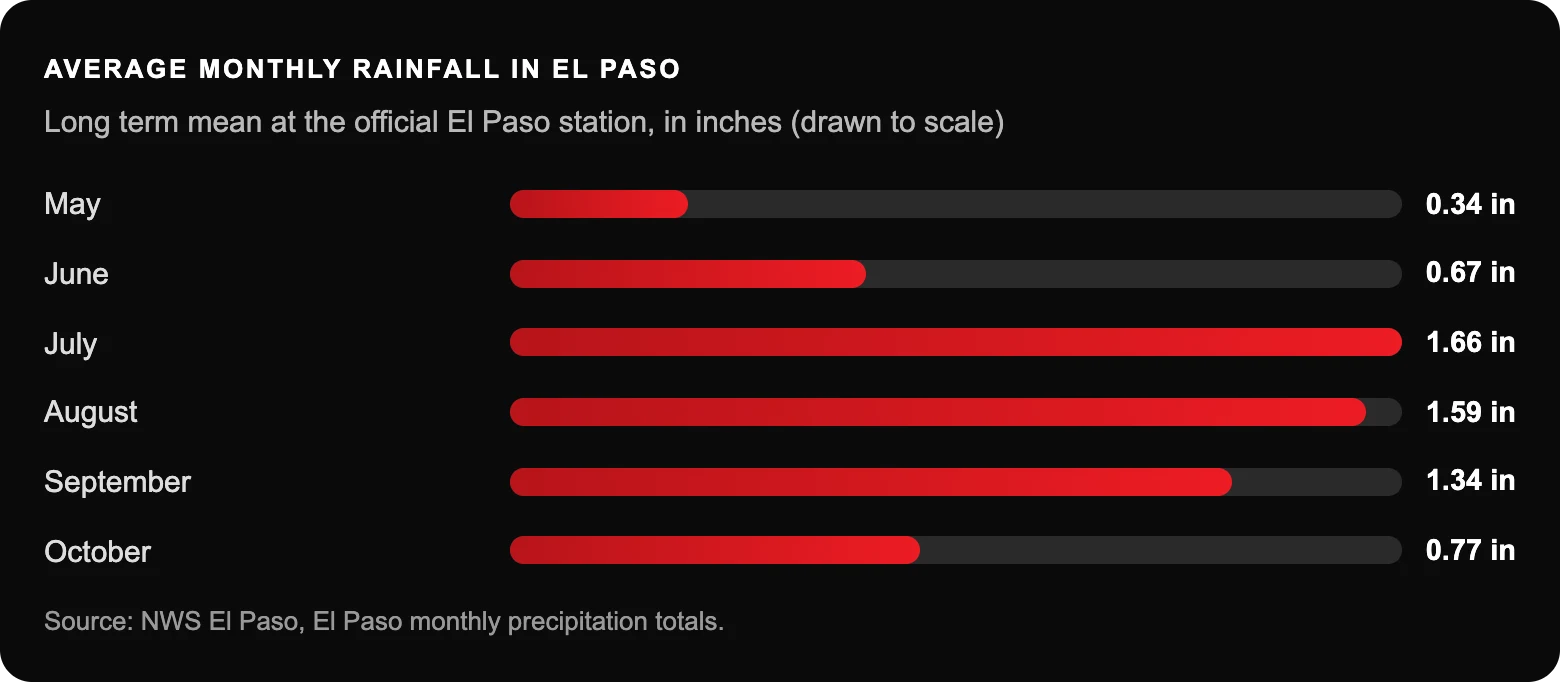
Averages hide the danger. The wettest season on record, 2006, brought 15.28 inches, while 1994 produced only 0.23 inches. A year that looks dry until August can still deliver a storm that overwhelms every clogged inlet on your lot.
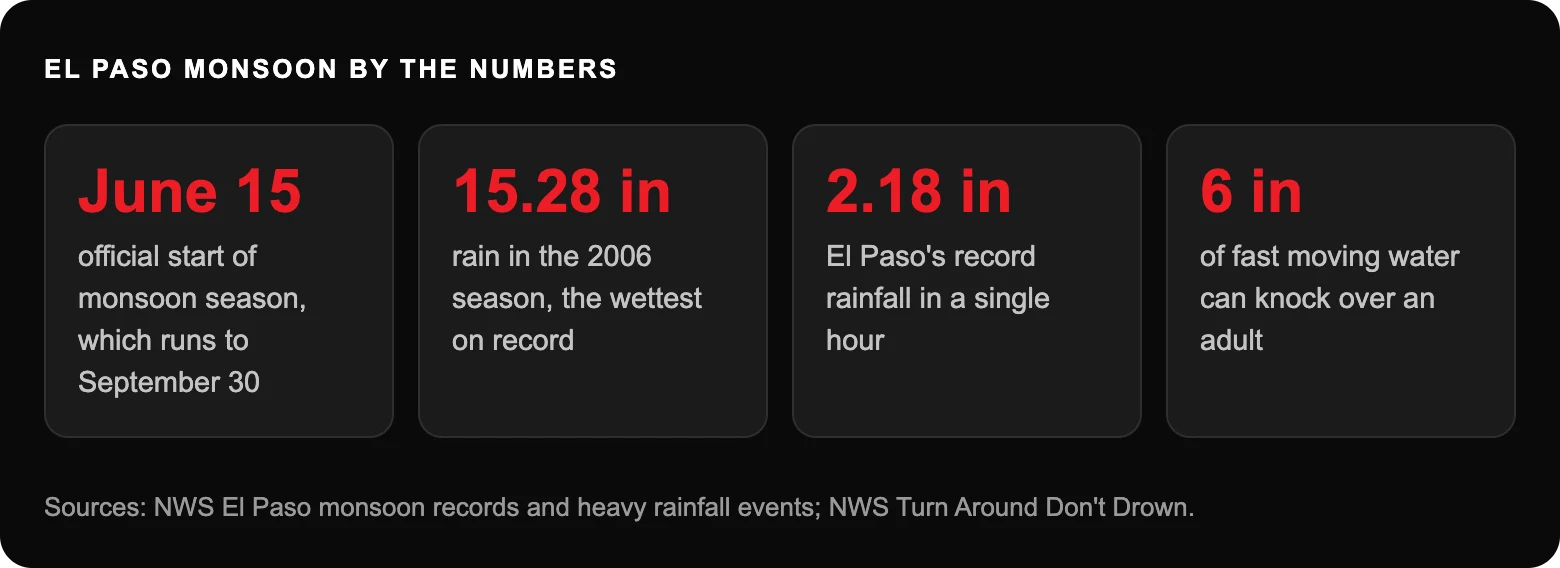
There is a local twist too. Months of wind move sand, caliche dust and landscape gravel onto pavement, and the first real storm washes it all toward the drains at once. The NWS El Paso monsoon records show the scale of what the season can bring.
What actually fails in a commercial drain system
Most monsoon flooding on commercial property is a maintenance failure at one of a few predictable points.
| Component | What clogs or breaks it | What to check before June |
|---|---|---|
| Catch basin sump | Sand, gravel, trash and oily sediment settling below the outlet | Depth of material in the sump compared with the outlet pipe |
| Inlet grate | Leaves, plastic bags, cups and tumbleweeds matting on top | Open area of the grate and whether it sits flush |
| Trench drain | Fine grit packing the channel, broken grates | Full length of the channel and its outlet box |
| Connecting pipe | Sediment bars, root intrusion at joints, cracked or offset sections | Camera inspection end to end |
| Onsite pond | Silt buildup, weeds, blocked outfall structure | Bottom condition and whether it drains between storms |
The EPA warns that drains not routinely cleaned “can accumulate large amounts of debris and pollutants, which can lead to clogging, flooding and water quality problems.” A grate can look clear while the sump beneath it is nearly full.
Storm drain maintenance before El Paso monsoon season: a timeline
Properties that stay dry usually follow a simple calendar: survey and clean in spring, check after storms in summer, repair in fall.
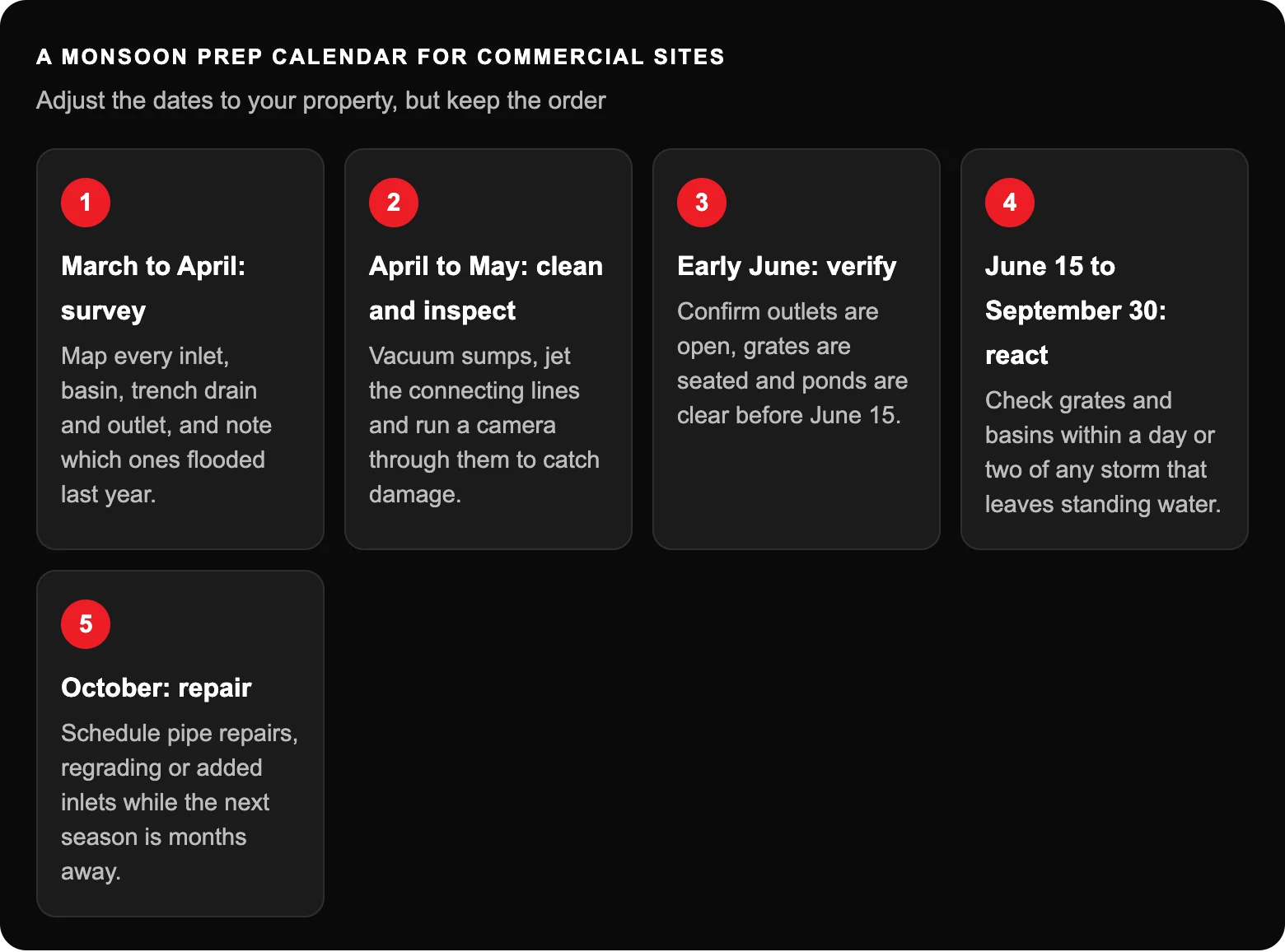
If you do not know where all of your drains go, start there. Older El Paso sites that were repaved or expanded often have buried lines with no drawings.
Routine frequency depends on traffic and site use, covered in our guide on how often parking lot catch basins should be cleaned. For monsoon prep, every basin gets cleaned or verified clean before the season.
Storm Drain Cleaning and Maintenance in El Paso
Want a straight answer about your pipes?
Every U.T. Trenchless job starts with a camera inspection and a photo report, so you see the problem before you decide on a fix. Licensed Master Plumber Ubaldo Torres leads the work.
Checks to run during the season
Every storm spends some of the capacity you bought. One cell can wash enough sediment off a neighboring dirt lot to refill a sump, so assign staff to walk the drainage after storms.
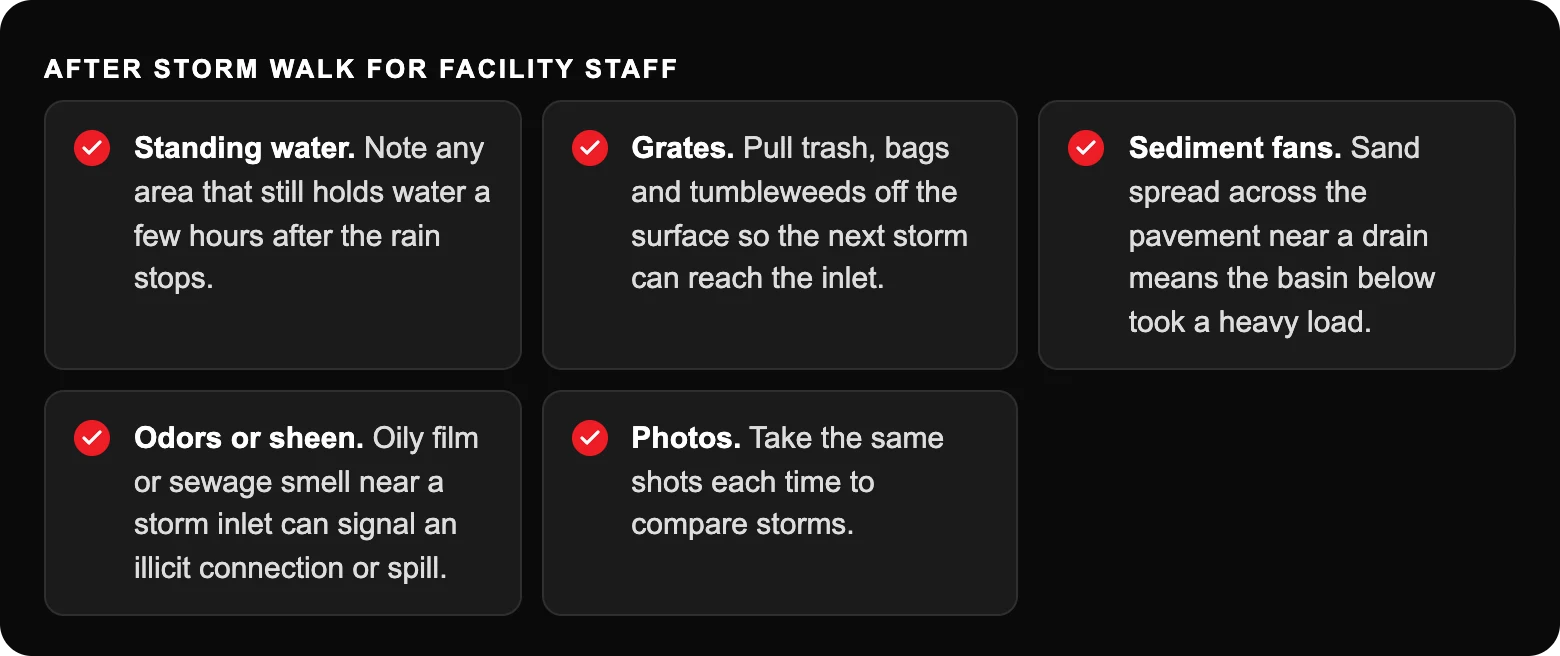
Never enter a flooded area
Wait until water recedes before inspecting. The National Weather Service warns that 12 inches of rushing water can carry away most cars, and a lifted grate under flood water is an invisible hole. Our guide on what counts as a plumbing emergency covers what to do while you wait for help.
A drain that backs up after a spring cleaning usually points to a damaged pipe, an undersized line, or water arriving from off site.
When cleaning is not enough
A thorough cleaning restores the capacity a drain was designed with. It cannot fix a pipe that has cracked, separated at a joint or filled with roots. That is why our process starts with a high resolution video camera inspection and a photo report, so you can see the condition of the line before deciding anything.
Compacted sediment usually calls for drain hydro jetting, which scours the full pipe wall. Structural damage can often be fixed with cured in place pipe lining without tearing up the parking lot.
Be honest about the limits
Trenchless repair is not the answer to every drainage problem. A collapsed inlet box, a lot that was regraded so water no longer reaches the drain, or a system that is simply too small for the area it serves needs excavation or civil design work. A good contractor will tell you that instead of selling a liner.
Also check whether the problem is yours. A public street inlet is usually the utility’s to clear; see who is responsible for a clogged storm drain in El Paso.
What to do next
- Pull last year’s maintenance records and any photos of flooding on the property.
- Walk the site and list every inlet, catch basin, trench drain, outlet and pond.
- Book cleaning and camera inspection for April or May, well before June 15.
- Review the photo report and schedule any repairs the camera identified.
- Train staff on the after storm walk.
To get your site on the spring schedule, call 915.858.0166 or reach us through our contact page.
Questions property managers ask about monsoon storm drain prep
When is monsoon season in El Paso?
The National Weather Service office in El Paso uses June 15 through September 30 as the official monsoon season. The heaviest average rainfall falls in July and August, but September storms can be just as intense.
How do I know if my parking lot drain is clogged if it is not raining?
Lift the grate and look at the sump. If sediment is close to the outlet pipe, the basin is effectively full. Other signs include sand fans around the grate, water that lingered after the last storm, and grass or weeds growing in the inlet.
Can I hose or pressure wash debris into the storm drain?
No. Washing sediment, oil and cleaning products into a storm drain sends pollutants toward the Rio Grande and packs the pipe with the very material you are trying to remove. Sweep and collect debris instead.
Do sandbags help protect a commercial building?
They buy time at doorways and loading docks, and El Paso Water recommends them for buildings known to flood. They do not replace working drains.
Serving El Paso, Horizon City, Socorro and Las Cruces
Talk to a family owned trenchless team with 40+ years in the trade
Tell us what is going on and we will tell you what the camera shows, what your options are, and what we would do if it were our own property. Learn more about our storm drain cleaning and maintenance service.
Keep reading
Sources
- Monsoon Season Records, National Weather Service El Paso.
- El Paso Monthly Precipitation Totals, National Weather Service El Paso.
- El Paso All Time Heavy Rainfall Events, National Weather Service El Paso.
- Turn Around Don’t Drown, National Weather Service.
- Stormwater Best Management Practice: Storm Drain System Cleaning, U.S. Environmental Protection Agency.
- Flood Safety, El Paso Water.