
Get our plumbing guides firstAdd U.T. Trenchless as a preferred source and see our posts more often in Google Top Stories.
Add as a preferred source on GoogleSewer smoke testing blows a harmless, non toxic vapor into a sewer line under low pressure and watches where it escapes. In a sound system the smoke exits only through roof vents. If it shows up in your yard, around a fixture, or inside a wall, that spot is a leak. For homes and buildings, smoke testing in El Paso is safe when your drain traps hold water.
Most people meet smoke testing through a city door hanger or a plumber chasing a sewer smell. Both raise the same worry: am I about to fill my house with smoke?
Below: what the smoke is, what utilities and manufacturers say about safety, why dry P traps and broken vents let it indoors, and how a private test differs from a city program.
What’s in this guide
- The short answer: a pressure test you can see
- Is the smoke safe for people, pets and furniture?
- Why smoke gets inside a building
- Municipal smoke testing programs vs a private test
- What happens if the test finds a problem
- How to prepare your home for a smoke test
- What to do next
- Questions El Paso homeowners ask about sewer smoke testing
- Keep reading
The short answer: a pressure test you can see
A drain and vent system should be sealed everywhere except the vent terminals on the roof. A technician blocks the line at a cleanout or manhole, and a blower pushes smoke in. The smoke follows every path air can take.
If the plumbing is tight, you see plumes at the roof vents and nothing else. A cracked fitting behind drywall, an open cleanout, a broken lateral or a disconnected attic vent leaks smoke right at the defect. Instead of guessing, you watch the problem announce itself.

Is the smoke safe for people, pets and furniture?
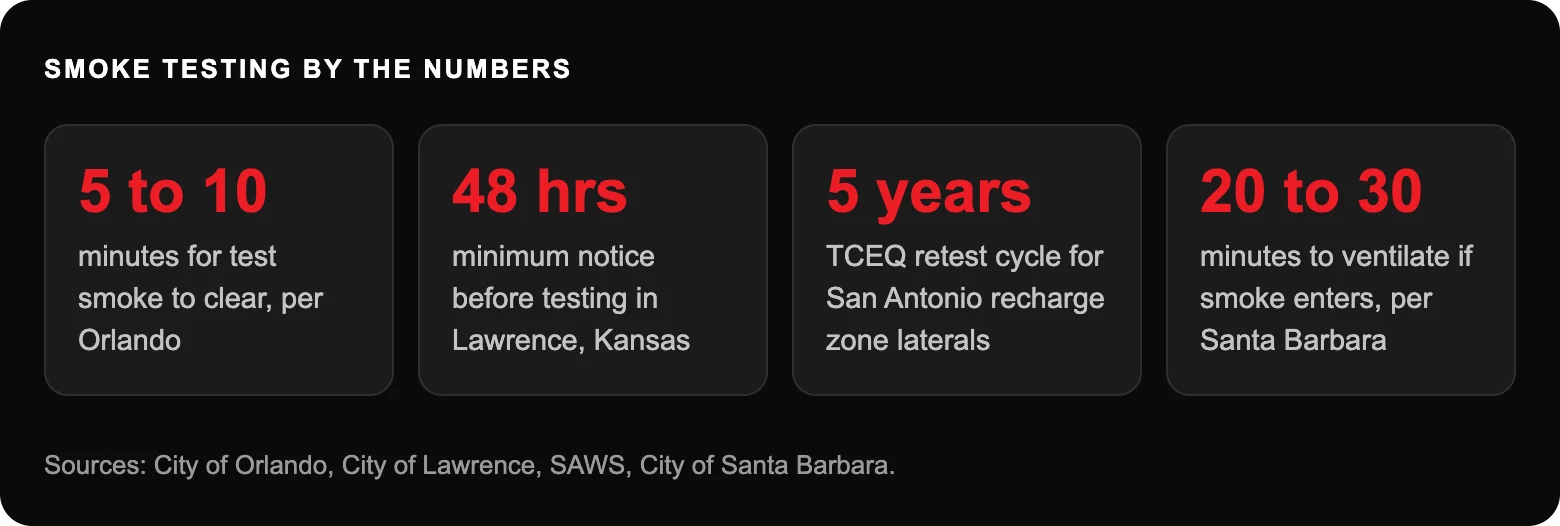
Utilities describe the smoke consistently. Orlando calls it non toxic, odorless and non staining, clearing in 5 to 10 minutes. Brevard County says it “will disappear rapidly without leaving an odor.” Minneapolis adds that it “may be an irritant for some people or pets with respiratory conditions.”
Product data sheets add nuance. The Hurco LiquiSmoke sheet Austin publishes lists a hydrotreated petroleum distillate vaporized into white fog, with third party tests showing no staining or residue and exposure well below OSHA limits. Smoke candles differ: the Superior Smoke sheet lists zinc chloride and warns that ten minutes of dense smoke can irritate the throat.
Who should take extra care
Anyone with asthma, COPD or another breathing condition, plus birds and small pets, should step outside while testing is underway. Most city programs let you request advance notice for exactly this reason.
Why smoke gets inside a building
Smoke only reaches your living space through a path sewer gas could also use. A test that puts smoke in your bathroom has not created a problem; it has revealed one.
Dry P traps
Every fixture has a curved P trap holding a plug of water between the room and the sewer. When a guest shower or floor drain goes unused, that water evaporates, and El Paso’s dry desert air speeds it up. A dry trap is the most common reason smoke, and sewer odor, gets indoors. The fix is a cup of water.
Broken or disconnected vent pipes
Vent pipes run up through walls to the roof. A cracked vent in the attic, a joint that separated when the house settled, or a vent that a remodeler capped off inside a wall will all show smoke. In older central and east El Paso homes, cast iron vents can rust through at a joint.
Loose seals and open cleanouts
A missing cleanout cap, a failed toilet wax ring, or a dishwasher or washer standpipe with no trap can also leak smoke. The Santa Barbara program handout is blunt about what that means: smoke inside points to “an open fault where sewer gas has been entering the home for months or years.”
| Where you see smoke | Likely cause | Whose problem |
|---|---|---|
| Roof vent terminals | Normal operation; vents are open | No problem |
| A sink, tub or floor drain | Dry or missing P trap | Property owner |
| Around a toilet base | Failed wax ring or cracked flange | Property owner |
| Wall, ceiling or attic | Broken or disconnected vent or drain pipe | Property owner |
| Yard or driveway crack | Broken sewer lateral or bad joint | Property owner, from the tap at the main inward |
| Street, curb or storm inlet | Main line defect or cross connection | Utility, usually |
Smoke Testing in El Paso
Want a straight answer about your pipes?
Every U.T. Trenchless job starts with a camera inspection and a photo report, so you see the problem before you decide on a fix. Licensed Master Plumber Ubaldo Torres leads the work.
Municipal smoke testing programs vs a private test
Cities smoke test sewer mains to find inflow and infiltration: rain and groundwater entering sanitary pipes through cracks, open cleanouts and illegal downspout connections. A California State Water Board evaluation guide lists catch basins, roof drains, cross connections, manhole covers and bad joints among the defects smoke reveals.
In Texas, San Antonio Water System smoke tests private laterals over the Edwards Aquifer recharge zone because leaking sewage there threatens drinking water, and SAWS notes the testing is required by the Texas Commission on Environmental Quality every five years. Lawrence, Kansas gives residents at least 48 hours of notice.
A private test is narrower and more detailed. Our smoke testing for homes and commercial buildings usually targets an odor source or confirms the vent system before a remodel, and covers every room, the attic and the crawl space.
What happens if the test finds a problem
El Paso Water makes the customer responsible for the sewer service line “from the tap at the main into the property” and everything inside. Smoke on your side means the repair is yours; see who is responsible for the sewer line in El Paso.
Many fixes are small: refill a trap, replace a wax ring, cap a cleanout. When smoke rises from the yard, the next step is a video camera inspection to see the break, and then a repair plan that may include trenchless options if the lateral is cracked or root damaged.
When smoke testing is the wrong tool
Smoke will not reveal a sag, roots or scale in a line that is still airtight. For slow drains and backups, start with a camera; see the signs of a main sewer line clog.
How to prepare your home for a smoke test

What to do next
- If a city notice arrived, fill your traps the day before.
- If smoke entered during a city test, ventilate, photograph the spot, and call a licensed plumber.
- For a persistent sewer smell with no obvious cause, ask for a private smoke test.
- If smoke came up in the yard, get a camera inspection of the lateral before choosing a repair.
- In El Paso, Horizon City, Socorro or Las Cruces, Request Service or call 915.858.0166.
Questions El Paso homeowners ask about sewer smoke testing
Do I need to be home during a city smoke test?
Usually not. SAWS and Missouri American Water both say residents do not need to be present. Do fill your traps beforehand, and avoid leaving pets shut in small rooms. If you have a breathing condition, many cities will call you in advance if you ask.
Will smoke testing set off my smoke detectors?
It can. Brevard County’s program warns that alarms may activate if smoke enters. That is useful information, because it means a path exists for sewer gas too. Open doors and windows, and the vapor clears within minutes.
Is smoke in the house dangerous or just a sign of a problem?
The test smoke itself is not poisonous, but it signals a gap. Anything smoke can pass through, sewer gas can pass through, and sewer gas contains hydrogen sulfide and methane. Treat it as a repair item, not an emergency.
Can smoke testing find a leak under the slab?
Sometimes. Smoke can seep up through slab cracks or around pipe penetrations, but a tight slab can hide it. For under slab drains, a camera inspection combined with pipe locating is usually more reliable.
Serving El Paso, Horizon City, Socorro and Las Cruces
Talk to a family owned trenchless team with 40+ years in the trade
Tell us what is going on and we will tell you what the camera shows, what your options are, and what we would do if it were our own property. Learn more about our smoke testing service.
Keep reading
Sources
- Continuous Sanitary Sewer Smoke Testing, City of Orlando.
- Sewer Smoke Testing Frequently Asked Questions, Brevard County.
- Smoke Testing FAQ, City of Minneapolis.
- LiquiSmoke Material Safety Data Sheet, City of Austin.
- Superior Smoke Safety Data Sheet, West Liberty University.
- Sewer Smoke Testing Handout, City of Santa Barbara.
- Sewer System Evaluation, California State Water Resources Control Board.
- SAWS Smoke Testing Sewers to Ensure Water Safety, San Antonio Water System.
- City to Conduct Sewer Smoke Testing in Quail Run Neighborhood, City of Lawrence.
- Smoke Testing: What Homeowners Need to Know, Missouri American Water.
- Customer Rights and Responsibilities, El Paso Water.