

Get our plumbing guides firstAdd U.T. Trenchless as a preferred source and see our posts more often in Google Top Stories.
Add as a preferred source on GoogleA sewer camera inspection shows the inside of your drain line from the cleanout to the city main: cracks, offset joints, sags that hold water, root intrusion, crushed or deformed pipe, heavy scale and grease. A good sewer camera inspection report ties each finding to a distance, so you know exactly where the problem is and how serious it is.
Getting a video file and a page of notes back from a plumber can be confusing. The footage is dark, the pipe looks rough even when it is healthy, and the terms on the report are trade shorthand.
This guide explains how to read the report, what common defects look like, how the industry grades severity, and which findings are maintenance versus a reason to plan a repair. We start every El Paso job with the camera, so this is how we walk customers through it.
What’s in this guide
- The short answer: what the camera can and cannot see
- How to read a sewer camera inspection report
- Common defects and what they look like on screen
- How severity is graded: the NASSCO PACP system
- Maintenance problem or structural problem?
- What to do next
- Questions El Paso homeowners ask about sewer camera reports
- Keep reading
The short answer: what the camera can and cannot see
The camera sees the inside surface of the pipe and anything in it: the material, joints, turns and distance traveled, plus pooling water, roots and cracked, broken or missing pipe.
It does not see outside the pipe. It cannot tell you how deep the line is on its own, whether the soil around it has washed away, or how the pipe looks under standing water. A locator transmitter in the camera head handles depth and position from the surface, and a clean line gives the clearest picture.
How to read a sewer camera inspection report
Most reports follow the same pattern. Each finding is a row that answers where, what, how bad, and what next.

The distance column is the most useful number on the page. If the report says roots at 42 feet, a locator can mark that spot on your lawn or driveway, and any repair can be targeted there instead of the whole run.
Common defects and what they look like on screen
| Finding | What you see on screen | Why it matters | Typical response |
|---|---|---|---|
| Belly or sag | Water pooling across the pipe, camera lens dipping underwater | Solids settle in the low spot and cause repeat clogs | Monitor if short and shallow; repair if deep or long |
| Offset joint | A visible lip where one pipe section sits higher or lower than the next | Catches paper and debris; opens a path for roots | Spot repair or lining depending on size |
| Crack or fracture | Thin lines along or around the pipe wall; fractures show visible separation | Lets roots and soil in; can progress to breaks | Lining or sectional repair |
| Root intrusion | Fine hair roots or thick root masses at joints | Blocks flow and widens the gap over time | Root cutting, then seal the entry point |
| Deformed pipe | Pipe no longer round, often oval or flattened | Common in Orangeburg; a sign of structural failure | Replacement, often by pipe bursting |
| Scale and tuberculation | Rough, bumpy buildup on cast iron walls | Narrows the pipe and snags waste | Descaling, then evaluate the wall |
| Grease and deposits | White or yellow coating, debris piles on the invert | Reduces capacity; common in kitchens and restaurants | Jetting and better habits at the sink |
| Broken or collapsed | Missing pipe, soil visible, camera cannot pass | Line is failing or has failed | Repair soon |
Orangeburg: the pipe that flattens
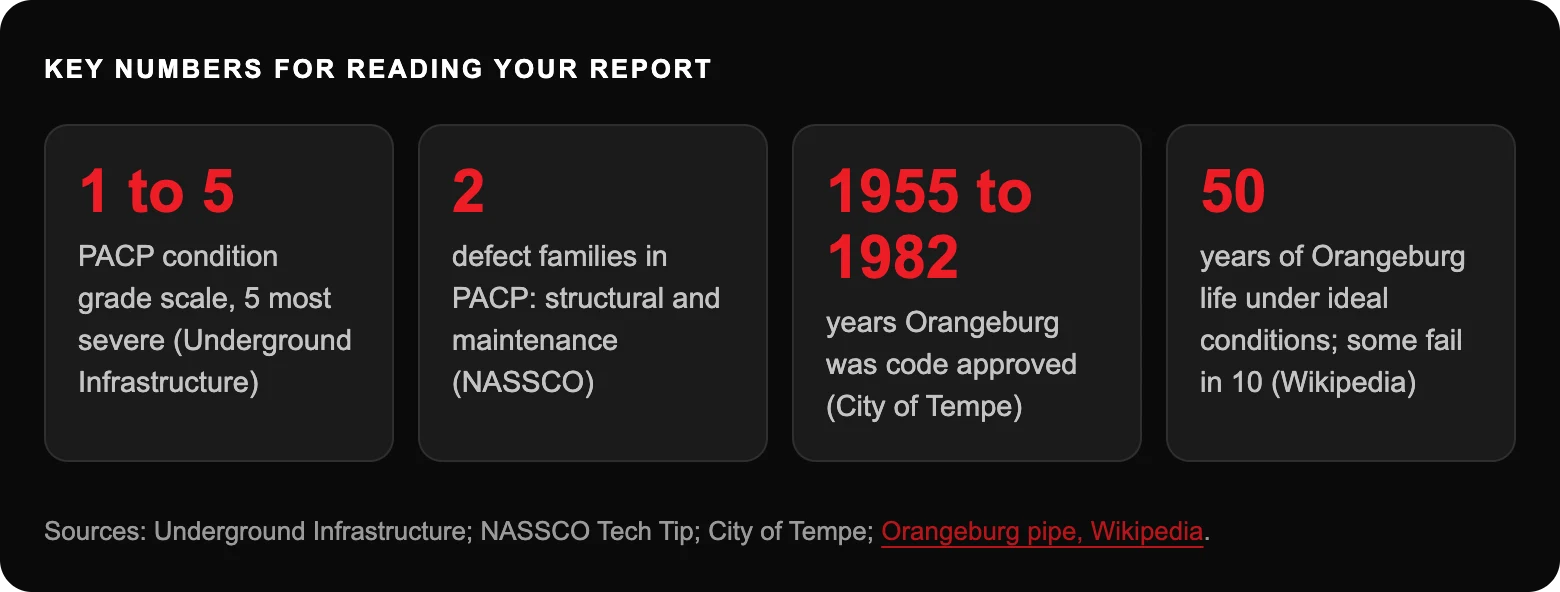
Orangeburg is a fiber pipe made of layered tar and paper. The City of Tempe says it was code approved from 1955 to 1982 and that it tends to flatten and lose its round shape as it ages. On camera the pipe squeezes into an oval, and no amount of cleaning fixes that.
Scale in cast iron
Cast iron drains corrode from the inside, building a crust that looks like rough rock on screen. Heavy scale can hide cracks behind it, which is why plumbers often recommend pipe descaling first and a second camera pass before deciding on repairs. Our article on why cast iron drains need descaling covers that process.
Video Camera Inspections in El Paso
Want a straight answer about your pipes?
Every U.T. Trenchless job starts with a camera inspection and a photo report, so you see the problem before you decide on a fix. Licensed Master Plumber Ubaldo Torres leads the work.
How severity is graded: the NASSCO PACP system
Cities and engineers grade sewer footage with the Pipeline Assessment Certification Program, or PACP, published by NASSCO. Homeowner reports often use simpler language, but many plumbers borrow its logic, and knowing it helps you judge how urgent a finding is.
“Each defect observed is assigned a condition grade from 1 to 5, with 5 being the most significant defect grade and 1 being a minor defect grade.”
That description comes from a NASSCO trainers’ article in Underground Infrastructure. PACP also separates structural defects, like cracks, fractures and deformation, from operation and maintenance defects, like roots, grease and deposits. A NASSCO tech tip notes that structural findings typically call for engineering assessment, while maintenance findings trigger work like cleaning and root removal.
A grade is not a verdict
The same trainers stress that condition grade alone is not enough to decide whether a pipe should be replaced or rehabilitated. One grade 4 crack in an otherwise sound line is a spot repair. Dozens of grade 3 defects along the whole run may justify lining the entire pipe.
Maintenance problem or structural problem?
The practical question after any inspection is whether the line needs cleaning or fixing.
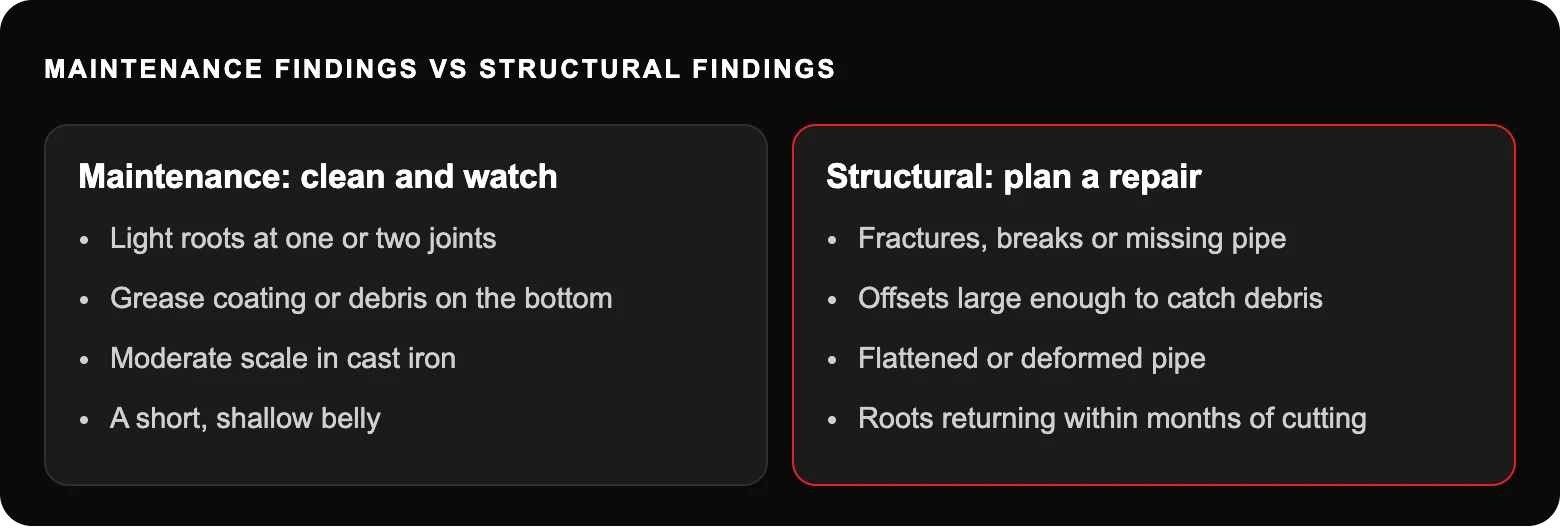
Maintenance findings usually respond to hydro jetting or root cutting and a follow up camera check. Structural findings often suit trenchless repair, but not always. A deep belly, for example, is a grade problem: lining follows the existing sag, so correcting it usually means excavating that section.
Ask to see it yourself
Any finding that drives a repair recommendation should be on the video with a distance. If a contractor cannot show you the defect on screen, get a second opinion before you pay for work.
What to do next
- Ask for the full video file and the written log, not just a verbal summary.
- For each finding, note the distance, the clock position and the recommended action.
- Separate maintenance items from structural items using the list above.
- Ask whether heavy scale or debris should be cleared and the line filmed again before a final recommendation.
- If you are buying a home, read our guide on whether a sewer scope is worth it before buying in El Paso.
- To schedule an inspection with a photo report, see our video camera inspection service or contact U.T. Trenchless at 915.858.0166.
Questions El Paso homeowners ask about sewer camera reports
Is some water in the line on camera normal?
A small stream along the bottom is normal, since fixtures drain constantly. The concern is water that spans the pipe or submerges the camera, which points to a belly or a blockage downstream.
Can a camera show if my sewer line is leaking?
It shows the openings that let water out, such as cracks, fractures, separated joints and holes. It cannot measure how much water is escaping. For that, plumbers pair the camera with dye testing or smoke testing to confirm where flow leaves the pipe.
How do I know where the defect is in my yard?
The camera head carries a small transmitter. A handheld locator picks up its signal from the surface to mark the spot and estimate depth.
Do hair roots mean I need a new sewer line?
Not necessarily. Fine roots at a joint are common in older clay and cast iron lines and can be cut and monitored. They do mean there is an opening at that joint. If roots return quickly or the joint is also offset, sealing it with a liner is usually the long term answer.
Why did the plumber clean the line before filming?
Grease, scale and debris hide the pipe wall. Clearing the line first lets the camera see cracks and joint problems that would otherwise be buried.
Serving El Paso, Horizon City, Socorro and Las Cruces
Talk to a family owned trenchless team with 40+ years in the trade
Tell us what is going on and we will tell you what the camera shows, what your options are, and what we would do if it were our own property. Learn more about our video camera inspections service.
Keep reading
Sources
- Tech Tips: PACP Condition Grades and Their Proper Application, Underground Infrastructure.
- NASSCO Tech Tip, July 2023, NASSCO.
- Orangeburg Pipe, City of Tempe Building Safety.
- Orangeburg pipe, Wikipedia.